





 Portuguese
  English
  Spanish
  7 min of reading
  0 comments


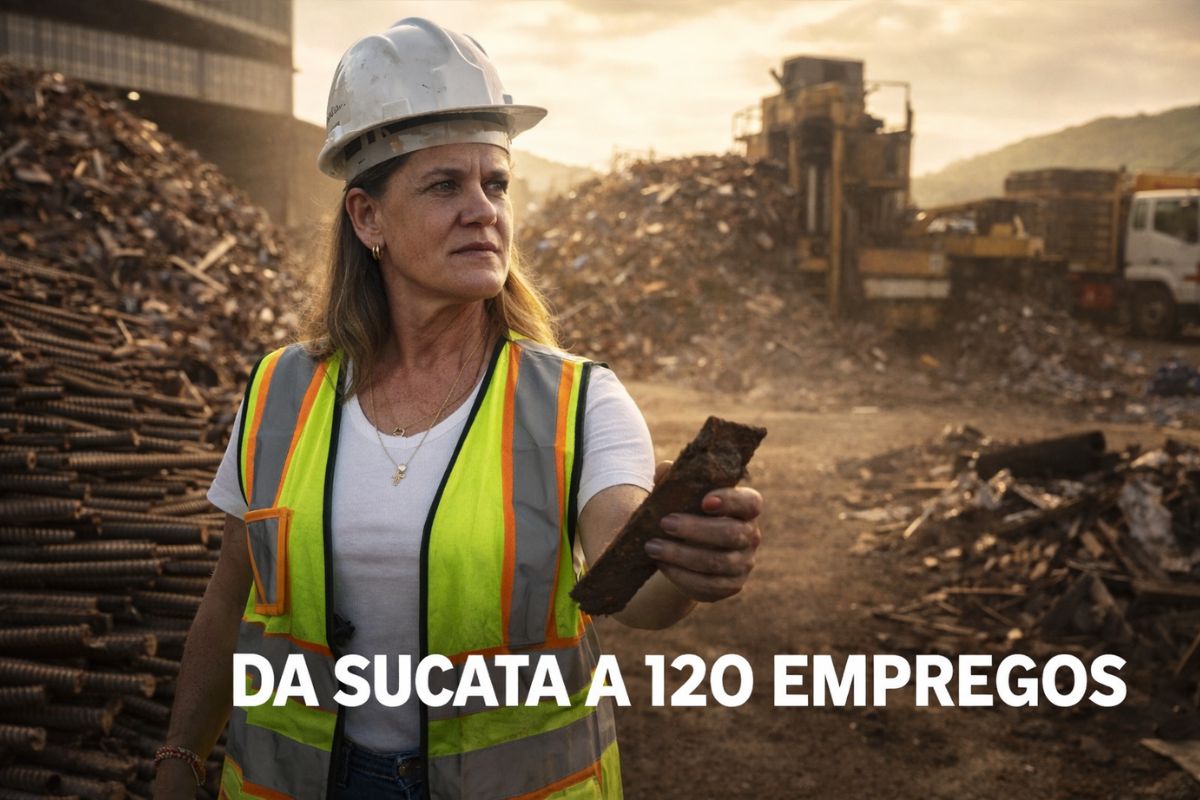
Daughter of a Scrap Collector Transforms Scrap Into a Steel Industry with 120 Jobs and Exposes the Waste of a Brazil That Only Recycles 4 Percent of Its Waste in Major Cities.
In Campo Grande, Vanessa Coin moved from her father’s simple deposit to lead a steel industry created in 2007, which today reuses scrap, generates about 120 jobs, and exposes a country that in 2023 still recycled only 4 percent of its waste, despite so many resources available.
In 2007, Brazil was recycling little and continued to bury opportunity, but the daughter of a scrap collector transformed scrap into a steel industry and showed another path in Campo Grande.
The numbers emerged years later. In 2023, a survey by Abrema with data from SNIS revealed that the country still recycled only 4 percent of the waste produced, while Aço e Aço grew in the capital of Mato Grosso do Sul, using precisely what many people insist on throwing away.
From 14 de Julho Street to the First Scrap Deposit
Before becoming a branded steel industry, the Coin family’s story was the story of many scrap collectors. In Campo Grande, Wagner began collecting cardboard on streets like 14 de Julho and gradually started collecting aluminum, copper, and plastic.
-
50 viaducts, 4 tunnels, 28 bridges, and 40 kilometers of bike paths: BR-262 in Espírito Santo will receive 8.6 billion reais for the largest engineering project in the state’s history, inspired by the Immigrant Highway in São Paulo.

-
Brazil produces too much clean energy and doesn’t know what to do with it: over 20% of solar and wind capacity was wasted in 2025 while investors flee and 509 renewable generation projects were abandoned in the last year.

-
Piauí will produce a new fuel that replaces diesel without needing to change anything in the truck’s engine and reduces pollutant gas emissions by half: truck drivers from all over the Northeast are already celebrating the news that will arrive later this decade.

-
A new Brazilian shopping center worth R$ 400 million will be built in an area equivalent to more than 4 football fields, featuring 90 stores, 5 cinemas, a supermarket, a college, and parking for 1,700 cars, potentially generating 3,000 jobs.


With more material coming in, it became necessary to hire an employee and have Vanessa and her brother Flávio Coin work with their father, while their mother made room to start a laundry business and craft work.
As soon as they managed to save some money, the family rented a piece of land, had a cover made, and transformed it into a deposit to store recyclable materials.
At that time, the scrap was pressed and sent to São Paulo.
There were hardly any places that took on processing and transforming into something new in Campo Grande, which forced the family to spend on heavy logistics, using the collector’s own truck or chartered vehicles to transport the material to the most populous capital in the country.
From Near Abandonment to A Definitive Return to Recycling
The path was not linear. During a period of adaptation and difficulty, Wagner even stopped recycling.
He started working on repairing tractors and also as an employee at an auto parts store, trying to secure income during a time of uncertainty.
Still, the knowledge accumulated through daily contact with waste spoke louder.
Shortly after, Wagner returned to the business he understood well and that, years later, would transform the lives of the family and dozens of workers linked to scrap.
When Scrap Became a Steel Industry in Campo Grande

The turning point came in 2007. It was Vanessa who made the strategic decision.
She decided to work solely with steel, seeing countless possibilities within the reuse market for that material. From that move, Aço e Aço was born, today a reference in recycling in the city.
Currently, the company’s raw material comes from auctions of vehicles that can no longer run and from purchases at recycling centers that collect everything from bicycles to refrigerators in a state of scrap.
In the words of the businesswoman, “we revalue all this material”, keeping in the economy what was once destined for waste.
At Aço e Aço, the process includes decontamination, separation of batteries and shock absorbers, and finally, pressing.
Everything becomes rebar, wire, nails, trusses, and proprietary columns, products that end up in the construction of houses and buildings and even in the making of furniture.
The steel casting stage still requires logistics to São Paulo, but, even with that cost, the business remains advantageous.
From scrap that traversed roads without a clear destination, essential inputs for the construction industry emerged, generating income in a chain.
120 Jobs Built on Scrap
What began with a collector in Campo Grande is now an industrial structure. Vanessa, now 50 years old, is the director of Aço e Aço and oversees about 120 employees alongside her younger brother, Flávio, who is 47 years old.
Their father, Wagner, at 72, still visits the company whenever he can, even though he is retired. Their mother, who also participated in the family’s effort, has passed away and is remembered as the greatest nostalgia in this journey.
A trained administrator, Vanessa sums up the path simply: “We came from a humble family that built its entire history from scrap.”
What was an improvised deposit became an industrial yard, with mountains of reused steel by the side of BR 163 and a consolidated brand in the regional market.
Respect for the Recycling Chain from Cart to Auction
More than moving tons of steel, the director emphasizes that the business grew based on respect.
She learned to value every person who is part of the recycling chain, from the collector who arrives with 1 kilogram of cans or steel to the auctioneer of public entities and the owners of large companies.
“We respect everyone from the person who brings 1 kg of cans, 1 kg of steel to us, to the people involved in an auction of a public entity.
It was the legacy my father and my grandfather left for us,” she claims.
For her, this is precisely the difference in a sector that relies on cooperation.
“Our field is like a gear in which everyone ends up winning. We have to help each other. What one does not do, another does. The whole purpose is not to let this remain as waste, it is to transform, it is to return.”
Woman on the Front Line of Heavy Recycling
When she started working with her father, Vanessa noticed a quite unequal scenario.
The recycling market was predominantly male, with most manual labor, under the strong sun, in the hands of male collectors. There were very few women in collecting or buying and selling scrap.
Over time, this reality began to change.
Today, the businesswoman observes entire families working together in cooperatives, mixing men and women in all stages of the process.
To take her place, Vanessa needed to develop another skill beyond technique.
She learned to have a firm hand and strong voice so that being a woman would not be interpreted as a sign of ignorance or justification for attempts to scam during negotiations.
“My father always gave me a lot of autonomy, it was a very smooth process for me to negotiate directly with our suppliers and clients.
He gave me this foundation,” she shares, remembering that this trust was essential for her to pave the way in a heavy recycling segment and later in managing a steel industry.
Passion for the Industrial Process and a Reference in Mato Grosso do Sul
Alongside her sister, Flávio also fell in love with the factory routine.
He says that the passion for the industrial process drove the family business, leading Aço e Aço to seek a prominent place among recycling companies in the state.
“With her, we have been pushing the company to be a reference in Mato Grosso do Sul every day,” the brother summarizes, pointing to the rows of rebar that were once wrecks of abandoned vehicles in yards and backyards.
In the company’s outdoor area, a true “mountain” of scrap dominates the landscape, with BR 163 as the backdrop.
It is from this heap of discarded steel that raw materials and jobs come for hundreds of families.
Stability, Pandemic, and the Future of Steel Recycling
In Vanessa’s view, recycling is a segment that generally does not experience significant collapses. There are ups and downs, but with limited impact for those in the day-to-day business of scrap.
She describes the sector as relatively stable, precisely because everything that becomes waste needs a destination at some point.
The exception was the period of the COVID-19 pandemic. Those years were tougher than normal because there was less scrap production.
With reduced consumption, there was less raw material to buy and sell, creating what she calls a “product crisis.”
Even so, the businesswoman looks ahead with optimism.
With solid waste policies being put into practice and greater population awareness of recycling, the future of the steel industry based on scrap seems promising in Vanessa’s assessment.
The plan for the coming years is to invest more in machinery to expand the transformation of materials within the company itself and further integrate into the chain.
And you, looking at the amount of waste that Brazil still discards, do you believe that stories like that of Aço e Aço can truly change the way the country deals with steel recycling?









-

-

-

-

15 pessoas reagiram a isso.