





 Portuguese
  English
  Spanish
  5 min of reading
  0 comments



With the Advancement of Sustainable Practices, Interest Grows in Simple and Effective Solutions to Reduce Potable Water Consumption. One of Them Is Rainwater Harvesting, Which Can Be Implemented in Any Type of Property at Low Cost and with Great Benefits.
The rainwater harvesting is becoming an increasingly common practice in sustainable projects.
Focusing on economy and the conscious use of natural resources, this initiative has gained ground in homes, businesses, and rural areas.
The proposal is simple: collect rainwater and use it for activities that do not require potable water.
-
Friends have been building a small “town” for 30 years to grow old together, with compact houses, a common area, nature surrounding it, and a collective life project designed for friendship, coexistence, and simplicity.

-
This small town in Germany created its own currency 24 years ago, today it circulates millions per year, is accepted in over 300 stores, and the German government allowed all of this to happen under one condition.

-
Curitiba is shrinking and is expected to lose 97,000 residents by 2050, while inland cities in Paraná such as Sarandi, Araucária, and Toledo are experiencing accelerated growth that is changing the entire state’s map.

-
Tourists were poisoned on Everest in a million-dollar fraud scheme involving helicopters that diverted over $19 million and shocked international authorities.

This system brings benefits both for the environment and for the residents’ wallets.
Next, understand what rainwater harvesting is, its advantages, the most common types of systems, and the necessary care to ensure proper functioning.
What Is Rainwater Harvesting
Rainwater harvesting, or stormwater harvesting, involves collecting rainwater and storing it in an appropriate reservoir.
This water can be used for activities that do not require potability, such as watering gardens, washing cars, floors, or for sanitary flushing.
Considered one of the pillars of sustainable architecture, this practice helps reduce dependence on the public supply network and contributes to minimizing the effects of poor water distribution.
Among the most common systems on the market, cisterns are the most popular models.
Advantages of Rainwater Harvesting
Implementing a harvesting system in a property offers many benefits. One of the main ones is the savings on the water bill — in some cases, consumption can drop by up to 50%, depending on the installed system and usage.
Another positive point is the appreciation of the property. Sustainable systems are increasingly sought after, which can raise the value of sale or rental.
Additionally, these systems can be installed in both urban and rural areas, adapting to houses, apartments, businesses, and offices.
There is also a wide variety of cistern models available in the market. This allows each project to choose an option that meets its space and consumption needs.
In regions with water scarcity, such as the northeastern hinterland, the cistern can ensure supply even in the driest periods.
By using rainwater for daily activities, residents reduce their water footprint and contribute to a more responsible use of resources.
Types of Rainwater Harvesting
There are several cistern models available on the market, with different materials, capacities, and uses. Below, learn about the five main types:
- Masonry Cistern: Made with bricks, cement, and lime, this cistern has a large storage capacity and requires space on the property. It is common in eco-villages and rural areas seeking self-sufficiency.
- Fiberglass Cistern: Lightweight and affordable, made of plastic but with inferior sealing. Requires frequent maintenance to avoid mold, bacteria, and mosquitoes.
- Rotomolded Plastic Cistern: Made of polyethylene, it is durable, lightweight, and easy to install. Can be expanded with extra modules and does not require excavation.
- Slim Cistern: With a modern and compact design, ideal for those with limited space. Can be fixed to walls and connected to other units if more capacity is needed.
- Small Plastic Tank: Ideal for smaller houses. Connected to gutters, stores up to 240 liters and has a tap at the base for easy use.
How to Set Up a Rainwater Harvesting System
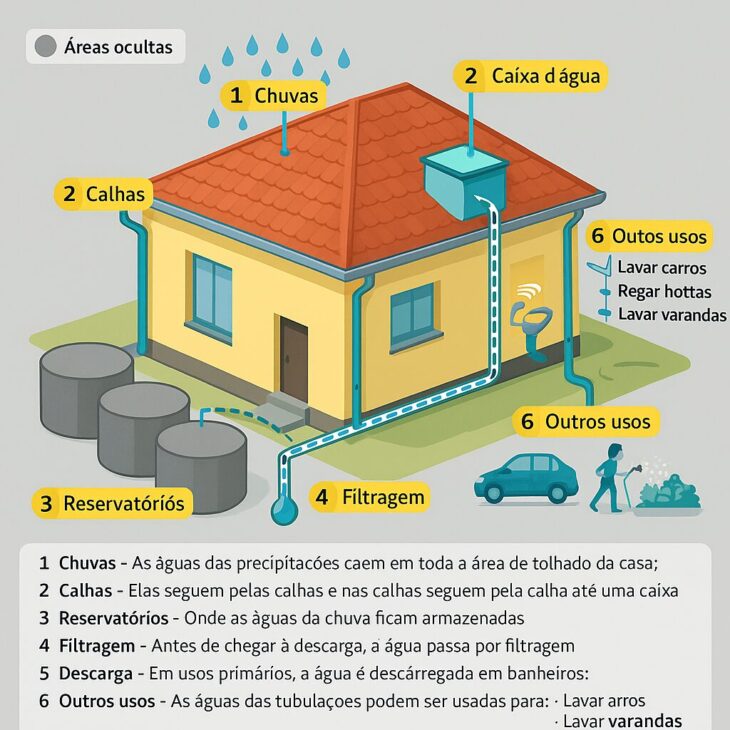
Before acquiring the system, it is essential to calculate your actual water needs. This avoids wasting money and frustrations with undersized systems.
If the idea is only to water plants, the demand will be lower. But if the goal is to supply toilets or washing machines, the consumption is much higher. For example:
- A garden consumes 5 to 6 liters per square meter per watering.
- A toilet uses about 40 liters a day per person.
Therefore, it is crucial to do the calculations carefully before installing the system.
Necessary Materials
Here are the main items to set up a rainwater harvesting system:
- Roof and Gutters: Clean roof with a good coverage area (ceramic, metal, or fiber cement tiles). PVC or metal gutters, with supports and screws.
- Piping: PVC pipes (75 mm or 100 mm), connections, bends, glue, and thread seal tape.
- Filter: Mesh for leaves (plastic or metal), sand filter or first flush separator tank (optional but recommended).
- Cistern or Tank: Waterproof structure with a lid and outlet with a valve. Can be masonry or plastic.
- Water Outlet: Tap, valve, or pump, as well as distribution piping. May include a float or level indicator.
- Safety and Sealing: Insect screens at the entries and exits and waterproofing on the internal walls of the cistern.
Installation Steps
Check the step-by-step process to correctly set up your harvesting system:
- Choose the Location: Install the system in a spot where the roof can effectively collect water. The cistern should be below the gutters or a pump will be needed.
- Install the Gutters with Inclination: The ideal slope is 1 cm per meter. This helps direct the water efficiently. Use screens to prevent leaves.
- Connect the Collector Pipes: Connect the PVC pipes to the gutters and use a first flush diverter, which carries more dirt.
- Water Filtration: The water should pass through a filter with fine mesh or through a sand and gravel system. This prevents debris from entering the cistern.
- Entry into the Cistern: The water should enter from the top with a splash box to avoid erosion at the bottom of the structure.
- Protect Your Water: Use screens against mosquitoes and ensure complete sealing. This prevents contamination and vector proliferation.
- Install the Water Outlet: This can be done with a tap at the base or a low-pressure pump for more practical use.
Important Tips
- Use a float or transparent tube to monitor the water level.
- Avoid collecting water from roofs with toxic paint or asbestos tiles.
- Perform frequent cleanings on the roof and gutters.
- Remember: rainwater is not potable. Only use it for specific purposes.
How to Ensure Proper Functioning
Maintenance is essential. Gutters should always be clean, as leaves and animal droppings contaminate the water. Use screens or filters before the water enters the cistern.
The cistern needs to be cleaned frequently. Mold and slime harm water quality. Its structure should be waterproof and well-sealed to avoid leaks.
Additionally, choose suitable and certified materials to ensure greater durability and safety.
Rainwater harvesting is a simple, efficient practice with positive environmental impact. Whether in large constructions or small properties, it contributes to saving water and preserving the planet.
In light of climate change and water crises, adopting this measure becomes even more important. In addition to being sustainable, it is a smart and economical choice.
Among the available models, slim and rotomolded cisterns stand out for their ease of installation and expansion. They are ideal for those who wish to start practically, even with limited space.










-

Uma pessoa reagiu a isso.