





 Português
  Inglês
  Espanhol
  3 min de leitura
  10 comentários


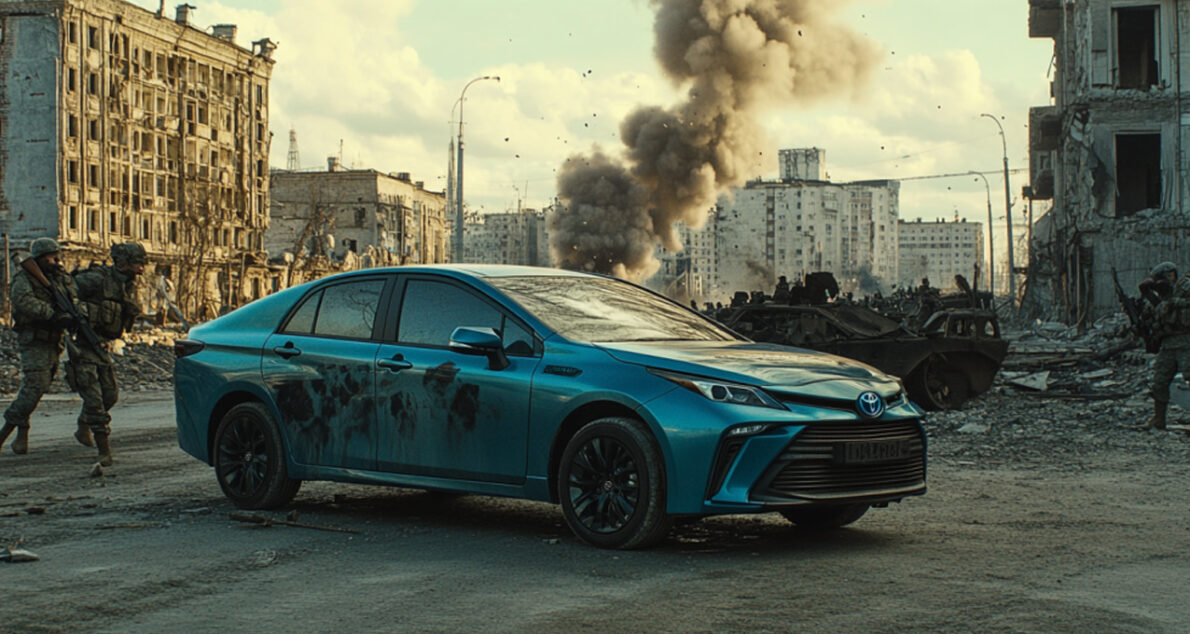


Creativity In Times Of War Reaches Surprising Levels, And Ukraine Has Just Shown The World An Unprecedented Tactic: The Use Of A Toyota Mirai As A War Weapon.
Amidst the devastating conflict with Russia, where military technology intertwines with ingenious improvisation, a car originally designed to be an ecological solution has ended up transformed into an instrument of destruction.
The city of Vovchansk in eastern Ukraine was the scene of a scenario that, at first glance, appears to be straight out of a science fiction movie. In June 2024, Ukrainian forces found a damaged Toyota Mirai amidst the rubble of the city, which continues to be a zone of intense conflict.
This hydrogen-powered car model, whose technology is seen as a hope for a sustainable future, has unexpectedly taken on a completely different role in one of the fiercest confrontations of the war.
-
The U.S. Army receives the first Black Hawk helicopter that can fly without pilots, be controlled by a tablet, and even land on its own during high-risk missions.

-
With 11,000 tons and sensors capable of hunting submarines at long distances, the Type 055 has become one of the most feared floating arsenals of the Chinese navy.

-
With over 15,000 tons, radars capable of tracking hundreds of targets simultaneously, and more than 120 missiles ready for launch in seconds, modern destroyers cease to be escorts and begin to dominate the naval battlefield.
-
OMODA & JAECOO grows in Europe in 2026 with an integrated strategy of sales, innovation, local production, and technological advancement in the United Kingdom, Italy, and Spain.

Toyota Mirai: From Japanese Innovation To War Zone
The Toyota Mirai, known for being one of the first hydrogen-powered vehicles sold worldwide, was developed in Japan with the aim of promoting sustainable mobility.
However, the vehicle that ended up in Vovchansk carried a function that had never crossed the minds of its Japanese engineers.
According to reports from Euro Maidan, this sedan, whose name means “future” in Japanese, became a central piece in a planned attack by Ukrainian forces.
After being hit during a battle in the city, the vehicle, which features highly durable hydrogen tanks, caught the attention of Ukrainian soldiers.
Recognizing the destructive potential of the fuel contained in the Mirai’s cylinders, the military decided to repurpose the hydrogen tank as part of an improvised weapon.
The Transformation Of The Toyota Mirai Into A Bomb
The hydrogen tanks of the Toyota Mirai were designed to withstand severe collisions, such as those involving high-speed trucks.
However, the resistance of this component made it an ideal choice for an explosive device. Ukrainian soldiers, in a demonstration of improvisation and desperation, wrapped the tank with plastic explosives to enhance its destructive potential.
Using a ground drone, a makeshift vehicle crafted in local workshops, the hydrogen cylinder was transported to a tower occupied by Russian snipers. Upon detonation, the resulting explosion was equivalent to 1,778 kg of TNT, generating a massive shockwave and a smoke cloud that rose over the battlefield.
Uncertain Consequences
Although the explosion was of great magnitude, the concrete outcomes in terms of territorial gains or strategic impact are still unknown.
The use of the Toyota Mirai as a weapon is yet another reflection of the unpredictability and brutality of war, where even symbols of hope and innovation can be distorted to serve destructive purposes.
The fate of the city of Vovchansk remains undefined, just like the future of the war between Ukraine and Russia. The episode involving the Mirai is a bitter reminder of how war can subvert even the most peaceful human innovations, turning them into instruments of destruction.
The Toyota Mirai, designed to be a vision of the future, is now part of a grim narrative of war, where the struggle for survival outweighs any original intention of peace and progress.
The question remains: How far can creativity in war go, and what will be the next innovations to be subverted for military purposes?







https://euromaidanpress.com/2024/08/03/frontline-report-ukrainian-forces-use-salvaged-hydrogen-fuel-cell-to-decimate-russian-position-in-vovchansk/
Pode compartllhar a fonte original da notícia?
Como podem ter certeza que a potência da explosão foi de 1778 kg de TNT?