





 English
  Francês
  Alemão
  Italiano
  Japonês
  Norueguês
  Portuguese
  Spanish
  3 min of reading
  1 comment


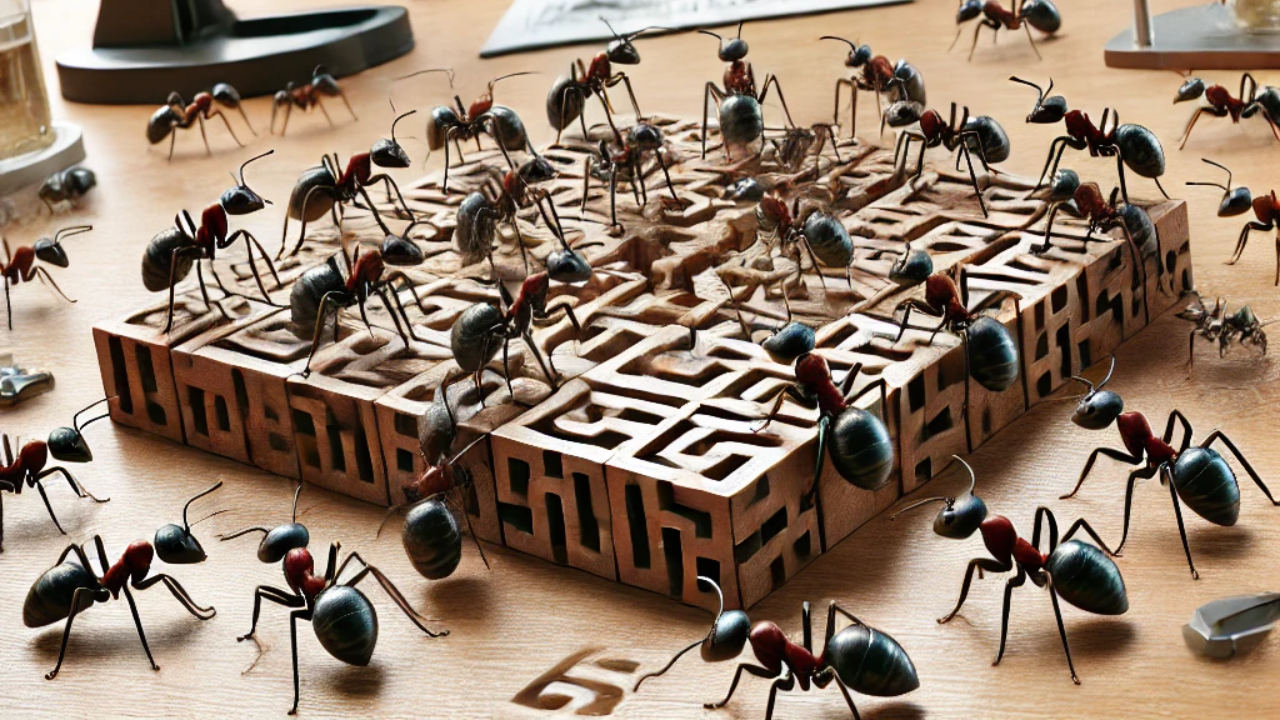


Ant Colony Excels at Teamwork and Outperforms Humans in Puzzle-Solving Test, Revealing Remarkable Collective Skills.
Recently, an intriguing study compared teamwork abilities between ants and humans. Using a test called “piano movers,” researchers observed how both groups solved cooperative problems.
The goal was to move a T-shaped load through a narrow space, challenging both groups’ ability to work together to achieve the objective.
Surprisingly, in several situations, the ants demonstrated superior performance to that of humans.
-
A “silent skill” is allowing Brazilians to earn up to R$ 22,000 per month without a degree and become indispensable for companies that rely on millions of data to survive.

-
Researchers at the Toyota Research Institute found that if a human uses robotic arms to flip a pancake 300 times in an afternoon, the robot learns to do it on its own the next morning, and this is currently the most promising method to solve the biggest bottleneck in modern robotics.

-
Goodbye iron: a common item in households is starting to lose space to technology that smooths clothes in minutes without an ironing board and with less energy consumption.

-
Antarctica reveals an unusual clue high in the Hudson Mountains, and what appeared to be just an isolated rock began to expose a secret hidden under the ice for ages.


The Puzzle-Solving Challenge with the “Piano Movers” Test
The “piano movers” challenge is a classic puzzle that tests the ability to solve problems collectively.
It requires participants to maneuver a load efficiently through narrow passages, an exercise that involves spatial reasoning and coordination.
In the case of ants, the load was interpreted as food, which motivated their natural cooperation. On the other hand, humans participated in the challenge voluntarily.
The ant groups were divided into three categories: one ant alone, a small group of seven ants, and a large group with 80 ants.
Similarly, the humans were divided into groups of one person, a group of six to nine people, and a larger group of 26 people.
To make the comparison fair, in some cases, human groups were challenged to solve the puzzle without verbal communication, using masks and sunglasses.

How Do Ants Work Together?
In the initial tests, when conducted individually, humans performed better.
The human participants utilized their cognitive skills to solve the problem more efficiently.
However, the dynamics changed when groups were formed.
Ants, when working in groups, showed remarkable coordination and collective memory capabilities.
Their group efforts enhanced teamwork effectiveness, allowing them to avoid mistakes and improve their strategies over time.
On the other hand, human groups faced challenges when communication was restricted.
In this scenario, humans could not leverage their individual advantages, showing below-expected performance.
In some situations, ant groups even outperformed humans in groups, highlighting that simple and efficient collaboration is more effective than an individualistic approach in a collective context.
Differences in Evolutionary Strategy between Humans and Ants
The study brought to light an interesting evolutionary difference between the two species.
While ants maximized collective abilities by working in groups, humans developed more sophisticated cognition at an individual level.
However, humans struggled to adapt this intelligence to collective work situations.
The co-author of the study, Ofer Feinerman, explained that ants operate as a “superorganism,” where cooperation among parts is far more valuable than competition.
In contrast, although humans possess advanced cognitive abilities, they demonstrated that teamwork is not always easy to apply.
Lessons for Teamwork
The study results suggest that the collective strategy of ants could inspire new forms of group work organization.
The research may pave the way for further investigations into collective cognition and how it can be applied to improve human team dynamics.
Moreover, the study of ants could influence the development of decentralized robotic systems, where collaboration among simple machines can create more efficient solutions.
Ants have proven that, when it comes to teamwork, they have much to teach humans. Their ability to act collectively, without relying on individual cognition, is an important lesson for the challenges of group collaboration.
Click here to read the full article







MEU COMENTÁRIO VAI SER SÓ PRA INTERAGIR MESMO. GENTE O **** DEIXOU EM DESVANTAGENS OS HUMANOS, POIS ELES FORAM VENDADOS NÉ, ENTÃO AS FORMIGAS 🐜 TAMBÉM TERIA QUE SER VENDADAS. POIS ELAS JA POSUI UMA ENZIMA CHAMADA DE FEROMONIO. ONDE FACILITA SUAS HABILIDADES DE LOCOMOÇÃO. E OS HUMANOS NÃO, E AINDA VENDADOS TORNOU MAIS DIFÍCIL O **** PRA ELES. MAS OBVIAMENTE QUE SIM, TRABALHO EM EQUIPE NÃO É NEM NUNCA FOI UMA TAREFA FÁCIL. PARABÉNS PELO TRABALHO E **** BEM BACANA.