





 English
  Francês
  Alemão
  Italiano
  Japonês
  Norueguês
  Portuguese
  Spanish
  4 min of reading
  1 comment





Engineers in Canada Developed a New Material That Combines Strength and Lightness, Ideal for High-Performance Aerospace Applications.
Imagine a material with the strength of carbon steel, but as light as foam. It sounds like science fiction, but it is a reality thanks to a team of researchers from the Faculty of Applied Science and Engineering at the University of Toronto.
Using machine learning, these scientists designed nano-architected materials that combine high strength, extreme lightness, and customization.
This innovation, published in the journal Advanced Materials, promises to revolutionize industries such as automotive and aerospace, redefining the limits of what is possible in materials engineering.
-
A “silent skill” is allowing Brazilians to earn up to R$ 22,000 per month without a degree and become indispensable for companies that rely on millions of data to survive.

-
Researchers at the Toyota Research Institute found that if a human uses robotic arms to flip a pancake 300 times in an afternoon, the robot learns to do it on its own the next morning, and this is currently the most promising method to solve the biggest bottleneck in modern robotics.

-
Goodbye iron: a common item in households is starting to lose space to technology that smooths clothes in minutes without an ironing board and with less energy consumption.

-
Antarctica reveals an unusual clue high in the Hudson Mountains, and what appeared to be just an isolated rock began to expose a secret hidden under the ice for ages.


What Are Nano-Architected Materials?
Nano-architected materials are composed of small structural units with dimensions on the nanometer scale—so small that it would take over 100 of them aligned to reach the thickness of a human hair.
These units are organized into three-dimensional structures known as nanolattices, composed of carbon in the case of this study.
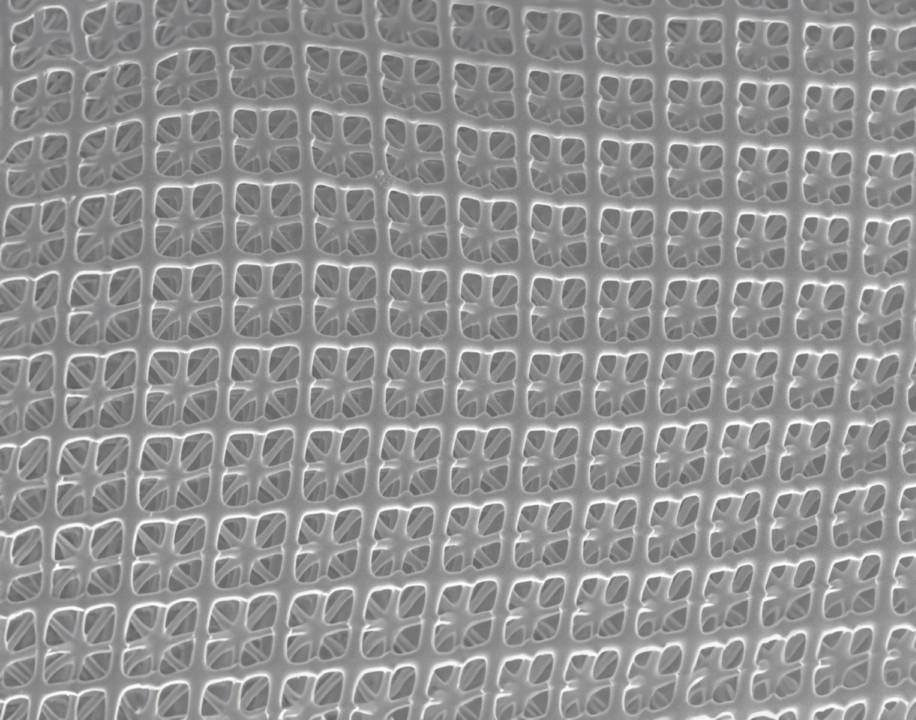
“Smaller is Stronger”, achieving exceptional properties.
The main differentiator of these structures lies in the combination of optimized geometric shapes on a tiny scale, taking advantage of the phenomenon known as “the smaller, the stronger.”
According to Peter Serles, the lead author of the study, these characteristics allow the nanolattices to exhibit some of the highest strength-to-weight ratios ever recorded.
However, the standard geometries of these materials tend to have sharp corners and intersections that concentrate stresses and can lead to premature failure. Addressing this challenge was one of the central focuses of the research team.
The Role of Machine Learning in Material Design
To overcome design limitations, researchers turned to machine learning. Collaborating with the team from the Korea Advanced Institute of Science and Technology (KAIST), they utilized a multi-objective Bayesian optimization algorithm.
This algorithm analyzed simulated geometries to predict the best configurations for distributing stresses and improving the strength-to-weight ratio of the nanolattices.
According to Serles, this was the first use of machine learning to optimize nano-architected materials.
The algorithm surprisingly required only 400 high-quality data points to learn what worked and what did not. “We were shocked by the improvements,” says Serles. “It not only replicated known geometries, but it also predicted entirely new and innovative designs.”
Technological Advancements of the Material
After the computational modeling phase, the researchers used a two-photon polymerization 3D printer located at the Center for Research and Application in Fluidic Technologies (CRAFT) to create prototypes of the optimized structures.
This additive manufacturing technology allowed for the production of carbon nanolattices with extraordinary precision.
The results were impressive. The new geometries doubled the strength of existing designs, withstanding a stress of 2.03 megapascals per cubic meter per kilogram of density.
To put this in perspective, this is about five times stronger than titanium, one of the most used materials in aerospace applications.
Potential Applications and Environmental Impact
This innovation has deep implications for various industries. In the aerospace sector, for example, ultralight components can significantly reduce fuel consumption, decreasing the environmental impact of flights.
According to Filleter, the study’s leader, replacing titanium parts in aircraft with this material could save up to 80 liters of fuel per year for every kilogram of material replaced.
Additionally, the lightness and strength of the nanolattices offer advantages in other sectors. In the automotive industry, they could result in more efficient vehicles with greater range.
In civil engineering, they can be used in structures that require high strength with reduced weight, such as bridges and buildings.
A Global Collaboration for the Future
The development of these materials was made possible through collaboration among world-renowned institutions, including the Karlsruhe Institute of Technology in Germany, the Massachusetts Institute of Technology (MIT) in the United States, and Rice University, also in the United States.
Additionally, the International PhD Cluster program at the University of Toronto played a crucial role in connecting researchers from different parts of the world.
This collaborative approach allowed for the integration of knowledge from materials science, machine learning, chemistry, and mechanics, resulting in significant advances. “This was a multifaceted project that brought together various elements to help improve and implement this technology,” emphasized Serles, who is currently a science fellow at the California Institute of Technology (Caltech).
Next Steps for the Material
Although the initial results are promising, researchers are already planning the next steps. One of the main challenges is scaling the production of these structures to make them economically viable for practical applications.
Furthermore, the team aims to explore new designs that maintain high strength and stiffness but with even lower densities.
“We believe that these new material architectures could pave the way for large-scale components in the near future,” says Filleter. This advancement could not only enhance the performance of existing products but also create possibilities for entirely new innovations.
With information from utoronto.







Desenvolvimento incrível, com aplicações na ortopedia, e em diversos outros segmentos na área da saúde e bem estar, seria fantástico.