





 Portuguese
  English
  Spanish
  5 min of reading
  0 comments


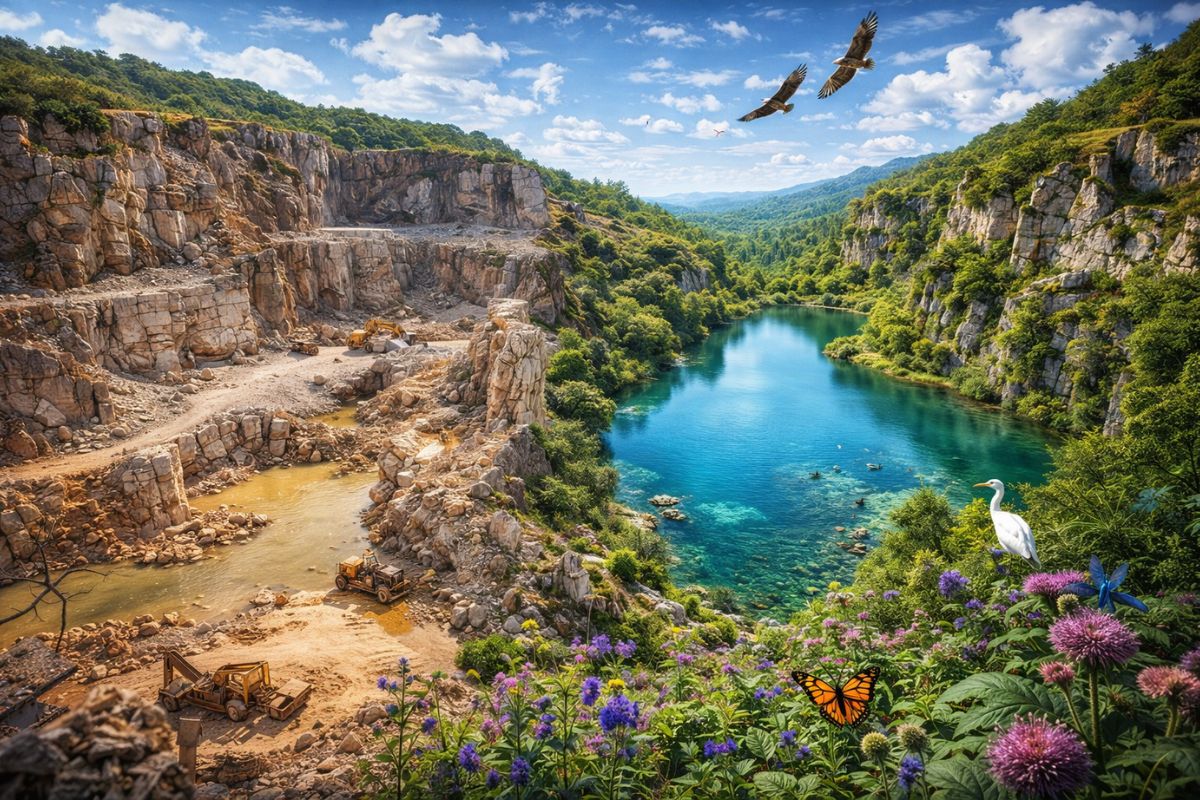
An old tin mine in the Vale do Côa in Portugal has transformed from abandoned industrial land to a wetland with amazing biodiversity. The ecological restoration of the Paul de Toirões Park has already recorded more than 200 species and has become a reference for how destroyed landscapes can be reborn.
The Paul de Toirões Park, in the Vale do Côa, Portugal, was until recently an open scar on the landscape, an old quarry for tin, tungsten, and sand abandoned in the early 2010s, with deep pits, craters, and artificial drainage systems that expelled water from the land. Today, the 300-hectare area hosts a mosaic of lakes, ponds, and wetlands where biodiversity has exploded, with environmental DNA analyses revealing the presence of over 200 species in the area.
The transformation began spontaneously when water started to accumulate in the depressions left by mining, but it gained momentum in 2022 with the entry of Rewilding Portugal in the management of the park. The ecological restoration project demonstrates something that environmental scientists have repeated for decades: even highly degraded landscapes can recover and become refuges for biodiversity when natural processes are given space and a push in the right direction.
The legacy of destruction left behind by mining

For decades, the site that is now Paul de Toirões Park, previously known as Quinta de Santa Margarida, was exploited for tin, tungsten, and sand extraction. Mining activities drastically reshaped the land, creating a landscape of deep pits, steep slopes, and artificial drainage channels designed to drain water out of the area as quickly as possible.
-
This house in Japan has been transformed on the inside and now looks as if it has been excavated from the inside out like a surreal cave.

-
Globo presenter lives in an R$ 8 million mansion in the interior of São Paulo, with a private lake, basketball and tennis courts, a “private hotel,” a condominium costing R$ 4,000, and surprising details in the decor.

-
Want to fall asleep faster and better? This technique reduces the temperature of the extremities, slows down heartbeats, regulates breathing, and can prompt the release of melatonin in minutes, helping to combat nighttime anxiety.

-
The USA surprises the world with a new Trump dollar after 165 years, breaking historical tradition.


When mining ceased in the early 2010s, what remained was an industrial wasteland. But the very shape of the devastation contained, paradoxically, the seeds of recovery.
Water began to accumulate in the excavated depressions, forming a varied network of interconnected aquatic habitats that would later prove fundamental for biodiversity.
Still, significant barriers persisted: steep slopes prevented access for wildlife, drainage channels continued to empty naturally floodable areas, and large expanses remained dominated by plantations of exotic trees.
How Rewilding Portugal accelerated ecological restoration

Image: Marco Westberg
The practical work of ecological restoration began in November 2022, when the Rewilding Portugal team took over the management of the park with financial support from Mossy Earth. The goal was to set the site on the path to becoming a self-sustaining ecosystem, capable of maintaining and diversifying itself with minimal human intervention over time.

Using heavy machinery, the team smoothed the edges of water bodies, removed artificial drainage systems, and built small barriers to retain water for longer periods.
These interventions expanded the wetlands and created a wider range of habitats from deep lakes to shallow areas subject to seasonal flooding. Rows of exotic cypress trees were removed to allow the regeneration of native species such as the Pyrenean oak and the holm oak, which increased the diversity and connectivity of habitats available for wildlife and flora.
The numbers that prove the biodiversity explosion
The results of surveys conducted in 2023 and 2024 are significant. 94 species of aquatic plants have been recorded, covering everything from sandy margins to flooded willow groves.
Among the discoveries is the southern bladderwort, an insectivorous plant extremely sensitive to water quality and with very few records in inland Portugal, an indicator that the ecosystem is healthy.
The environmental DNA analysis, a technique that identifies species from genetic traces in water and soil, revealed the presence of over 200 species throughout the park, confirming the richness of biodiversity that has settled in the area.
Specific surveys of amphibians and birds highlighted the growing importance of temporary ponds and wetlands as breeding and feeding areas.
Black storks, red-footed falcons, spoonbills, peregrine falcons, and otters are among the documented species, alongside a growing population of amphibians colonizing the newly formed puddles.
The Vale do Côa gains an ecological corridor
The ecological restoration of Paul de Toirões benefits not only the park itself. The revitalization of the site boosts ecological connectivity throughout the Vale do Côa, creating a bridge for species moving through the landscape.
The expanding wetlands and regenerating forests complement other restoration projects in the valley, reinforcing Rewilding Portugal’s work to build a large-scale ecological corridor.
“The rebirth of Paul de Toirões demonstrates the remarkable power of nature to heal when we give it the opportunity,” says André Couto, field manager of Rewilding Portugal.
The biodiversity that has returned to the site serves as a thermometer for the environmental health of the region, and each new species recorded indicates that the ecosystem is gaining complexity and resilience. The long-term goal is for natural processes to take the lead, with human intervention decreasing over time.
Sustainable tourism turns biodiversity into local economy
The rebirth of biodiversity in Paul de Toirões is also generating economic impact. The site has become a focal point for sustainable tourism in the Vale do Côa, with guided tours, wildlife observation opportunities, and immersive stays that connect visitors to the recovered landscape.
A dedicated wildlife observatory allows close encounters with birds and other species, while the WilderCamp, a mobile camp managed by Rewilding Portugal, offers a lodging experience that places guests within the restored ecosystem.
These initiatives create economic opportunities for local communities and demonstrate that ecological restoration and development can go hand in hand, transforming biodiversity into a sustainable source of income for the region.
A journey that is far from over
Although the transformation of Paul de Toirões has been rapid, the project still has a long way to go.
Rewilding Portugal will continue to monitor ecological changes and track the return of wildlife over the coming years, with repeated surveys to measure the evolution of biodiversity, water quality, and habitat development.
As vegetation matures and food chains strengthen, the expectation is that the site will evolve into an increasingly vibrant ecosystem.
What was once a devastated industrial land is now a living demonstration of ecological restoration and a testament to the fact that seemingly irrecoverable landscapes can transform into refuges for biodiversity if someone gives nature the space and time it needs.
With information from the portal rewildingeurope.
What do you think of this transformation? Do you believe that ecological restoration projects like this can be replicated on a large scale or do they depend on very specific conditions? Let us know in the comments.







Seja o primeiro a reagir!