





 Portuguese
  English
  Spanish
  3 min of reading
  0 comments


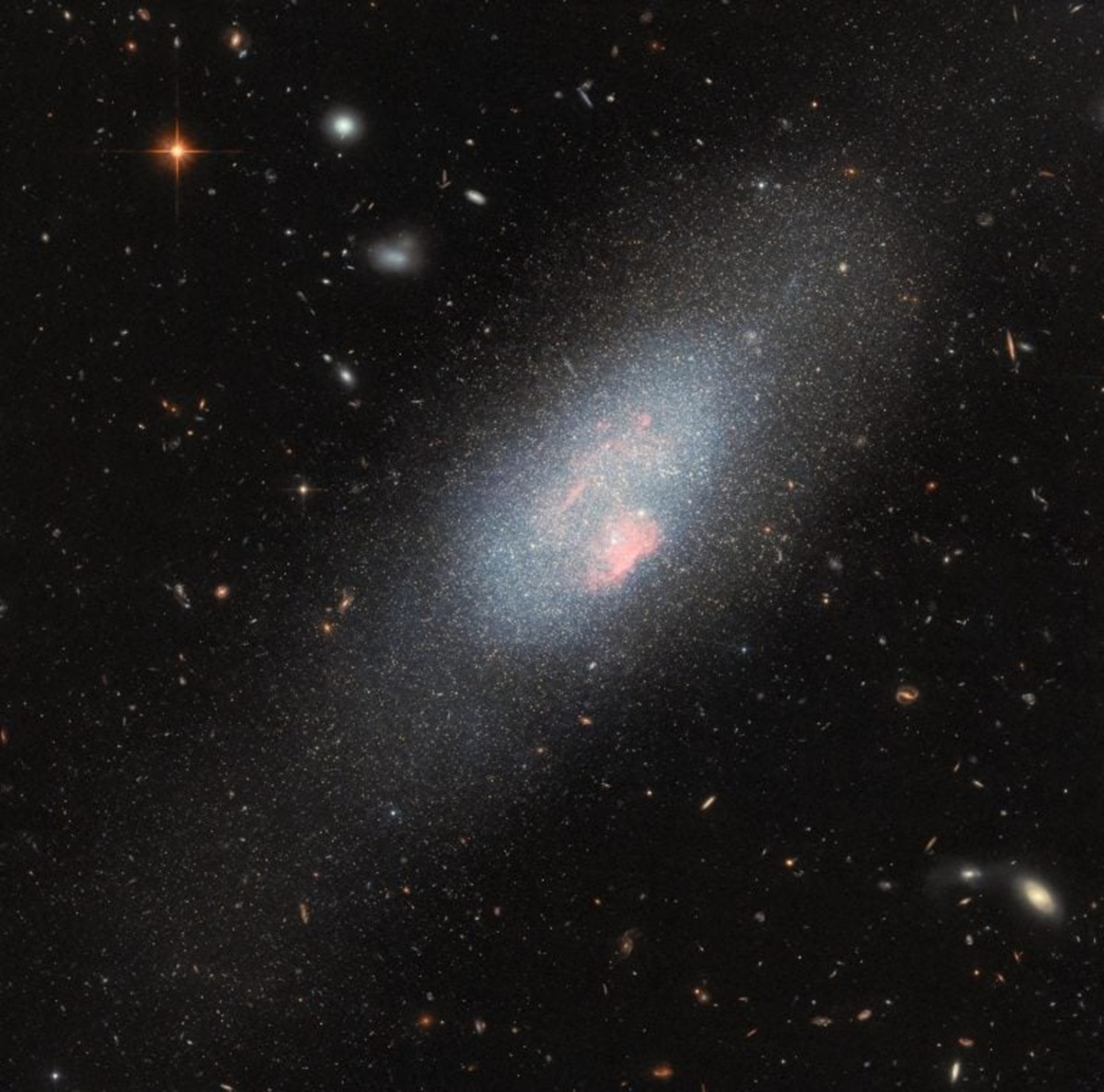
Located about 13 million light-years away in the constellation Ursa Major, the dwarf galaxy Markarian 178 is part of a catalog containing more than 1500 systems identified by their strong ultraviolet emission and reveals clear signs of a recent star formation explosion associated with possible cosmic interaction
A small blue galaxy called Markarian 178, located about 13 million light-years away in the constellation Ursa Major, displays strong ultraviolet brightness, a concentration of rare Wolf-Rayet stars, and signs of a recent star formation explosion associated with possible past interaction.
Galaxy Markarian 178 Is Part of a Catalog Containing Over 1500 Systems
The compact dwarf galaxy Markarian 178, also identified as Mrk 178, is featured as the Hubble’s Image of the Week from ESA. Much smaller than the Milky Way, this galaxy is part of a family of over 1500 Markarian galaxies.
These systems were cataloged by Armenian astrophysicist Benjamin Markarian, who identified galaxies with exceptionally strong ultraviolet light. The galaxy Markarian 178 stands out for this characteristic and for its predominant blue color.
-
Motorola launched the Signature with a gold seal from DxOMark, tying with the iPhone 17 Pro in camera performance, Snapdragon 8 Gen 5 that surpassed 3 million in benchmarks, and a zoom that impresses even at night.

-
Satellites reveal beneath the Sahara a giant river buried for thousands of kilometers: study shows that the largest hot desert on the planet was once traversed by a river system comparable to the largest on Earth.

-
Scientists have captured something never seen in space: newly born stars are creating gigantic rings of light a thousand times larger than the distance between the Earth and the Sun, and this changes everything we knew about stellar birth.

-
Geologists find traces of a continent that disappeared 155 million years ago after separating from Australia and reveal that it did not sink, but broke into fragments scattered across Southeast Asia.

Dominant Blue Brightness and Contrasting Red Regions
The majority of the galaxy shines blue due to the presence of young and extremely hot stars, minimally obscured by dust. This composition gives the galaxy a bright and intense appearance in the visible spectrum.
However, parts of the galaxy also exhibit a reddish hue. This coloration is associated with a dense concentration of massive stars grouped near the brightest outer region. In this area, a remarkable number of rare Wolf-Rayet stars can be observed.
When viewed through special filters from Hubble, emissions of ionized hydrogen and oxygen appear in red tones, creating a contrast with the dominant blue of the galaxy.
Wolf-Rayet Stars Indicate Recent Star Formation
Wolf-Rayet stars are massive and rapidly shed their outer layers through intense stellar winds. In Markarian 178, these winds produce strong emission signatures clearly visible in the spectrum of the galaxy.
This stage occurs shortly before the stars collapse into black holes or neutron stars. Since the Wolf-Rayet phase lasts only a few million years, its abundance indicates that the galaxy has undergone a recent increase in star formation.
Tidal Structures Suggest Past Interaction
The cause of the recent activity is not immediately obvious. The galaxy appears to be relatively isolated, with no large nearby galaxies that could have easily disturbed its gas.
Astronomers consider that the trigger may have been a close encounter with a much smaller companion galaxy. Deep observations from the Large Binocular Telescope revealed faint tidal structures around Mrk178, suggesting past interaction.
New high-resolution observations from Hubble will be crucial in unraveling the complete history of star formation in this energetic dwarf galaxy and clarifying the processes that shaped its current structure.








-

-

-

3 pessoas reagiram a isso.