





 Portuguese
  English
  Spanish
  5 min of reading
  0 comments


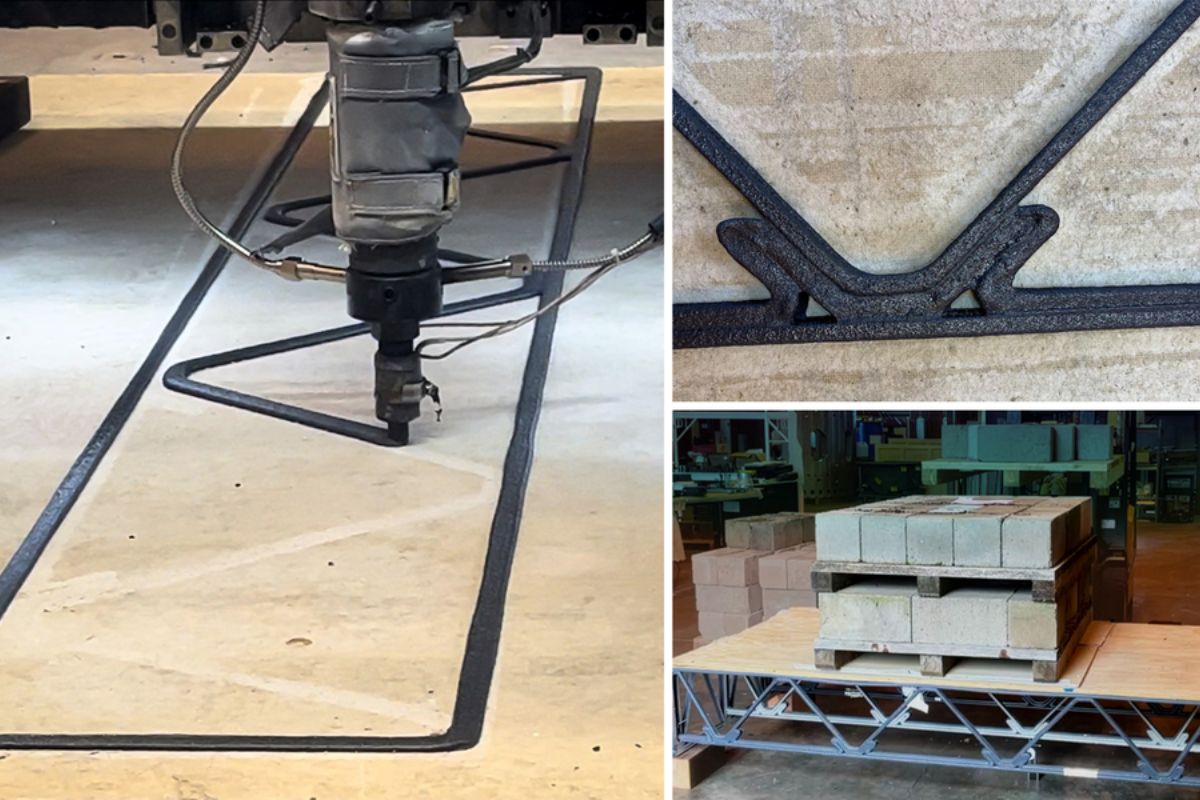
Discarded Water Bottle In Recycling Turns Into 3D-Printed Floor Truss At MIT, Lighter Than Wood, Capable Of Supporting Entire Houses And Relieving Pressure On Forests.
The water bottle you throw in the recycling bin can, in a short time, become part of the structure of your own house. Engineers at MIT are using recycled plastic to 3D print beams, trusses, and structural elements that compete with wood in strength but excel in lightness, modularity, and sustainability. In laboratory tests, a floor made with recycled plastic trusses supported over 1,800 kg, exceeding official building standards in the United States.
Behind this transformation of the water bottle into a beam is the MIT HAUS group, which researches large-scale additive manufacturing for housing. The proposal is simple to explain and complex to execute: to replace part of the wood and concrete with recycled plastic, including “dirty” plastic, and create lightweight, durable, and quickly produced structural systems capable of meeting the global demand for housing without requiring deforestation of areas equivalent to multiple Amazons.
How The Water Bottle Becomes House Structure
In the researchers’ view, the water bottle is not just waste, but structural raw material. Discarded plastic can be shredded, turned into pellets, and fed into a large-format industrial 3D printer.
-
Motorola launched the Signature with a gold seal from DxOMark, tying with the iPhone 17 Pro in camera performance, Snapdragon 8 Gen 5 that surpassed 3 million in benchmarks, and a zoom that impresses even at night.

-
Satellites reveal beneath the Sahara a giant river buried for thousands of kilometers: study shows that the largest hot desert on the planet was once traversed by a river system comparable to the largest on Earth.

-
Scientists have captured something never seen in space: newly born stars are creating gigantic rings of light a thousand times larger than the distance between the Earth and the Sun, and this changes everything we knew about stellar birth.

-
Geologists find traces of a continent that disappeared 155 million years ago after separating from Australia and reveal that it did not sink, but broke into fragments scattered across Southeast Asia.

In this study, the MIT team used a blend of recycled PET polymers with fiberglass, creating a composite that is easier to print and more durable.
The group aims to go beyond “clean” factory plastic and reach really dirty plastic, like used water bottles and food packaging, still containing liquid residues.
The idea is to skip washing and pre-processing steps and feed this shredded material directly into large-scale additive manufacturing systems. The resulting parts would be light enough to travel in a pickup truck instead of heavy trucks loaded with sawn wood.
The researchers envision a future where water bottles, soda packaging, and other post-consumer plastics go from collection containers directly to micro-factories, installed in shipping containers next to stadiums, urban centers, or areas with high volumes of plastic waste.
From there, these printed parts would travel to construction sites, where they would fit together like a structural Lego system.
3D-Printed Floor Truss That Supports Over 1,800 Kg
The study presented focuses on a 3D-printed floor truss made from recycled plastic. A traditional floor truss is formed by wooden beams connected by metal plates, in a design that resembles a ladder with diagonal “steps.”
The MIT team recreated this concept in plastic composite, optimizing the stiffness-to-weight ratio so that the structure can support large loads with minimal deformation.
They simulated various truss designs until finding the pattern with the best mechanical performance. Then, they printed four trusses about 2.4 meters long, 30 centimeters high, and approximately 2.5 centimeters wide.
Each truss took less than 13 minutes to print, weighing around 6 kg, lighter than a comparable wooden truss.
The four pieces were assembled in parallel, bolted to a plywood sheet, forming a test floor. Progressive loads of sand and concrete were placed in the center of the structure, while the researchers measured deflection.
The printed floor held over 1,800 kg before yielding, performance that meets and exceeds construction standards set by the U.S. Department of Housing and Urban Development.
In practice, this means that the truss made from recycled plastic and your water bottle can, technically, enter the same category of structural performance today reserved for wood, paving the way for a new class of components for civil construction.
Why Replace Wood With Recycled Plastic
The driving force behind this type of research is not just technological innovation but also the sum of two crises: the global housing crisis and the pressure on natural resources.
The researchers estimate that the world will need about 1 billion new homes by 2050. If all this demand were met with wooden structures, it would require deforesting an area three times the size of the Amazon rainforest.
At the same time, the planet is facing mountains of plastic waste, including billions of discarded water bottles every year. This combination of excess waste and scarcity of forest resources makes recycled plastic a natural candidate for structural material.
In MIT’s view, using low-quality plastic to manufacture high-responsibility components, such as trusses, beams, and stakes, can alleviate pressure on forests, reduce emissions associated with concrete production, and provide a long-term destination for the water bottle that today would have few effective recycling routes. The lightness of the parts also reduces logistics costs and facilitates transportation to remote areas.
Microfactories Near Plastic Waste
A central point of the project is the idea of decentralizing production. Instead of large factories in distant locations, the researchers envision microfactories installed in shipping containers, strategically positioned in areas with high waste generation, such as next to a soccer stadium or dense urban centers.
In these microfactories, water bottles, food packaging, and other dirty plastics would be shredded and immediately turned into “ink” for 3D printing. Large-scale additive manufacturing machines would produce floor trusses, wall studs, stair stringers, and roof trusses.
The light and modular parts could be transported on motorcycles or small trucks to where housing is most urgent. Instead of transporting wood over long distances, intelligent geometry made from the same water bottle that was clogging landfills is transported.
Challenges For The Water Bottle To Become A Building Standard
Despite the promising results, the researchers emphasize that there is still a significant path ahead. One of the main challenges is cost.
For the plastic truss to truly compete with wood, production needs to be cheaper, which requires efficient collection, shredding, and feeding chains for dirty plastic into the printers.
Another critical point is understanding how contaminants present in used water bottles and other post-consumer plastics affect the quality of the final product.
Liquid residues, labels, and impurities can alter the mechanical behavior of the composite, and this needs to be rigorously mapped so that the structures meet building codes.
Still, the study demonstrates that it is possible to print structural building elements with recycled plastic and achieve performance compatible with existing standards.
If the stage of using truly dirty plastic is mastered, the water bottle that today seems like waste can be seen as a key piece of a new low-carbon architecture, based on distributed additive manufacturing and massive waste repurposing.
In the end, would you live in a house whose structure was born from the water bottle you just threw in recycling?







-

-

-

10 pessoas reagiram a isso.