





 English
  Francês
  Alemão
  Italiano
  Japonês
  Norueguês
  Portuguese
  Spanish
  3 min of reading


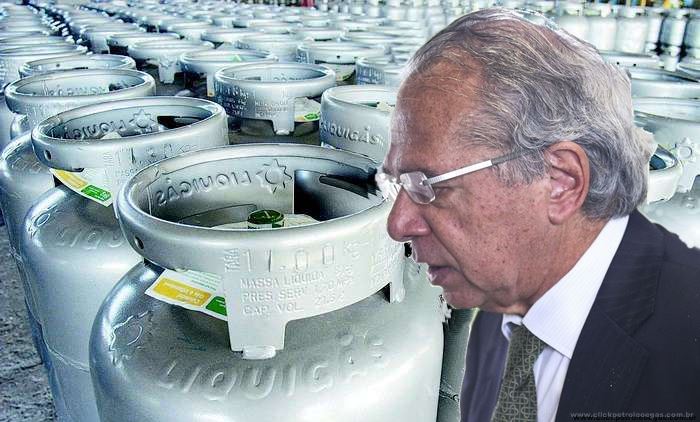
The Minister of Economy, Paulo Guedes, stated on this Tuesday, April 9, that the government plans to reduce the price of cooking gas by half over a period of two years with the end of the monopoly, among other actions
To achieve the goal of halving the price of cooking gas in two years in Brazil, Guedes argued that it will be necessary to address the monopolies. “In two years, the gas canister will reach half the price in the homes of Brazilian workers. We will break these monopolies and lower the price of gas and oil through competition,” said the minister.
The statement was made during the 22nd March to Brasília in Defense of Municipalities, which took place in Brasília. Guedes also highlighted that Petrobras’ monopoly in this case raises the product’s price in countries where the solution would come from oil, by exploring the pre-salt layer.
-
Government unlocks R$ 554 million for a highway that has been requested for decades and accelerates the duplication of BR.
-
Without bricks, without cement, and without endless construction: the cardboard house that is assembled in modules and can be moved.

-
Billions of barrels on the equatorial margin could lead Amapá to double its oil production in Brazil — the state aims to enter the route of companies in the Campos Basin, attract investments, and boost jobs and businesses in the oil and gas sector.
-
Without bricks, without cement, and without endless construction: the cardboard house that is assembled in modules and can be moved.

According to the National Union of Liquefied Petroleum Gas Distributors (Sindigas), six companies account for almost 90% of the distribution market.
The main issue in the federal government was also addressed: pension reform. At the event, the minister also mentioned that the government intends to simplify some taxes to make “Brazil grow” and advocated the measure among those present. “We all know that pension reform is also important for municipalities and states,” he stated. On the occasion, the Special Secretariat for Pensions of the Ministry of Finance distributed a booklet stating that the country’s economic environment will improve, with job creation and increased revenue.
The unification of taxes was also a topic in Guedes’ speech. “We will lower, simplify, and reduce taxes for Brazil to grow. It is the tax reform. First, we will take three, four, five taxes and merge them into one. It will be called the Federal Unique Tax,” he stated.
Guedes also advocated for an increase in the division of resources for states and municipalities. According to the minister, “today, 65% is for the Union, 35% for states and municipalities. In the future, 70% should be for states and municipalities.”
“The state is unequipped, the city hall does not have resources for outpatient clinics. The idea is to start tapping the pre-salt – and it is not gradual – already next year and allocate 70% to states and municipalities,” he declared.
Paulo Guedes stated that it is necessary to establish this new distribution format “now,” and not in 20 years. The Minister of Economy estimated a collection with pre-salt resources of R$ 500 billion to R$ 1 trillion over the next 20 years. “The future comes from oil,” he declared.
An Important Note: Cooking Gas Is Different from Natural Gas.
- Cooking Gas (LPG)( ⇒ consists of a gas mixture of hydrocarbons obtained from underground reserves or from the refining process of crude oil in refineries.
- Natural Gas (NG) ⇒ is a fossil fuel found in nature, usually in deep underground reservoirs; NG results from the combination of gaseous hydrocarbons under normal atmospheric conditions of pressure and temperature.
NG is relatively cheaper than LPG because it goes through fewer processes. Industry experts, such as Marcelo Gauto, say that the only way it is virtually possible to reach this price is through subsidies, as cooking gas is taxed all the way to the final consumer during processing and distribution.






Seja o primeiro a reagir!