





 Portuguese
  English
  Spanish
  7 min of reading
  0 comments


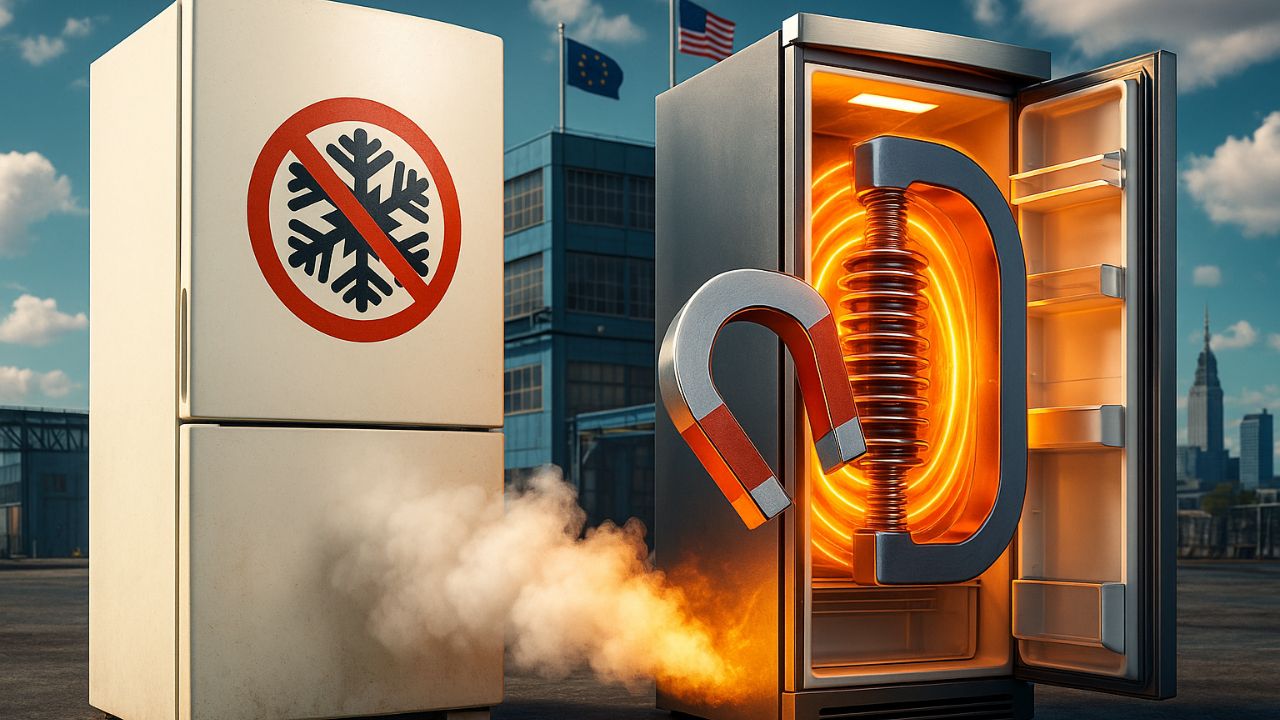
Magnetocaloric Technology Uses Magnets to Cool More Efficiently, Cuts HFCs and Points a Way to Transform from Gas-Free Domestic Refrigerators to Entire Industrial Systems
Gas-free refrigerators are moving from science fiction to real engineering. Instead of that circuit full of refrigerant fluid, valves, and noisy compressors, researchers are showing that it is possible to cool using solid materials and magnetic fields. This means completely cutting hydrofluorocarbons (HFCs), which currently sustain billions of refrigerators, freezers, air conditioning units, and heat pumps around the world, but have a huge climate impact. Instead of traditional refrigerants, permanent magnets and special materials that heat and cool when entering and exiting a magnetic field come into play.
While laboratories refine this magnetocaloric technology, European companies have already tested the first commercial equipment, focused on beverages, supermarkets, and data centers.
It is still expensive, still niche, and still in the pre-industrialization phase, but the direction is clear: if they can reduce costs and size, the next generation of gas-free refrigerators could retire the old vapor compression cycle that has dominated cooling since the 19th century.
-
A “silent skill” is allowing Brazilians to earn up to R$ 22,000 per month without a degree and become indispensable for companies that rely on millions of data to survive.

-
Researchers at the Toyota Research Institute found that if a human uses robotic arms to flip a pancake 300 times in an afternoon, the robot learns to do it on its own the next morning, and this is currently the most promising method to solve the biggest bottleneck in modern robotics.

-
Goodbye iron: a common item in households is starting to lose space to technology that smooths clothes in minutes without an ironing board and with less energy consumption.

-
Antarctica reveals an unusual clue high in the Hudson Mountains, and what appeared to be just an isolated rock began to expose a secret hidden under the ice for ages.


Why Do We Still Depend on Gas to Cool Everything
Today, almost every refrigerator, freezer, or air conditioner you know is a heat exchanger based on the vapor compression cycle. In practice, it is a machine that takes the heat from inside and throws it outside using a refrigerant gas that constantly changes phase.
This cycle has four main stages: the compressor raises the pressure and the temperature of the gas, the condenser converts this gas into liquid and releases heat into the environment, the expander reduces the fluid’s pressure and cools it much more than the space we want to cool, and the evaporator absorbs the heat from inside the refrigerator while the refrigerant turns back into vapor. The process repeats continuously.
The problem is that the most common refrigerants are HFCs. They work very well but have a violent climate impact if they leak into the atmosphere, something that is still much more common than it should be.
The transition to clean energy also involves a change in how we cool homes, food, and servers. This is exactly where the gas-free magnetocaloric refrigerators come in.
What Is Magnetocaloric Cooling in Practice
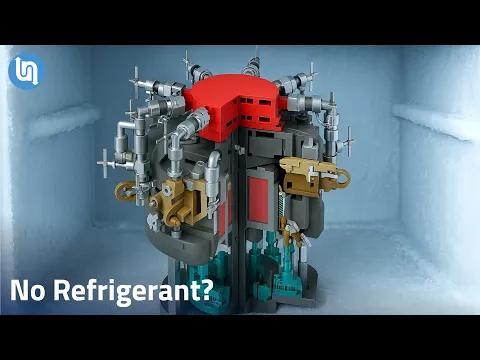

In the world of so-called caloric effects, the idea is always the same: instead of using a fluid that evaporates and condenses, you choose a solid material that changes temperature when it is “forced” in some way.
This can be done with mechanical stress, electric field, or magnetic field. In the case of gas-free magnetocaloric refrigerators, the star of the show is the magnetic field.
You start with a magnetocaloric material, such as gadolinium or special alloys based on lanthanum, iron, and silicon. When this material enters a strong magnetic field, its magnetic domains align, and it heats up.
When the field is removed, it disorganizes again and cools down. This temperature variation is used to cool a working fluid, usually water with additives, that circulates through the system and takes on the role that today is filled by the gaseous refrigerant.
Instead of a compressor, the heart of the system is a set of permanent magnets and an active magnetic regenerator, a kind of heat exchanger where the fluid passes through “beds” filled with magnetocaloric particles.
As the magnets rotate, they magnetize and demagnetize these beds in sequence. The result is a heating and cooling cycle that allows temperature control without the need for refrigerant gas.
The Leap from Laboratory: The Magnetocaloric Heat Pump from Ames Lab
In the United States, a team linked to the Ames National Laboratory designed a magnetocaloric heat pump aimed at competing with traditional heat pumps in weight, cost, and performance.
In the prototype, the active magnetic regenerator is made up of several “beds” of magnetocaloric material arranged in a ring, initially with gadolinium particles the size of very fine coffee powder.
The working fluid, based on water with corrosion-inhibiting additives, circulates through these beds. When the set of permanent magnets passes over a bed, the gadolinium magnetizes and heats up, warming the fluid.
When the magnets move away, the gadolinium demagnetizes and cools, cooling the fluid. By repeating this cycle at high speed, the system can transfer heat from one side to the other continuously, exactly what a refrigerator or a heat pump needs to do.
After testing gadolinium as a “baseline,” the team analyzed a magnetocaloric alloy of lanthanum, iron, and silicon.
The simulation showed that swapping gadolinium for this alloy can significantly increase the power density of the system, that is, the thermal power per kilogram of device, allowing magnetocaloric heat pumps to compete with vapor compression devices in typical power ranges for residential applications.
A detailed performance evaluation is still underway, but the signal is clear: it is possible to get close to existing technologies without relying on gas.
The First Commercial Gas-Free Refrigerators Have Arrived, But Not in Your Kitchen

While laboratories refine models and materials, Europe has begun testing the commercial side of gas-free magnetocaloric refrigerators. The Franco-German startup Magnoric showcased a working magnetocaloric refrigerator serving cold drinks to the public at a heating and cooling fair.
The company states that it is entering the pre-industrialization phase with units above 6 kW, designed for supermarkets, data centers, and other environments with high and constant cooling demand.
Not far from there, in Germany, Magnotherm is also heavily betting on magnetocaloric technology. The company already sells a beverage refrigerator based on magnets, in the range of €6,500, and offers a two-door model aimed at commercial applications.
These products are real-life proof of the concept that it is possible to cool without gas on a commercial scale, but for now, they are focused on specific niches and with prices still far from the domestic reality.
In other words, gas-free refrigerators already exist, but they are still far from mass retail. What the market is doing now is paving the way at the more expensive and energy-intensive end, where it makes sense to pay more to save energy, cut emissions, and test new technologies.
Magnetocaloric vs Elastocaloric: Why Insist on Magnets
In the world of caloric effects, magnetocalorics are not alone. There is another promising family, elastocalorics, which uses materials that change phase and temperature when they are stretched, compressed, or bent.
In terms of raw performance, elastocalorics have already shown very high efficiency in research, which naturally raises the question: why spend so much effort on magnets.
The answer is that each approach has its own challenges. Magnetocaloric systems require intense magnetic fields, usually above 1 tesla, which implies sophisticated permanent magnets and careful design of the magnetic circuit.
On the other hand, elastocalorics deal with a pesky durability problem, as the material is constantly subjected to mechanical stress and tends to degrade over time.
Magnetocalorics have an important advantage: they have been studied for decades, with kilowatt-range prototypes already demonstrated in the lab. The technology is still expensive and bulky, but it is more mature in terms of understanding materials, designing regenerators, and integrating into real systems.
Meanwhile, elastocalorics are the “prodigy child” of solid-state refrigeration, with enormous potential, but in a much earlier phase of development.
Ultimately, what really matters is advancing any technology that allows gas-free refrigerators, refrigerant-free heat pumps, and air conditioning systems without HFCs, while maintaining or exceeding the efficiency of what we already have today.
When Do Gas-Free Refrigerators Arrive at Consumers’ Homes
If you’re imagining swapping your kitchen refrigerator tomorrow for a magnetocaloric version, you’ll still need a bit of patience.
The current prototypes focus on commercial applications, are expensive, and are still in validation and pre-industrialization phases. There is a need to reduce costs, shrink the size of the equipment, and simplify manufacturing so that this technology can physically and financially fit into people’s homes.
On the other hand, the fact that real products already exist, even if niche, and that independent laboratories are showing that parity with vapor compression systems is possible, indicates that gas-free refrigerators have ceased to be a distant concept.
They are beginning to emerge as a concrete option in the near future, especially in a scenario where climate regulations tighten restrictions on HFCs and entire industries need cleaner alternatives.
In the end, any advancements in solid-state refrigeration are an important step toward energy transition, because cooling is everywhere: from hospitals to data centers, from supermarkets to your kitchen.
Exchanging a problematic gas for magnets and smart materials may be one of the silent but decisive changes in how we handle heat and cold in our daily lives.
And you, when these magnet-based gas-free refrigerators become accessible, would you switch your traditional refrigerator for a gas-free one that cools using magnetic fields?






-

Uma pessoa reagiu a isso.