





 Portuguese
  English
  Spanish
  4 min of reading
  0 comments


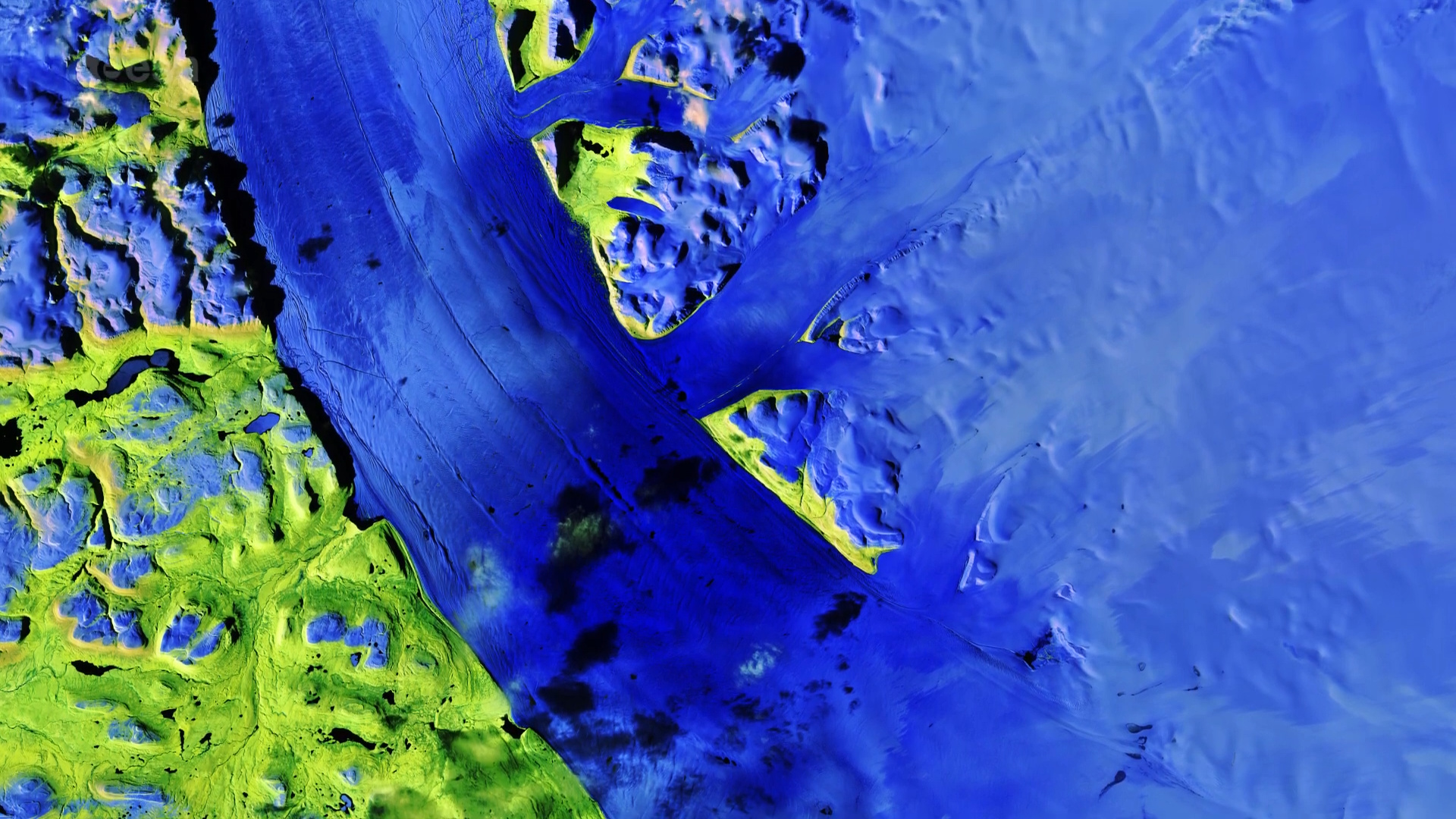
Study Published in 2024 Shows That the Petermann Glacier in Greenland Has Thinned About 140 Meters Below Since 2000, Following Intrusion of Ocean Water Into the Cracks.
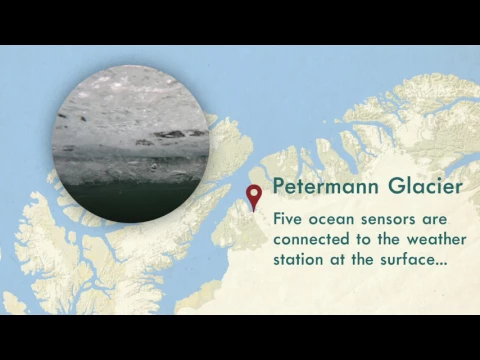
In the northwestern tip of Greenland, in the Arctic, the Petermann Glacier, one of the largest glaciers flowing into the ocean, is undergoing a transformation that few can see. It’s not the summer surface melting that catches attention in aerial images. What worries scientists happens below. On January 11, 2024, the American Geophysical Union (AGU) published a synthesis of a study led by researchers from the NASA Jet Propulsion Laboratory and collaborators in the journal Geophysical Research Letters, showing that the glacier has thinned about 140 meters at its base between 2000 and 2020 due to melting caused by the intrusion of seawater under the ice.
The phenomenon is not explosive, but it is persistent and may be more decisive than it appears.
The Tide That Moves the Ice for Miles
The central discovery of the study is counterintuitive. The zone where the glacier ceases to be supported by the bedrock and begins to float, called the grounding zone — is not fixed. It “breathes” with the tides.
-
Motorola launched the Signature with a gold seal from DxOMark, tying with the iPhone 17 Pro in camera performance, Snapdragon 8 Gen 5 that surpassed 3 million in benchmarks, and a zoom that impresses even at night.

-
Satellites reveal beneath the Sahara a giant river buried for thousands of kilometers: study shows that the largest hot desert on the planet was once traversed by a river system comparable to the largest on Earth.

-
Scientists have captured something never seen in space: newly born stars are creating gigantic rings of light a thousand times larger than the distance between the Earth and the Sun, and this changes everything we knew about stellar birth.

-
Geologists find traces of a continent that disappeared 155 million years ago after separating from Australia and reveal that it did not sink, but broke into fragments scattered across Southeast Asia.

When the tide rises, the ice elevates enough to allow relatively warmer ocean water to advance miles beneath the glacier. When it falls, some of that water remains, exchanging heat with the base of the ice.
This repetitive process creates an invisible cycle of thermal erosion. It’s not just about global warming in a broad sense. It’s about the ocean’s ability to access previously protected regions.
From 3 Meters Per Year to Nearly 10 Meters Per Year – Petermann Glacier
The researchers estimated that basal melting at Petermann increased from an average of about 3 meters per year in the 1990s to nearly 10 meters per year in the 2020s.

This acceleration does not mean immediate collapse. But it indicates that the mechanism is intensifying.
And most importantly: the study suggests that the expansion and mobility of the grounding zone may be more decisive for melting than the simple increase in water temperature alone.
The Invisible Brake of the Petermann Glacier That May Fail
Glaciers that terminate in the sea function as natural dams. The part that is still supported by the bottom helps contain the flow of continental ice.
When this base loses thickness, the “brake” weakens. The glacier can then speed up its flow toward the ocean, increasing the discharge of ice.
It is this indirect effect that concerns climate modelers. It’s not just about the ice disappearing locally — it’s the potential for alterations in flow dynamics.
Why This Matters for Sea Level
The study does not claim that Petermann alone will raise sea level by several centimeters. What it shows is that underappreciated processes in previous models could accelerate future contributions.
If ocean intrusion beneath glaciers is more intense and frequent than previously thought, global projections may need adjustments.
And since Greenland already accounts for a significant share of the current sea level rise, any structural change in its large glaciers is monitored with the highest attention.
The Most Troubling Detail: Everything Happens Out of Sight
Satellites show the surface. Photographs reveal cracks and calving. But the critical zone is in the dark, hundreds of meters below sea level, where pressure, salinity, and currents work silently.
It is there that the ocean meets the ice. And it is there that the ice begins to yield.
A Mechanism That May Repeat
Although the study focuses on Petermann, the process described — tides amplifying water intrusion beneath marine glaciers — is not exclusive to Greenland.
Research in Antarctica also points to complex interactions between the ocean and the base of ice shelves.
This transforms the case of Petermann into more than just a local event. It becomes an example of how subtle mechanisms can have systemic impacts.
The glacier is still there. Massive. Imposing. But below, with each tidal cycle, with each intrusion of ocean water, something changes.
And in the Arctic, where transformations happen faster than in any other part of the planet, what changes below often appears on the surface some time later.








-

-

-

5 pessoas reagiram a isso.