





 Portuguese
  English
  Spanish
  3 min of reading
  0 comments


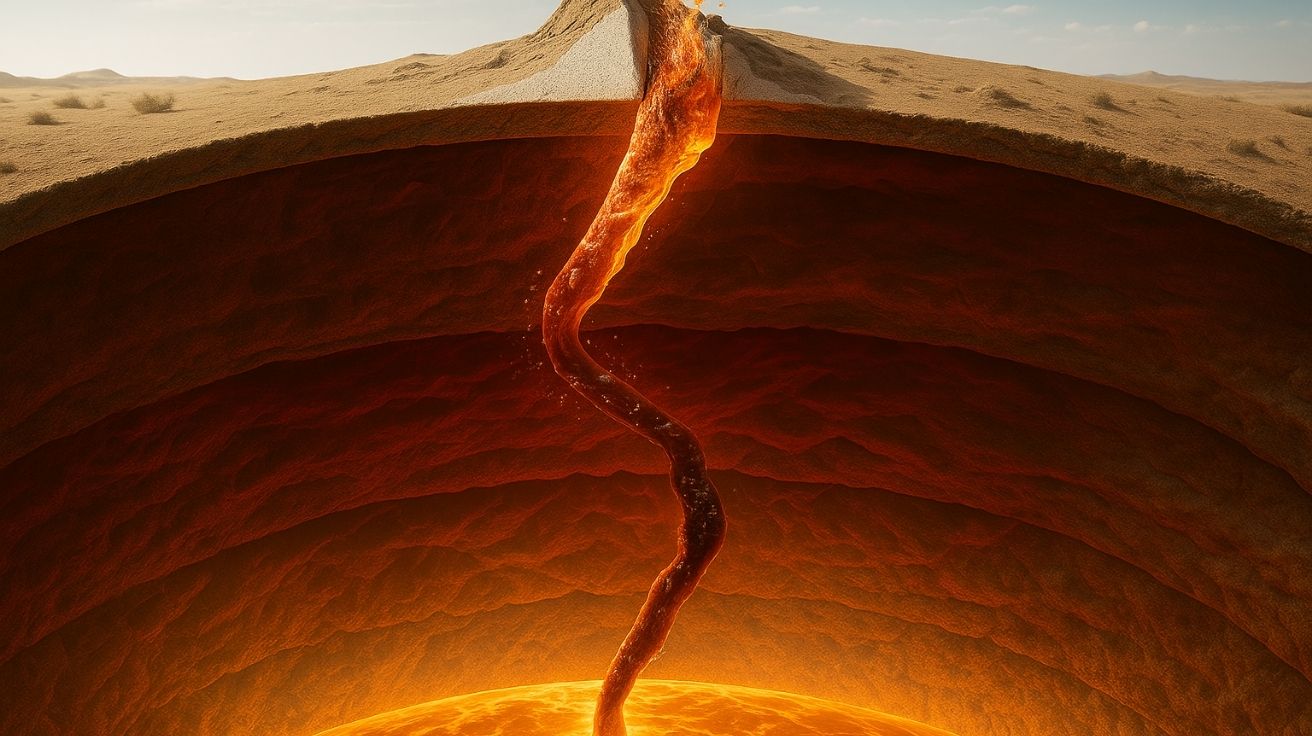
Without Causing Volcanoes Or Earthquakes, This Subsurface Heat Column Silently Heats The Soil And May Change The Understanding Of The Thermal Functioning Of The Earth’s Core
An international team of geologists accidentally identified a ghost plume rising from the Earth’s mantle beneath eastern Oman. The Unprecedented Find Reveals An Ascending Heat Column At A Depth Of 660 Km, Which Shows No Signs Of Volcanism At The Surface But Directly Affects Ground Uplift.
The Discovery Was Made By Geophysicist Simone Pilia Of King Fahd University While Analyzing Seismic Data From The Region. When Studying The Earthquake Waves That Cross The Planet, He Observed A Cylindrical Thermal Anomaly With Hotter And Less Rigid Rocks, Indicating The Presence Of A Plume Emerging From The Earth’s Deep Interior.
ARTICLE CONTINUES BELOWSee also
Motorola launched the Signature with a gold seal from DxOMark, tying with the iPhone 17 Pro in camera performance, Snapdragon 8 Gen 5 that surpassed 3 million in benchmarks, and a zoom that impresses even at night.

Satellites reveal beneath the Sahara a giant river buried for thousands of kilometers: study shows that the largest hot desert on the planet was once traversed by a river system comparable to the largest on Earth.

Scientists have captured something never seen in space: newly born stars are creating gigantic rings of light a thousand times larger than the distance between the Earth and the Sun, and this changes everything we knew about stellar birth.

Geologists find traces of a continent that disappeared 155 million years ago after separating from Australia and reveal that it did not sink, but broke into fragments scattered across Southeast Asia.
The phenomenon was named Dani Plume in honor of the researcher’s son. Because it does not produce lava or visible volcanic activity, this type of subsurface structure has been nicknamed ghost plume, a term that may inaugurate a new class of hidden geological processes.

Ghost Plume Heats The Crust Without Causing Eruptions
Measurements show that the ghost plume is about 200 kilometers wide and causes a reduction in the speed of seismic waves, a classic signal of increased temperature. The estimated thermal uplift ranges from 93 °C to 260 °C, sufficient to soften the peridotite of the mantle, but insufficient to generate melting and eruptions in the upper crust.
Even without lava, the plume gradually raises the surface terrain. The region of Salma Plateau, for example, features altitudes of up to 1,980 meters, despite the absence of tectonic compression. GPS studies also show that the nearby coast continues to rise millimeter by millimeter every year.
For geologists, this behavior is an indication that the ghost plume acts as a floating base of heat and pressure, supporting the ground from below and influencing the geodynamic balance of the region.
Subsurface Column May Have Altered The Movement Of The Indian Plate
Tectonic models indicate that the ghost plume of Oman may have been located under the Indian Tectonic Plate about 40 million years ago, coinciding with a slight inflection in the plate’s trajectory at that time. Scientists believe that the force generated by the friction of the hot column against the base of the lithosphere would have been sufficient to alter the continent’s course.
According to calculations, a conduit with this thermal volume and width could slowly displace the plate above it, acting as an “invisible push” in global tectonic dynamics. This suggests that ghost plumes could have shaped part of the current geography of the planet without leaving volcanic signs.
Moreover, the phenomenon has important implications for the so-called Earth’s Thermal Budget, indicating that more heat is rising directly from the Earth’s core than previously thought. This alters estimates regarding the lifespan of the dynamo generating the Earth’s magnetic field.
The research was published in the journal Earth and Planetary Science Letters and reported by outlets such as Popular Mechanics and Earth.com. Independent experts, such as Saskia Goes from Imperial College London, consider the data robust and the identification plausible, although seismic images of narrow columns are extremely challenging to obtain.
The ghost plume of Oman is considered the first of its kind accurately detected. Its discovery paves the way for mapping other similar structures hidden beneath thick continental crusts and ancient ocean basins. The technology employed, based on seismic tomography, can be replicated in various regions around the world.
Combining geophysical data, topographic elevations, and plate movements, geologists aim to locate new ghost plumes and understand how they influence earthquakes, the distribution of mineral resources, and even climate changes over geological eras.








-

-

2 pessoas reagiram a isso.