





 Portuguese
  English
  Spanish
  8 min of reading
  23 comments


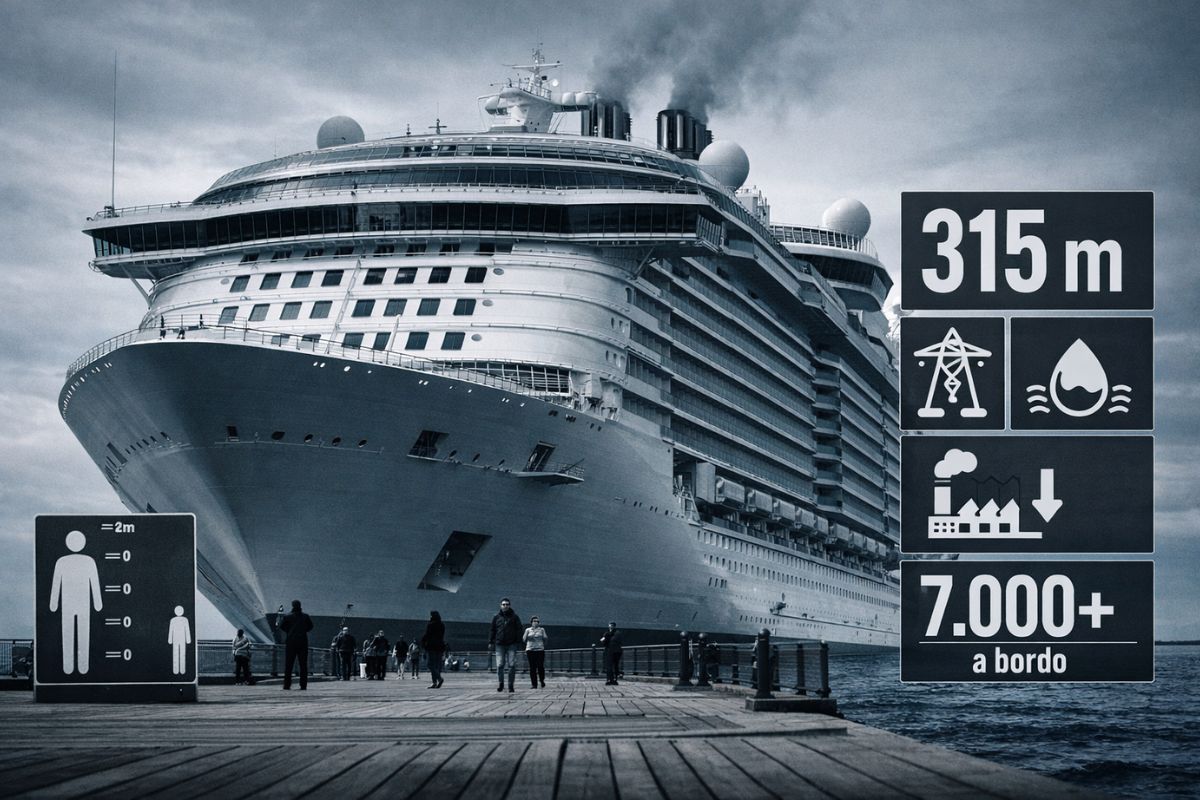


Ocean Giant Transforms That Produces Its Own Electricity, Desalinate Sea Water, Reduces Pollution, Cuts Fuel Consumption and Still Offers Maximum Comfort for Over Seven Thousand People Onboard in Long, Silent and Stable Ocean Voyages
After four years of research and construction and about 6 million hours of work, the ocean giant leaves the French shipyard of Saint-Nazaire as a cruise ship valued at €600 million, ready to welcome thousands of passengers on international cruises. The 315-meter long, 65-meter high and 80,000-ton ship has been designed from the first drawing as a self-sufficient floating city.
During this period, the STX shipyard integrated new technologies in hydrodynamics, electric propulsion, energy management, desalination, and emissions control to meet a strict schedule, with a daily penalty of €100,000 for delays. While the hull was still being assembled in steel blocks, the cabins were already sold months in advance, turning the delivery time of this ocean giant into a matter of industrial pride.
Construction of an 80,000-ton Floating City
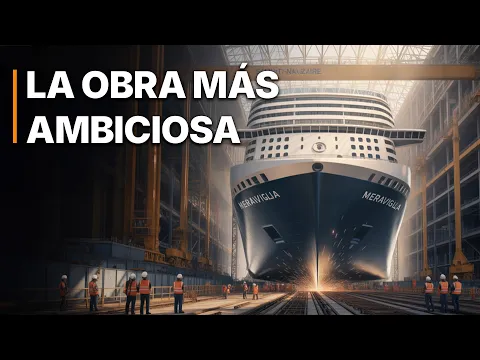
The ocean giant is born at the largest shipyard in Europe, in Saint-Nazaire, in a complex of 150 hectares with a dry dock capable of assembling two ships at the same time.
-
Millions of people have been eating yam for centuries without knowing that this humble tuber contains a compound called diosgenin, which scientists have now discovered can improve memory and help control blood sugar levels.

-
Scientists from an international project drill 1,800 meters of ice in Antarctica using hot water and discover details about one of the most intriguing places on planet Earth.
-
Seen from space, a colossal volcano nearly 5,000 meters high in Russia has released 1,600 km of smoke over the Pacific, forming “devil’s horns” of lava and revealing the brutal force of the Ring of Fire.
-
Expedition 501: Scientists drill into the ocean floor and discover a giant reserve of fresh water hidden beneath the sea, extracting nearly 50,000 liters and revealing an invisible system that could reshape the map of water scarcity.


There, 300,000 steel sheets arrive by train, are treated against corrosion, and cut by robots with a precision of one-tenth of a millimeter, to minimize waste and reduce the total weight of the hull.

These pieces transform into large structural blocks, pre-equipped with ventilation ducts, piping, and cables, which are then lifted by a 100-meter tall gantry crane, the most powerful in Europe, capable of lifting blocks of up to 100 tons.
With this machine, the shipyard shortens weeks to months of construction, assembling the ocean giant in just 40 months.
Welders work piece by piece, redoing any seam that is not perfect because one single crack can grow for meters and compromise the structure.
Quality control includes constant inspections since after the hull is assembled, it becomes much more difficult to correct.
In parallel, 100 kilometers of cables and a forest of piping are installed inside the panels, transforming raw steel into a city infrastructure.
Hull and Propeller Designed by Supercomputers

For the ocean giant to move with less fuel, the hull and bulbous bow were entirely redesigned using computational fluid dynamics (CFD) algorithms.
Engineers modeled over 150 hull shapes on a computer, simulated turbulence at each point, and only then built 13 or 14-meter models for tank testing, validating that the simulations were as accurate as physical sensors.
The bulbous bow generates a second wave that neutralizes the wave created by the bow itself, reducing water resistance by about 20 percent.
As a result, the ship requires much less energy to move forward, which translates to savings of hundreds of thousands of euros per year in fuel and fewer emissions.
The hull, optimized with the same system, accounts for half of the fuel consumption of a ship, which is why every curve has been calibrated to the limit.
Propellers That Rotate 360 Degrees and Reinvent Maneuvering
At the stern, the ocean giant abandons the traditional axis and adopts electric propulsion pods, giant capsules that combine motor, propeller, and rudder in a single unit.
Each electric motor delivers around 20 million watts, equivalent to seven thousand washing machines, propelling the ship at a maximum speed of 25 knots, even carrying 80,000 tons, equivalent to six thousand buses.
The propellers face forward, sucking in water and channeling the flow more efficiently. Each pod can rotate 360 degrees, allowing for asymmetrical maneuvers, such as one propeller at 90 degrees pushing sideways while the other pulls forward or backward.
This gives the ocean giant unprecedented turning capability, allowing it to dock at previously inaccessible ports with much more safety and precision.
At the bow, four cylindrical side thrusters complete the system, pushing the ship sideways to facilitate approaches and departures.
This entire set is managed by automatic power controls that distribute load among the motors in case of failure, preventing accidents such as giant waves caused by miscalculated forces in narrow ports.
Own Power Plant Fuels the Floating City
The heart of the ocean giant consists of four diesel engines that function as a true power plant, generating 11,000 volts at the bottom of the ship and distributing this energy to all levels, then reduced to 400 or 440 volts and finally to 230 volts at the cabin outlets.
There are 2,500 cabins, casinos, theaters, restaurants, entertainment systems, and technical areas, as well as the daily consumption of seven thousand people onboard, including passengers and crew.
This entire system needs to be turned on sequentially, like the human heart, so the ship can start operating its fire systems, bilge pumps, air conditioning, elevators, and navigation controls. The idea is simple and powerful: the ocean giant is a city that produces its own electricity in the open sea.
Mass Desalination and Real-Time Recycled Water
In terms of water, the challenge is monumental. Between swimming pools, showers, kitchens, and maintenance, the ocean giant needs about 200 liters of water per person per day, which means 1.4 million liters per day, equivalent to 5,600 full bathtubs.
Storing this amount for the entire trip would be impossible, in addition to making the ship too heavy.
Therefore, seawater is pumped close to the engines, where intense heat causes the liquid to boil, turning it into vapor.
This vapor is then condensed and passes through mineralizers, producing drinking water. The system can obtain 30 liters of fresh water for every 100 liters of salt water, using heat that would already be wasted, making the solution economical and ecological.
When the ship needs to stay docked for several days, a complementary reverse osmosis system kicks in, with highly sensitive membranes that separate salt and impurities from the water. The treated water returns to the ship’s internal potable network.
In parallel, all wastewater goes through treatment stations so rigorous that they would be accepted even in areas of extreme protection, like Alaska, and the toxic sludge is stored onboard until disposed of at proper facilities on land.
Protection Against Invasive Species and Air Pollution
To maintain the ship’s balance, ballast tanks are filled and emptied with seawater during the journey, according to fuel consumption and weight distribution.
This water can carry invasive species and dangerous bacteria, which is why the ocean giant treats the contents of the tanks with filtration and ultraviolet light chambers, eliminating living organisms before the liquid is returned to the ocean.
The gases from the diesel engines, fueled by heavy and highly polluting fuel oil, pass through a system of sprayers that act like a giant shower, washing the smoke with seawater and reducing up to 97 percent of the sulfur dioxide emitted by the chimney. The resulting sludge is neutralized and stored.
Subsequently, computational simulations define the ideal slope of the chimneys and the opening of holes for cold air intake, so that the smoke does not fall over the external areas where passengers walk and sunbathe.
Extreme Comfort: Less Wind, Less Vibration, and No Nausea

The aerodynamics of the ocean giant has been studied so that, adding a headwind of 20 knots and the speed of the ship, the feeling of relative wind on the deck does not become unbearable.
Large panels divert the airflow away from passengers, and the external shape has been adjusted on a computer to minimize uncomfortable gusts in leisure areas.
Inside the ship, floating floors, acoustic insulation in ceilings and partitions, and decoupling between metallic surfaces reduce noise and vibrations to a minimum.
The goal is clear: the passenger should not hear the engine or the kitchen while dining, and should not feel vibration even at maximum speed. During testing, sensors are installed at critical points to locate vibrating pipes; a small piece of rubber in the right place is enough to eliminate the problem.
To combat nausea, enormous stabilizers shaped like airplane wings, with up to 17 square meters, are activated when the ship leaves the port.
These surfaces continuously move, generating forces opposite to the waves’ roll, in a way that is almost invisible to those onboard.
When the speed drops below six knots, the stabilizers retract to avoid obstructing delicate maneuvers in port.
Maximum Safety in Case of Fire and System Failure
Fire is treated as the ship’s greatest enemy, both in construction and operation. Therefore, the ocean giant is compartmentalized into independent zones, each with its own power and service systems.
Even if one section is lost, the others remain powered, reducing the chance of total collapse in case of a serious accident.
Fire detection systems are tested shortly after the power plant becomes operational, still in the dock. Many equipment are duplicated, ensuring redundancy, and the insulation used against noise also helps contain the spread of flames.
Everything is designed so that the floating city remains operational even under heavy stress.
Launch, Open Sea Testing, and the Future of Ocean Giants
When the hull is ready, the dry dock is flooded and the ship floats for the first time, towed by four to ten tugboats depending on size.
This stage only happens with maximum tide coefficient and favorable weather conditions, since any mistake in the exit maneuver would pose a risk to the ship and the shipyard.
Then, the colossus is taken to the finishing dock, where it stays for several months while thousands of workers finalize interiors and systems.
During sea tests, the ocean giant sails in cruise configuration, at maximum speed, while technicians measure background noise in the cabins and vibrations at different points.
Extreme maneuvers are conducted, such as emergency stops with one of the four engines turned off, to check how the system automatically redistributes the load among the others.
Only after passing this battery of tests is the ship delivered to the shipowner, who already has tickets sold six months in advance.
The shipyard’s experience with this project serves as a basis for a new generation of even more economical, ecological, and connected vessels, featuring cleaner electric propulsion, even more efficient water systems, and, in the future, even the prospect of large cruises powered by solar energy and alternatives to diesel engines.
And you, would you dare to spend an entire week traveling in open water inside this ultra-technological and ecological ocean giant?








Los periodistas amenudo tienen problemas con los números. 80 toneladas es el peso de un pesquero pequeño. Supongo que serán 80.000 toneladas.
Alguien dice que debe ser espectacular. Pues no lo sé, con 80 Tn es como un remolcador pequeño o barco de pesca
Cual es el fabricante de los motores ?