





 English
  Francês
  Alemão
  Italiano
  Japonês
  Norueguês
  Portuguese
  Spanish
  5 min of reading
  0 comments


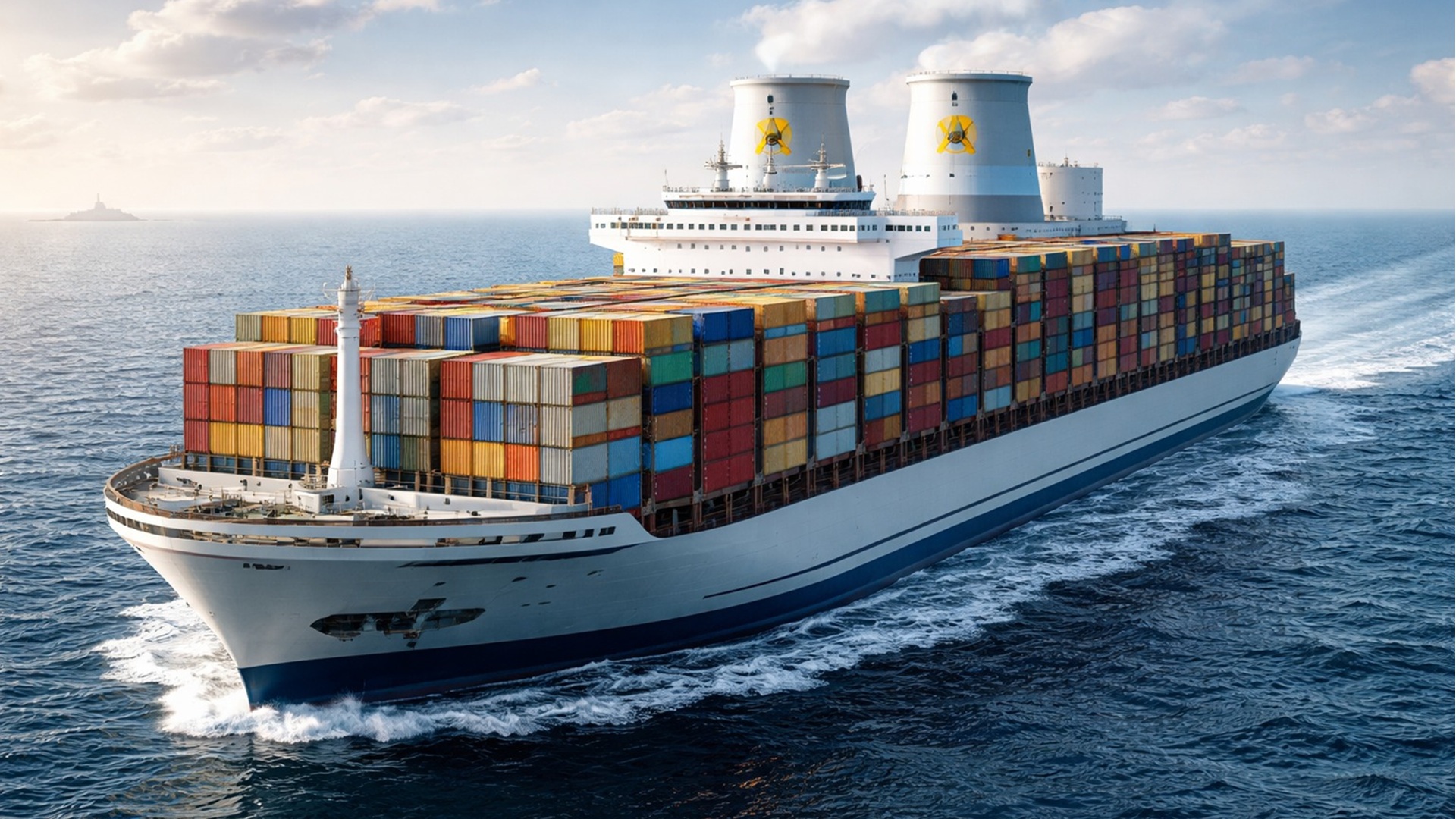
Partnership Between South Korean HD Hyundai and the American Bureau of Shipping Seeks to Develop the World’s First Nuclear Energy-Powered Container Ship, Designed to Carry Up to 16,000 TEUs and Operate on Global Commercial Routes with Electric Propulsion Based on Modular Reactors
The South Korean company HD Hyundai announced on March 9 an agreement with the American Bureau of Shipping to develop the conceptual design of the world’s first nuclear-powered container ship, with a planned capacity of 16,000 TEUs for commercial cargo transport.
The joint development agreement was signed at the Global Research and Development Center of HD Hyundai, located in Bundang, Gyeonggi Province, South Korea. The partnership aims to advance the study of electric propulsion systems coupled with nuclear energy applied to large container ships.
According to the organizations involved, the goal is to assess whether nuclear energy can provide a reliable and efficient source for long-distance maritime transport. The concept aims to support the operation of global trade routes with ships capable of carrying tens of thousands of containers.
-
Hormuz Strait: Hundreds of Ships and Oil Tankers Stranded After Attacks in the Middle East
-
World’s Largest Electric Ship, China Zorrilla, Will Connect Argentina and Uruguay Across the Río de la Plata with a $200 Million Investment and Operations Planned for 2026
-
How A 20-Ton Anchor Holds 200,000-Ton Ships Even Under Extreme Winds And Why It Fails In The Deep Ocean
-
China Launches 10,000-Ton Electric Container Ship with 19,000 kWh in Interchangeable Batteries and Autonomous Navigation for Coastal Trade Routes

Development of the Nuclear Container Ship Concept
The joint project envisions creating a concept for a container ship with a capacity of 16,000 TEUs using electric propulsion coupled with nuclear energy. This type of vessel can transport large volumes of cargo on international ocean routes.
The technical teams from both organizations will work on developing the basic engineering design necessary for this type of vessel. Areas analyzed include electric propulsion systems, the selection of electrical equipment, and the layout of the ship’s main energy systems.
The goal is to evaluate how nuclear energy can be applied to large container ships operating on long-distance routes. If the concept is feasible, the system could replace conventional engines powered by fossil fuels.
Use of Small Modular Reactors on the Container Ship
One of the central elements of the project is the use of Small Modular Reactor technology, known by the acronym SMR. These compact nuclear reactors can generate about 100 megawatts of power, equivalent to approximately 134,000 horsepower.
Due to their smaller size and modular construction, these reactors can be more easily integrated into new industrial applications. Engineers from both organizations will study how these systems could meet the high energy demands of a container ship operating on long ocean routes.
The studies include analyzing how these reactors could power electric propulsion systems and ensure continuous energy supply during prolonged sea voyages. The intention is to verify if the concept can meet the energy needs of large cargo ships.
Energy and Propulsion Systems Foreseen in the Project
In addition to the nuclear source, the project includes the development of a specialized energy management system. HD Hyundai intends to create a system specifically designed for large container ships using electric propulsion coupled with nuclear energy.
These ships require a constant energy supply to maintain high cruising speeds and power the various operational systems onboard. Efficient energy management is considered essential for the continuous operation of the vessel.
The concept also envisions a configuration with a twin-screw propeller. In this system, two propellers operate simultaneously, increasing the thrust and maneuverability of large cargo vessels operating in ports or narrow channels.
Another feature of the project is the direct drive propulsion system. In this model, the electric motor is directly connected to the propeller, reducing mechanical losses that typically occur in power transmission.
Expanded Capacity for Refrigerated Containers
The new container ship proposal also includes the possibility of carrying a larger number of refrigerated containers, known as reefer units. These containers are used to transport frozen or chilled cargo.
The operation of these units requires a high consumption of electrical energy to maintain controlled temperatures during transport. With a high and constant energy supply, the ship could operate with a greater number of these specialized containers.
According to the presented concept, this could offer greater flexibility for maritime transport operators dealing with temperature-controlled cargo. The planned energy system would allow for this additional electricity demand.
Safety and International Certification of the Project
Safety is highlighted as one of the central points in the development of the nuclear-powered container ship project. The work includes integrating safety standards directly into the vessel’s design.
Engineers plan to develop systems capable of maintaining safe operations even in extreme situations, such as collisions or flooding. These protective mechanisms are part of the initial development stage of the concept.
Classification societies such as the American Bureau of Shipping are involved in the process evaluating the ship designs. These independent organizations verify if the vessels meet international safety and performance standards before they are put into operation at sea.
The energy systems foreseen in the project must also comply with global standards set by the International Maritime Organization and nuclear safety guidelines from the International Atomic Energy Agency.
Matthew Muller, ABS Commercial Director for East Asia, stated that the collaboration represents an important project to verify the application of electric propulsion systems powered by nuclear energy in large container ships.
According to him, the combination of HD Hyundai’s shipbuilding technology with ABS’s experience in maritime safety engineering will allow for the assessment of safety, efficiency, and environmental impacts of the proposed propulsion solutions.
Shim Hak-moo, head of the Design Division of HD Hyundai Samho, stated that vessels with electric propulsion coupled with nuclear energy represent an innovative technology for achieving net zero emissions.
HD Hyundai first presented its concept of a nuclear container ship at the Nuclear Maritime Summit held in Houston in February last year. Subsequently, the company received Approval in Principle from ABS for the propulsion concept during Gastech 2026, indicating progress in the development of the project.









Seja o primeiro a reagir!