





 Portuguese
  English
  Spanish
  5 min of reading
  0 comments


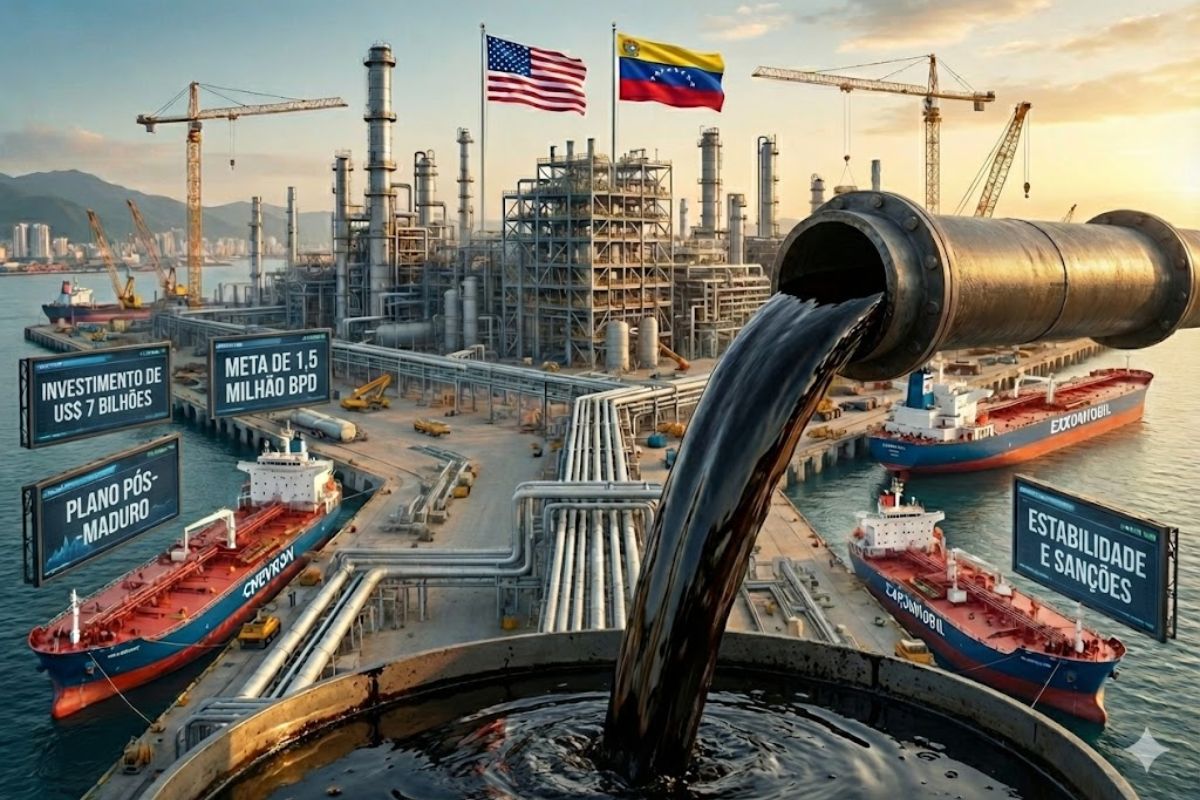
Donald Trump Described a Scenario in Which American Oil Companies Would Enter Venezuela After Nicolás Maduro’s Exit, Invest Billions, and Resume Revenue Generation. The Problem Is That the Local Industry Is Declining, the Infrastructure Is Fragile, and a Relevant Recovery Tends to Take Years and Tens of Billions.
Revitalizing Venezuela’s oil industry will not be easy or cheap. Donald Trump painted a picture over the weekend in which American oil companies would dive into the country following Nicolás Maduro’s ouster, “spending billions of dollars,” fixing “severely damaged” infrastructure, and resuming revenue generation.
The promise has political and economic appeal but faces formidable challenges: sanctions, legal risks, instability, technical bottlenecks, and a need for capital that cannot be resolved with an announcement. Even in a favorable political scenario, the substantial reconstruction of the sector is likely to take years and require tens of billions of dollars in investments.
What Trump Is Promising in Practice
The idea being sold is simple: change the political environment and create space for a “return” of U.S. oil companies, with money, technology, and management capacity to recover oil fields, pipelines, and refineries.
-
Offshore industrial demand in Macaé skyrockets with the recovery of oil and gas and could grow by up to 396% by 2026 in the Campos Basin.
-
Offshore industrial demand in Macaé surges with the recovery of oil and gas and could grow by up to 396% by 2026 in the Campos Basin.
-
Brazilian giant expands borders in the Southeast: Petrobras confirms new oil discovery in ultra-deep waters in the pre-salt of the Campos Basin.

-
Alert in the global energy market: Severe tropical cyclone hits the coast and disrupts gas production at major plants in Australia, threatening global supply.


In theory, this could reposition Venezuela as a major supplier and return to the state a significant source of cash.
The catch is that the promise mixes two different stages. The first is political: changing power and removing formal barriers, including sanctions.
The second is industrial: rebuilding a production, transportation, and refining chain that has degraded over the years.
The first can occur through decision and negotiation. The second depends on engineering, equipment, personnel, logistics, and, above all, time.
Why “Arriving with Billions” Won’t Quickly Translate into Production
In oil, the gap between investment and results is usually long. Even when there is reasonable infrastructure, increasing production requires drilling plans, maintenance, well recompletion, secondary recovery, purchase of pumps and compressors, as well as specialized contractors.
In a sector described as “decaying,” the challenge is greater. The infrastructure may be so degraded that part of the investment will only serve to “get back to basics”: reliable electricity, industrial water, replacement parts, measurement systems, operational safety, and evacuation capacity.
Without these, increasing production remains stalled, even if oil is beneath the ground.
There is also a point that investors do not ignore: when the base is deteriorated, the risk of accidents, stoppages, and losses rises.
And high risk increases the cost of capital, scares off suppliers, and extends timelines.
Sanctions and Instability: The Brake That No One Overcomes Willingly
The crux of the problem is political. Sanctions and operational restrictions complicate contracts, payments, insurance, international trade, and access to equipment.
Even companies willing to enter need predictability so as not to jeopardize their investments halfway through.
Moreover, the risk is not just “whether one can operate,” but “whether the rules will change.” The oil sector relies on long contracts and slow amortization.
Any doubt about stability, arbitration, the validity of concessions, and legal security directly weighs on investment decisions.
In other words: without a predictable environment, the promise of “billions” becomes a headline but not a signature.
Who Could Advance First and Why This Still Doesn’t Solve Everything
The main text itself acknowledges a relevant point: some Western producers with existing operations or agreements could expand relatively quickly if political conditions were favorable.
This is the “short-term scenario”: those who already know the terrain, have assets and contracts, are more likely to reactivate part of the operation with less friction than a newcomer.
The problem is that this usually generates incremental gains, not a complete transformation.
For a structural turnaround, greater needs come into play: rehabilitating mature fields, recovering refineries, modernizing logistics, and ensuring continuous supplies and maintenance.
This is where the “years” and “tens of billions” mentioned in the material come into play.
Infrastructure as a Main Character: The State of the Sector Sets the Pace
When Trump speaks of “fixing severely damaged infrastructure,” he touches upon the most costly aspect of the project.
Infrastructure is what makes oil marketable: without collection, treatment, storage, pipelines, terminals, and refining or export capacity, the barrel remains stuck.
And infrastructure cannot be repaired with a single contract. It typically involves multiple simultaneous fronts:
- recovery and maintenance of pipes and pumping stations
- reactivation of units in refineries and auxiliary plants
- replacement of parts and control systems
- recomposition of technical teams and safety protocols
- evacuation capacity and port logistics
If any link fails, the entire operation loses productivity. Hence, “investing billions” is often just the beginning of the calculation, not the end.
The Risk of “Quick Promise” Turning into Quick Frustration
Politics loves promises with short deadlines. Oil rarely delivers at the same pace.
This difference in timelines is an additional risk: if the rhetoric sells an immediate recovery and the results take time, the political cost rises, and the project’s stability may decline.
And for private companies, what matters is not the rhetoric, but the governance of the project: executable contracts, investment protection, clear export and revenue repatriation channels, in addition to tax and regulatory rules that are not rewritten with each crisis.
If Venezuela becomes a battleground for disputes, companies will do what they do anywhere: hold back on capex, delay decisions, and keep production as is.
What Venezuela Would Gain and What the Market Would Demand in Return
If reconstruction advances, Venezuela could gain revenue, jobs, tax collection, and energy relevance.
For the market, it could mean additional supply in the medium term and a significant shift in regional dynamics.
But this “gain” comes with an implicit demand: a package of predictability. This includes operational rules, export, payments, and contractual rights, as well as an operational safety environment.
Without this, the equation tends to become imbalanced: expensive capital, long timelines, and uncertain returns.
Do you believe that a political change would be enough to truly unlock tens of billions in investments in Venezuelan oil?








-

Uma pessoa reagiu a isso.