





 Portuguese
  English
  Spanish
  6 min of reading
  0 comments


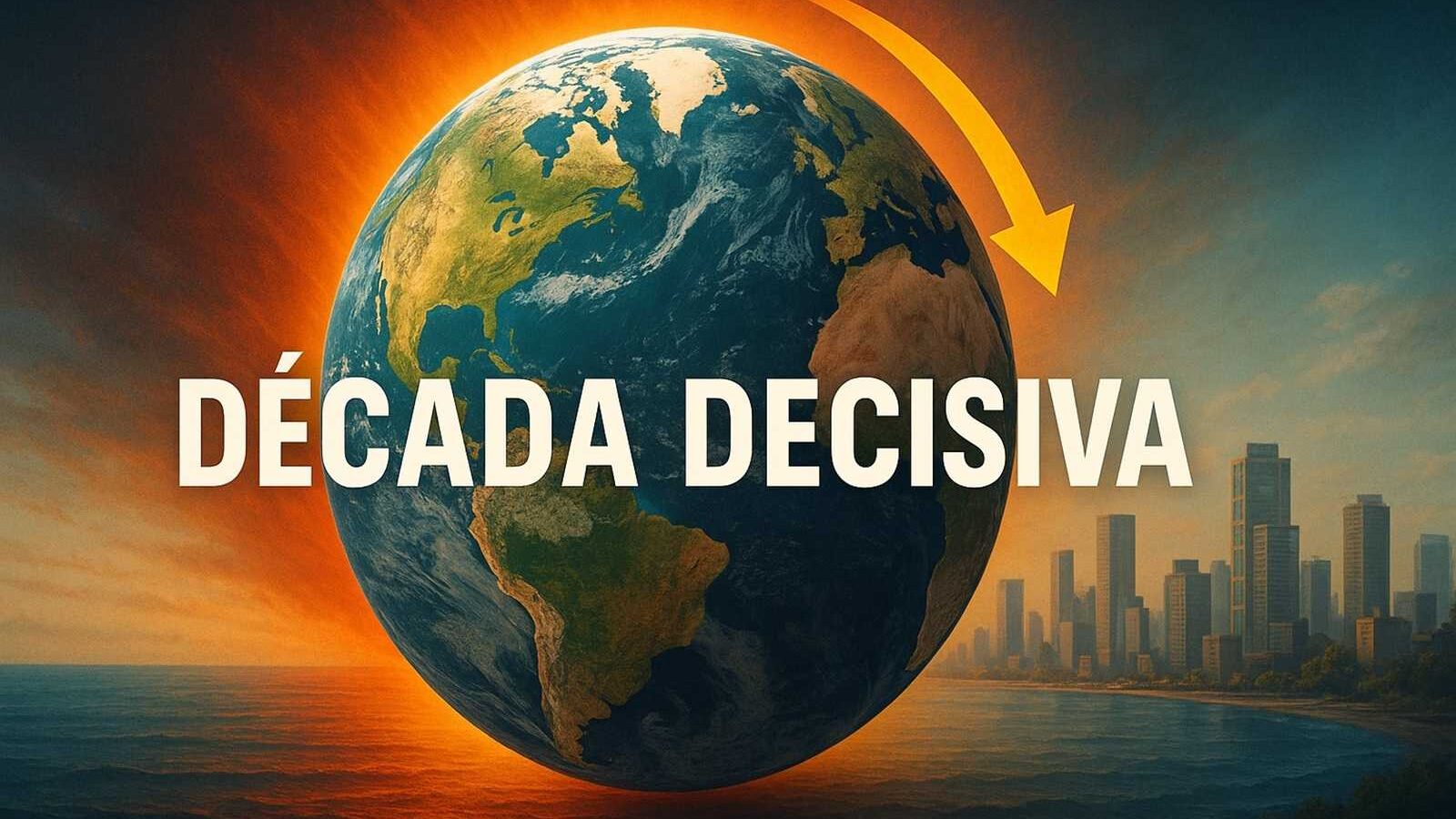
Half a Century After the “Limits to Growth” Study, New Analyses Show That Humanity Is in a Decisive Decade to Avoid Global Decline.
In 1972, the Club of Rome released “Limits to Growth.” The publication used the World3 computational model to simulate how five interactive forces would shape the future: population, industrial production, food production, resource use, and pollution.
The main message was clear: if the world followed a path of unchecked growth, humanity would exceed the planet’s capacity, leading to inevitable declines in the 21st century.
Besides the warning, the book also showed alternatives. A managed transition, based on population stabilization, consumption control, and investments in efficiency, could ensure sustainable living standards.
-
Motorola launched the Signature with a gold seal from DxOMark, tying with the iPhone 17 Pro in camera performance, Snapdragon 8 Gen 5 that surpassed 3 million in benchmarks, and a zoom that impresses even at night.

-
Satellites reveal beneath the Sahara a giant river buried for thousands of kilometers: study shows that the largest hot desert on the planet was once traversed by a river system comparable to the largest on Earth.

-
Scientists have captured something never seen in space: newly born stars are creating gigantic rings of light a thousand times larger than the distance between the Earth and the Sun, and this changes everything we knew about stellar birth.

-
Geologists find traces of a continent that disappeared 155 million years ago after separating from Australia and reveal that it did not sink, but broke into fragments scattered across Southeast Asia.
The work was controversial, but it ultimately shaped the modern conversation about planetary boundaries and the need for change.
The 2020 Verification
Nearly five decades later, analyst Gaya Herrington revisited the model.
Published in the Journal of Industrial Ecology in 2020, her study compared World3 scenarios with real data on population, production, mortality, fertility, resources, and human well-being.
The conclusion was unsettling. The world was following a path close to “business as usual,” meaning the continuity of growth as the primary goal.
In this scenario, the model pointed to declines in agricultural production, industrial capital, and well-being throughout the century. Herrington emphasized that this was not a catastrophic prediction, but a structural warning.
According to her, the crisis could intensify as early as the next decade, with deeper impacts by 2040.
Even unprecedented technological advances would not be enough, as unlimited growth amplifies stress when ecological limits are breached.
Implications of the Study
Herrington conducted the research independently as part of her master’s degree at Harvard. KPMG, where she worked, published the study, but it was not a corporate report. The method was simple: compare real data with World3 feedback curves.
The result showed that the pattern identified in 1972 still described the current world. Growth without structural adjustment inevitably leads to a phase of excess followed by decline.
The 2022 Update
Two years later, in May 2022, Herrington published further reflections. In the text “What a 50-Year Global Model Tells Us About the Path Forward Today,” she reinforced that the data were still aligned with multiple scenarios. The crucial detail is that more significant divergences would arise after 2020.
This means that we are exactly in the window of choices that will define the future. The scenario called “Stabilized World” appears as a viable alternative. In it, society shifts its goal from maximizing industrial production to resource efficiency, pollution control, and strengthening health and education services.
Herrington pointed out that the real world was not clearly following this direction yet, but it was also not too far off. It was a chance of “now or never.” The central question is whether humanity will manage to abandon growth as the organizing principle.
The Bases of a Balanced Future
The difference between decline and stability is not abstract. It depends on the ability to redefine priorities around human and ecological well-being. Herrington also cited the book “Earth for All,” published in 2022 by the Club of Rome, as a practical guide for transformation.
The message was direct. The decisions made this decade will shape life until the end of the century. If we change our goals and investments, it is still possible to achieve better outcomes.
The Model Recalibration
After Herrington’s work, a new team returned to World3. The question now was different: if the parameters were updated with modern data and greater computing power, would the results change?
The research, conducted by Nebel and colleagues and published in the Journal of Industrial Ecology, recalibrated the model without altering its basic structure. The goal was to align the parameters with the most recent evidence.
The result, however, was similar. Even with adjustments, the system still pointed towards “overshoot and collapse.” Industrial production would begin to fall in the mid-2020s. The population would start to decline from 2030. Food production would peak during this time, suggesting that technological gains might raise the limit, but could also deepen the drop once it was exceeded.
Environmental Impacts and Well-Being
The environmental impacts were also reassessed. Persistent pollution was below the original standard trajectory, but the recalibration indicated that its effects could last longer, generating higher cumulative levels.
Another relevant data point was the “human development” curve. Interpreted by Joachim Klement, this curve suggests that the present is close to a global peak. If nothing changes, the average well-being may fall to levels comparable to those of 1900 by the end of the century.
The authors warned that the feedbacks of an expanding system are not the same as those of a declining system. This means that the nature of the collapse may be different from what the model predicts. But the main message is clear: the interruption of exponential growth primarily stems from resource depletion, with an interconnected recession expected between 2024 and 2030.
The Convergence Point
When combined, the studies by Herrington and Nebel et al. reach similar conclusions. The former showed that the original scenarios still describe the current world. The latter confirmed that even with richer data, the structural dynamics remain the same.
Both reinforce that, without changing objectives, we will continue towards unsafe limits, with simultaneous declines in production, food, and well-being.
What We Have Learned So Far
The 1972 model still explains the situation. Herrington showed that the recent trajectory closely followed the scenario of reckless growth. Her 2022 reflection made it clear that choices made after 2020 are decisive.
Meanwhile, the recalibration by Nebel et al. reinforced that intensifying the same pattern is futile. The strategy of “more of the same, only faster” does not solve the issue. On the contrary, it transforms temporary solutions into new fragilities.
A Narrow Window of Action
The emerging message is simple yet urgent. The path to stability is not a fantasy, but rather the result of the same feedback structure that generates collapse in another context. By changing objectives, it is possible to redirect cycles to strengthen resilience.
This path requires fewer resources per unit of well-being, investments in pollution reduction, and expansion of social services. Health and education appear as factors that enhance quality of life without relying on constant increases in material production.
Precision on Uncertainties
The studies do not state when exactly each country will feel the effects. The World3 model operates with global dynamics. They also do not deny the importance of technology. On the contrary, it can postpone peaks and expand limits.
But there is a risk: without structural change, these technological gains could lead to harsher overshoots. Dennis Meadows, co-author of “Limits to Growth,” had already warned that higher peaks lead to sharper falls.
Herrington emphasized that technology aimed at the same growth objective keeps us on the wrong curve. When applied for efficiency, damage reduction, and human development, it can lead to a scenario of stability.
The recalibration also highlighted that systems in decline reorganize in ways that the original model does not foresee. This is not a reason to dismiss the warning. On the contrary, it reinforces the need to act sooner, when there is still room for maneuver.
The Decisive Decade
The set of studies does not indicate collapse as inevitable. It shows that it is a real risk if we maintain the same objectives. Avoiding it depends on choosing new priorities.
If the world insists on unlimited growth, the data suggests that it will enter a phase of decline as early as this decade. But if it adopts the “Stabilized World,” there is still a chance to achieve a balance between human well-being and planetary limits.








Seja o primeiro a reagir!