





 English
  Francês
  Alemão
  Italiano
  Japonês
  Norueguês
  Portuguese
  Spanish
  6 min of reading
  0 comments


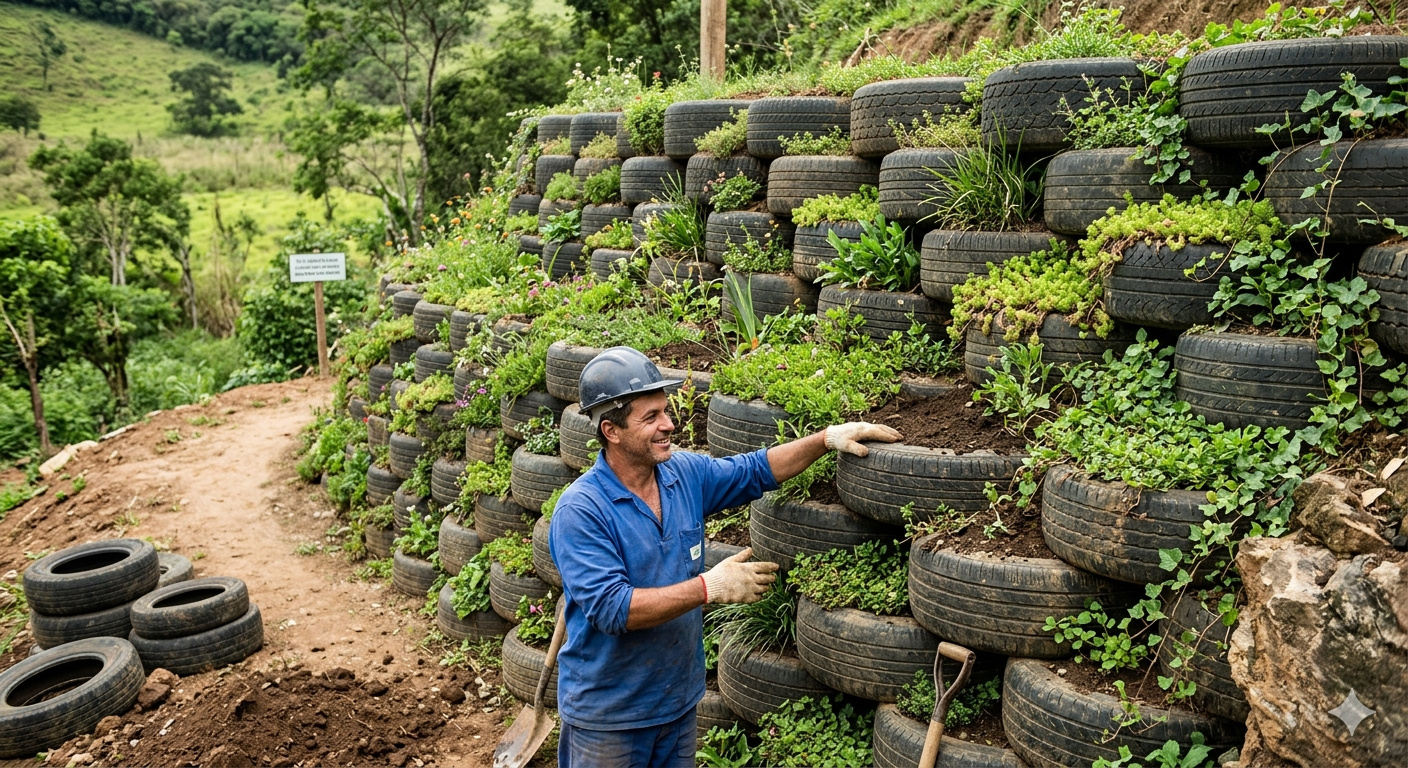
Ecological retaining wall with recycled tires: see how to do it step by step, reduce costs and ensure soil stability with an efficient technique.
The ecological retaining wall with recycled tires has gained traction as an efficient, low-cost, and highly functional solution for soil retention on sloped terrains. The technique, which uses discarded tires filled with compacted earth, allows for the construction of resistant, durable, and sustainable structures, significantly reducing costs compared to traditional concrete walls. As demonstrated in practice by the builder, the structure can remain stable for years when executed correctly, even on terrains with steep slopes.
How the ecological retaining wall with recycled tires works
The principle of the retaining wall with tires is simple but requires correct technical execution. The tires are positioned horizontally and filled with compacted earth, forming a heavy and stable structure that resists soil pressure.

Unlike a conventional wall, the system works by weight and friction, where each tire acts as a structural block. The compaction of the earth inside the tires transforms the set into a rigid mass, capable of containing the lateral pressure of the terrain even in areas with a significant slope.
-
For 45 years, Spain and Morocco have been trying to connect Europe to Africa through a project of just 14 kilometers in the Strait of Gibraltar, and an active tectonic fault on the seabed continues to make the project nearly impossible.

-
Goodbye expensive water tank: residents replace traditional system with a cheaper and more efficient solution that reduces water consumption and reuses rainwater.

-
Mexico is building a 300-kilometer railway corridor that connects the Pacific to the Atlantic in just seven hours and wants to compete directly with the Panama Canal, which is already facing water scarcity issues.

-
The largest tunnel module factory in the world was built from scratch on a beach in Denmark to produce 89 concrete blocks and will be demolished after the project: each structure weighs up to 10 times the Eiffel Tower and will be installed on the bottom of the Baltic Sea with an accuracy of 12 millimeters in a tunnel that will halve the travel time between Hamburg and Copenhagen.


Another essential point is that the retaining wall should not be completely straight. As shown in practical execution, the structure needs to have a slight inclination towards the slope. This detail increases resistance capacity and prevents soil pressure from pushing the wall forward.
Initial steps: cleaning the area and preparing the base
Before starting construction, the first step involves a complete cleaning of the area, removing vegetation, roots, and any material that could compromise the stability of the base.
The timing also makes a difference. Working after rainy periods facilitates the process, as the soil becomes softer, allowing for easier excavation and leveling. This operational detail directly impacts the productivity of the work.
After cleaning, it is necessary to create a slightly excavated base to accommodate the first tire. This base should be leveled, but already considering the strategic inclination of the retaining wall, which will be fundamental for the stability of the structure over time.
How to properly position and level the tires
The positioning of the tires is one of the most critical steps. The first tire should be placed on a previously adjusted base, ensuring that it is firm and partially inclined towards the inside of the terrain.
The use of a level is recommended to avoid misalignments, but it is not about making the piece completely straight. On the contrary, the slight inclination is intentional and necessary to increase structural resistance.

Another important factor is the choice of tires. Larger models facilitate faster height gain, but require a greater volume of earth and effort in compaction. Smaller tires demand more units, but are easier to handle.
The combination of different sizes can be used, as long as the fit between them is well planned, avoiding empty spaces that could compromise the performance of the retaining wall.
Compaction of the soil: the secret to the resistance of the retaining wall
The compaction of the soil inside the tires is the most important point of the entire process. It is not enough to just fill the tires — it is necessary to compress the soil in layers to eliminate empty spaces.
The process is done manually, gradually adding soil and pressing with tools or with one’s own body weight. This compaction transforms the set into a rigid and stable structure.
If this step is neglected, rainwater can infiltrate and remove the soil, weakening the retaining wall and increasing the risk of collapse. Therefore, each tire must be completely filled and compacted before the installation of the next one.
Over time, the compacted soil tends to consolidate even more, acquiring characteristics similar to a solid mass, which increases the durability of the structure.
Layered construction: how to ensure stability over time
After the installation of the first row, the following tires should be positioned in an alternating manner, creating a locking effect between the layers.
This technique distributes loads better and prevents displacements, functioning similarly to structural systems used in masonry and geotechnical engineering.


Each new layer should follow the same pattern: correct positioning, slight inclination towards the slope, and complete compaction of the soil. This repetitive process is what ensures the stability of the wall over the years.
In cases of very high terrains, the retaining wall can reach several meters in height, as long as these steps are followed and the appropriate structural logic is maintained.
Safety and essential care during execution
The construction of an ecological retaining wall involves risks, especially on elevated terrains. Working at height requires extra attention and, whenever possible, the use of safety equipment.
Additionally, there is a specific care related to the material used. Tires are made of rubber, which can burn under extreme conditions. Therefore, keeping the area clean, free of dry vegetation buildup, is essential to prevent fires.
Another important recommendation is to avoid using chemical products such as herbicides near the retaining wall, as the drying out of vegetation can increase the risk of fire.
In some cases, a superficial layer of concrete can be applied for protection, as long as it does not impede the natural drainage of soil moisture.
Where to get recycled tires and reduce costs even more
One of the great advantages of this technique is the virtually zero cost of the main material. Discarded tires can be obtained from tire shops, workshops, and automotive centers.
Many of these establishments even pay to dispose of tires, making the removal free, which is a benefit for both parties. This transforms the project into a solution that is not only economical but also environmentally responsible.
The reuse of these materials reduces the volume of waste discarded in the environment and contributes to more sustainable practices in civil construction.
Why the retaining wall with tires can last for years
When executed correctly, the ecological retaining wall with recycled tires can remain stable for many years, even under adverse conditions.
The combination of weight, compaction, and strategic inclination creates a structure capable of resisting soil pressure and climatic variations. As demonstrated, structures of this type can remain intact for over four years without showing structural failures.
Moreover, maintenance is simple: keeping the area clean, avoiding excessive infiltrations, and ensuring that vegetation does not compromise the structure are sufficient measures to prolong the lifespan of the retaining wall.
Is the ecological retaining wall worth it?
The retaining wall with recycled tires consolidates as a viable alternative for those looking to reduce costs without sacrificing efficiency. The technique combines sustainability, low investment, and structural functionality, being especially useful in rural areas, small farms, and terrains with steep slopes.
By reusing materials that would be discarded and applying simple engineering principles, it is possible to build a robust, durable structure adapted to the needs of the terrain.
When well executed, the result goes beyond savings: it delivers a practical, efficient solution aligned with sustainable practices in construction.










Seja o primeiro a reagir!