





 English
  Francês
  Alemão
  Italiano
  Japonês
  Norueguês
  Portuguese
  Spanish
  4 min of reading
  0 comments


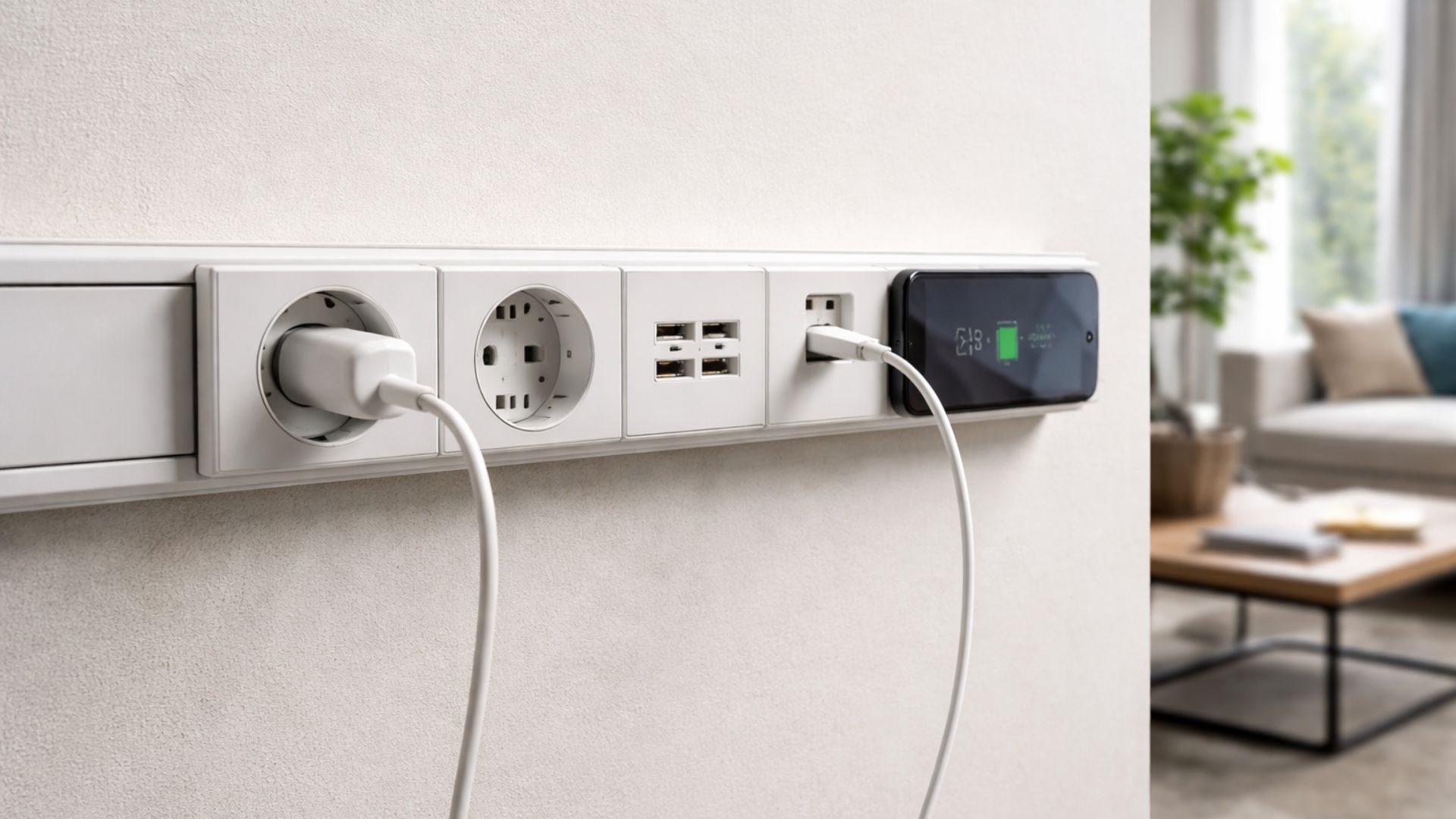
Modular electric solution gains space with quick installation, discreet design, and USB-C integration, allowing the reorganization of power points without renovations and reducing the use of extensions in increasingly connected homes.
Surface modular sockets are advancing in Spain as an alternative for those who need to redistribute power points without opening walls, generating debris, or relying on extensions scattered throughout the house.
The movement accompanies the multiplication of electronics in daily use and the search for more flexible solutions, with simplified installation and a more discreet appearance.
What are modular sockets and how do they work
Instead of the traditional fixed model, these systems work with a base installed on the wall, ceiling, or other surfaces, to which different modules are attached according to the needs of the environment.
-
Norsul achieves CAP 1 classification with the chemical ship Taruca after dry docking and reinforces operational excellence in maritime transport.

-
China discovers a mega reserve with 10.4 million tons of rare earths and could redefine global dominance in technology, clean energy, and the military industry with 27.1 million tons of fluorite and 37.2 million tons of barite.

-
China began working on 6G in 2019 when commercial 5G barely existed and now leads the world in patents for a technology that promises speeds 100 times greater, and no country wants to be left out.

-
Around 500,000 abandoned coal mines could be turned into giant batteries using only sand and gravity, studies indicate a potential of up to 70 TWh of storage, with China, India, and the USA concentrating enough capacity to power entire cities without needing to build anything new.


The proposal is simple: bring electrical power and connectivity to where they are truly needed, with the possibility of later reorganization.
In practice, the set can include Schuko standard sockets, USB or USB-C ports, and, in some lines, connected features for home control.
Manufacturers operating in the Spanish market offer combinations of this type in catalogs aimed at homes and renovations, which helps explain why the solution has gained recent visibility.
More devices, fewer sockets: pressure for change
Interest is growing especially in living rooms, home offices, kitchens, and bedrooms, where a single socket can no longer accommodate televisions, routers, speakers, laptops, monitors, phones, and small appliances.
When these devices accumulate on old power strips or makeshift extensions, the result is usually less organization, more visible cables, and a greater margin for improper use.
This type of installation stands out because it shifts the logic of heavy renovation to a much lighter intervention.
Instead of tearing into masonry to embed new points, the cabling can follow conduits or surface structures that hide the wires and preserve the wall, with finishes designed to better integrate into the environment.
Flexibility to reorganize the home without renovation
Modularity also changes the relationship of the home with its own electrical installation.
If the work desk moves from the bedroom to the living room, or if a corner of the home becomes an office, study area, or entertainment space, the system can be reconfigured more easily than in a fully embedded solution.
Another central point is the incorporation of USB-C ports directly into the sockets or charging modules.
This integration reduces the need for external adapters and frees up space for other equipment.
Additionally, some connected lines allow for the addition of wireless controls, remotely actionable sockets, and consumption monitoring through the manufacturer’s application.
These features bring these installations closer to the realm of home automation.
Electrical safety and reduction of extension use
The promise of practicality, however, does not eliminate the requirement for safety.
The Spanish regulatory framework for low voltage installations establishes criteria to preserve the safety of people and property and ensure the normal functioning of installations.
Therefore, although surface mounting can be quick, the connection to the main point, the sizing of the circuit, and the assessment of available power should not be treated as details.
The adequacy of the installation remains subject to technical standards, even in modular systems.
Manufacturers explore precisely this combination of convenience and protection.
There are lines with protective shutters, grounded bases, connected versions for load management, and models prepared for surface installation in areas that require greater protection against water and dust.
In this scenario, the main domestic advantage may lie less in visual appeal and more in the rational redistribution of power points.
When each zone of the house has sockets closer to actual use, the dependence on power strips, long extensions, and overloaded strips behind furniture decreases.
Discreet design and adaptation to different environments
Aesthetics also play a role.
Instead of visible improvisation, these systems tend to rely on linear profiles, neutral colors, and compact modules, which favor partial renovations and adaptations in rented properties or second homes.
The logic is to solve the deficit of sockets without turning the electrical intervention into an extensive and costly project.
The expansion of this market in Spain aligns with a broader trend of electrification in daily life.
The home has come to concentrate work, entertainment, connectivity, and device charging throughout almost the entire day.
The more functions accumulate in the same space, the greater the pressure for an electrical distribution that keeps up with this change without resorting to permanent temporary solutions.
Still, the adoption of these systems requires caution with generic promises.
Features such as overload protection, maximum number of modules, and the possibility of installation in a few minutes vary according to the line, the manufacturer, and the context of the work.
In connected products, the level of integration with Wi-Fi, wireless controls, consumption measurement, and compatibility with other devices also changes.
What is already clearly emerging in the Spanish market is the consolidation of an intermediate path between the traditional embedded socket and improvisation with extensions.
For homes that have gained more equipment than power points over time, surface modular sockets emerge as a practical response, provided that the project is compatible with the existing installation and executed with technical support.







Seja o primeiro a reagir!