





 English
  Francês
  Alemão
  Italiano
  Japonês
  Norueguês
  Portuguese
  Spanish
  5 min of reading
  0 comments


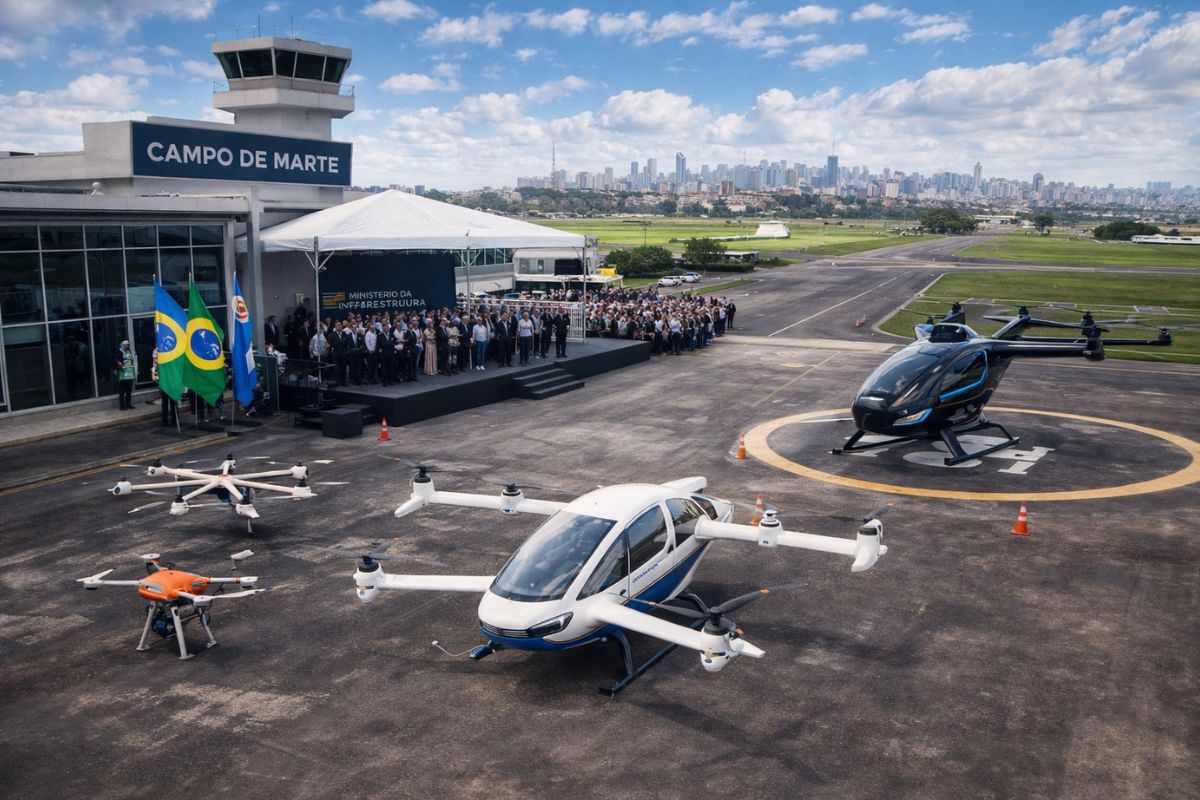
Campo de Marte enters a new phase with the inauguration of modernization works and the opening of the first public consultation by the government focused on Advanced Air Mobility, in a move that places drones and eVTOLs at the center of the upcoming policies in the sector in Brazil.
The advancement at Campo de Marte brings together two strategic fronts at the same time. On one hand, the delivery of improvements from Phase 1B of the concession reinforces safety and efficiency in general aviation. On the other, the Ministry of Ports and Airports initiates an unprecedented consultation to structure the framework of public policies related to the use of drones and electric vertical takeoff and landing aircraft, popularly known as flying cars.
This movement draws attention because it is not limited to an airport construction. What is at stake at Campo de Marte is also the attempt to prepare the country for a new stage of air mobility, with rules, guidelines, and institutional definitions for technologies that are still in consolidation.
By combining investment in infrastructure with regulatory discussion, the government signals that it wants to accelerate the preparation of the sector. It is not just a physical delivery of works, but a political and strategic step to organize the future of urban and regional aviation in Brazil.
-
Explorers find Roman treasure trapped between rocks on the seabed for nearly 1,600 years and reveal a desperate attempt to hide 53 gold coins during the invasions of the Empire.
-
Archaeologists discover Roman vase buried for over 2,000 years with more than 175 intact gold and silver coins, revealing a desperate strategy to protect wealth during the collapse of the Empire.

-
With 241 meters, 48 thousand tons, and a structure designed to accompany aircraft carriers at sea, the Chinese ship that refuels fleets in motion was born to push Beijing away from the coast and has become the hidden gear of its naval projection.

-
“Discreet” city in the interior of SP stands out among the smartest in Brazil thanks to a national ranking.

Campo de Marte receives modernization focused on safety and efficiency
The works inaugurated at Campo de Marte are part of Phase 1B of the concession contract executed by PAX Airports. The investment is around R$ 120 million and prioritizes enhancing operational safety and reinforcing the efficiency of activities related to general aviation.
This point is central because the airport plays a relevant role in a segment that requires reliable and well-organized infrastructure. When modernization targets safety and efficiency, it not only improves current operations but also prepares the foundation for new demands in the sector.
Airport has historical weight and strategic function in São Paulo
The Campo de Marte was inaugurated in 1929 and is one of the oldest aerodromes still in operation in Brazil. Besides its history, the location maintains practical importance by training pilots and conducting operations related to executive aviation.
This profile helps explain why modernization carries so much weight. This is not a secondary airport without a defined function, but a structure with a strategic role within Brazilian general aviation. In a scenario of technological transition, this history further increases the relevance of the site.
Government opens unprecedented consultation for advanced air mobility
In addition to the inauguration of the works, Campo de Marte also becomes the stage for the launch of the first Call for Contributions by the government focused on Advanced Air Mobility.
The initiative marks the beginning of a public consultation to help build the public policy related to this segment.
In practice, this means opening space to discuss how Brazil should organize the use of drones and eVTOLs. The goal is not only to hear opinions but to start outlining the legal and institutional framework that will guide these operations in the country.
Drones and flying cars enter the official radar
The consultation announced from Campo de Marte addresses a segment that encompasses drones and electric vertical takeoff and landing aircraft. These eVTOLs are often referred to as flying cars, precisely because they represent a promise of more flexible air transportation in urban and regional areas.
The fact that these technologies are now entering a formal government consultation shows an important shift. They are no longer just a topic of innovation but are being treated as a matter of public policy. This elevates the debate and places the topic on a new level within the agenda of the aviation sector.
Consultation aims to map risks, gaps, and opportunities
According to the presented basis, the ministry intends to listen to companies, specialists, and federal, state, and municipal public administration bodies. The proposal is to identify gaps in the Brazilian legal framework, map risks, understand opportunities, and assess the impacts of this new ecosystem.
This design shows that the debate will not be superficial. The idea is to build guidelines capable of balancing innovation and safety, something essential when the topic involves new aircraft, new routes, urban operations, and different public and private interests.
Safety appears as the central axis of the new policy
The advancement of discussions at Campo de Marte makes it clear that safety should be the main criterion of future public policy. This point appears as a priority when considering the operation of drones and eVTOLs within Brazilian airspace.
This makes sense because the arrival of new technologies requires extra care with rules, operational integration, and institutional control. Without a secure foundation, innovation loses strength and encounters resistance, especially in a highly sensitive sector like aviation.
Campo de Marte symbolizes a transition from the present to the future
The moment experienced by Campo de Marte has strong symbolic value. The airport, which already occupies a significant place in the history of aviation in Brazil, now also appears as a scenario for a transition focused on the future of air mobility.
This combination of tradition and modernization helps reinforce the government’s message. The airport is not just being renovated, but repositioned within a broader debate about technology, regulation, and the transformation of air transport in Brazil.
Investment and consultation place Brazil in a new stage of the sector
By inaugurating works and opening an unprecedented public consultation at Campo de Marte, the government connects infrastructure and rule formulation in the same movement. This gives the episode greater weight than a conventional ceremony for the delivery of airport improvements.
What is unfolding is an attempt to structure the ground for the more organized arrival of drones and flying cars into the regulated Brazilian environment. With physical investment on one side and normative construction on the other, the country begins to outline a new stage for its air mobility.
Do you think Campo de Marte can become the main symbol of this new phase of drones and flying cars in Brazil?





Seja o primeiro a reagir!