





 English
  Francês
  Alemão
  Italiano
  Japonês
  Norueguês
  Portuguese
  Spanish
  4 min of reading
  0 comments


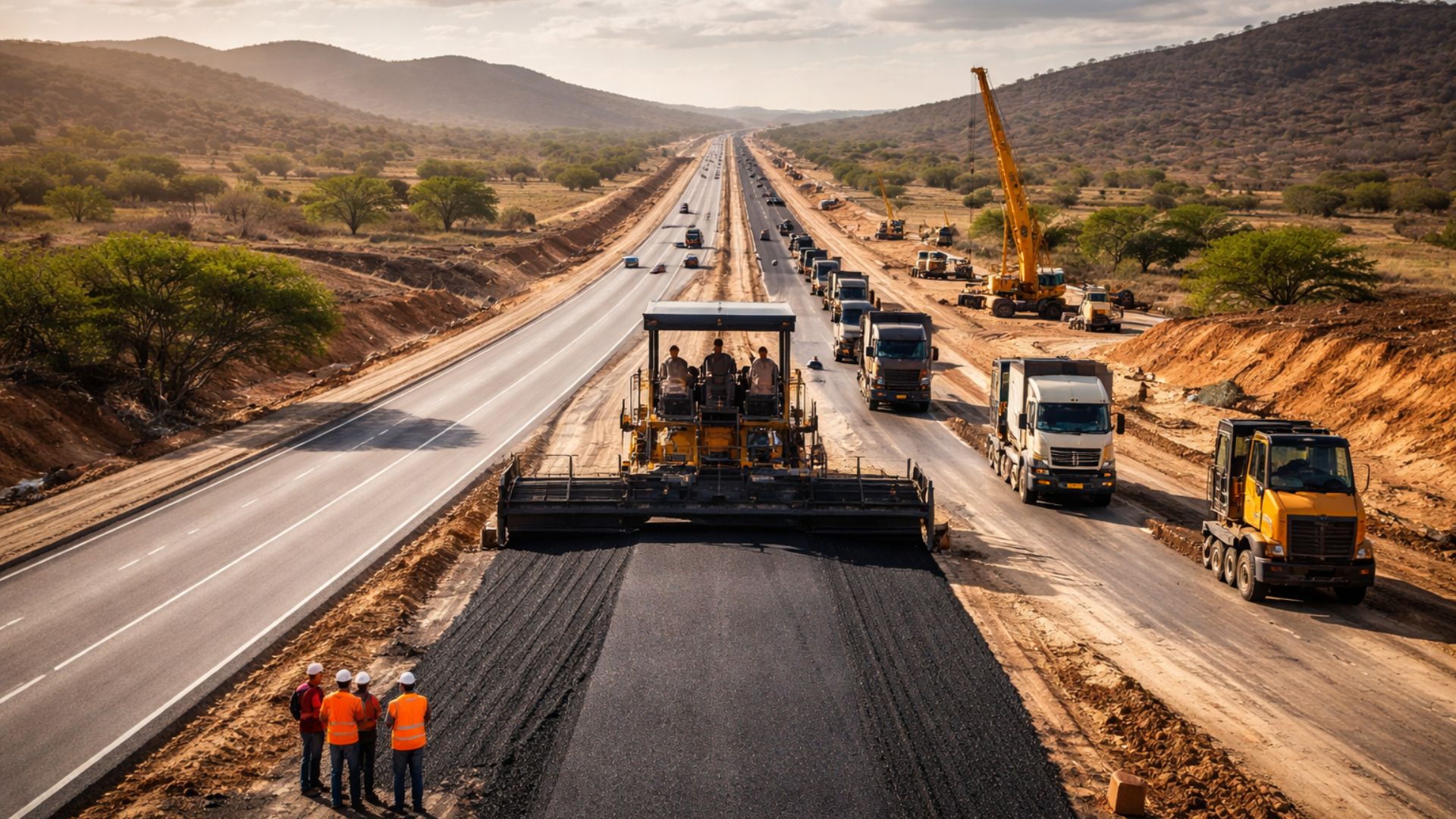
Investment unlocked after years of demands places BR-423 at the center of Agreste’s infrastructure, with ongoing works, resources from the New PAC, and a promise of partial deliveries starting in 2026 in one of the most strategic logistics corridors in Pernambuco.
The duplication of BR-423 has returned to the center of the infrastructure agenda in Pernambuco with the execution of the stretch between São Caetano and Lajedo, in Agreste, after years of demands for improvements in one of the most important road connections in the interior of the state.
The project is part of the New PAC, with a total public investment of R$ 554 million planned for two lots and already has ongoing works in the first segment, which encompasses just over 43 kilometers and is expected to have functional deliveries throughout 2026.
In practice, the advancement re-establishes a historical demand from residents, transporters, and productive sectors of Agreste, where BR-423 serves as a daily circulation corridor for passengers, cargo, and services.
-
Without bricks, without cement, and without endless construction: the cardboard house that is assembled in modules and can be moved.

-
Billions of barrels on the equatorial margin could lead Amapá to double its oil production in Brazil — the state aims to enter the route of companies in the Campos Basin, attract investments, and boost jobs and businesses in the oil and gas sector.

-
Without bricks, without cement, and without endless construction: the cardboard house that is assembled in modules and can be moved.
-
Billions of barrels on the equatorial margin could lead Amapá to double its oil production in Brazil — the state wants to enter the route of companies in the Campos Basin, attract investments, and boost jobs and businesses in the oil and gas sector.

The highway also has logistical weight for the outflow of regional production, especially in an area associated with dairy, poultry, commerce, and tourism activities, which helps explain why the duplication has become one of the most demanded works outside the capital of Pernambuco.
Investments and ongoing stretch of BR-423

The federal government authorized the service order for the first lot on November 8, 2023, focusing on the segment between kilometers 18.2 and 61.3 of BR-423.
At the time, the Ministry of Transport and the Palácio do Planalto informed that this stretch would have 43.1 kilometers duplicated and an investment of R$ 330.3 million, while the broader planning of the project, between São Caetano and Garanhuns, totals 83.1 kilometers included in the New PAC.
This outline helps clarify a point that often appears confusing in the public debate about the work.
The amount of R$ 330.3 million refers to the lot currently under execution between São Caetano and Lajedo, while the R$ 554 million corresponds to the planned public investment for the two lots of the duplication.
The road plays a strategic role because it connects cities with strong economic integration in Agreste and serves as a passage for movements that exceed regional boundaries.
On a single lane, the increase in traffic over the years has amplified operational bottlenecks, pressured safety conditions, and reinforced the perception that the existing structure no longer kept pace with the intensity of the flow.
Schedule and functional deliveries expected for 2026
Since the beginning of the services, DNIT has associated the duplication with expected gains in fluidity, road safety, and reduction of logistical costs for the local economy.
In official reports released throughout 2024 and 2025, the agency recorded the advancement of earthworks, drainage, and capacity adjustments in the Pernambuco stretch.
Additionally, the agency stated that the project should boost sectors such as commerce, services, and tourism in the municipalities crossed by the highway.
In a technical visit reported in March 2026, DNIT stated that the construction site of BR-423 focuses on the duplication of 41 kilometers between São Caetano and Lajedo.
The difference in relation to the 43.1 kilometers used in the project’s launch arises from the way the agencies began to describe the segment in subsequent notes.
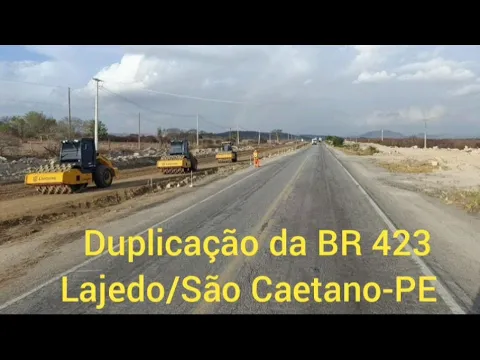

It was also during this technical agenda that the agency reiterated functional deliveries expected for 2026, indicating the release of completed stretches before the total completion.
In linear works of this magnitude, this model allows for the anticipation of some benefits to traffic, with ready segments gradually released.
The regional news also follows the schedule indicating that the stretch between Lajedo and São Caetano should be delivered in 2026.
Still, the total execution depends on the physical advancement of the contract and the maintenance of the expected budget flow.
Expansion to Garanhuns and regional impact
The discussion about BR-423 is not limited to the already contracted stretch. The project foresees the continuation of the duplication towards Garanhuns, with planning for new studies, projects, and future bidding.
This point is central because it outlines the real scope of the intervention in the region.
Although the stretch under construction already represents a significant change, the structural transformation of BR-423 depends on the continuation of the project to Garanhuns.
The highway appears in the broader scope of the New PAC with 83.1 kilometers planned for duplication.
By framing BR-423 as a long-awaited project, the Ministry of Transport associated the duplication with a response to a historical infrastructure backlog in the interior of Pernambuco.
The public interest in the project arises from the combination of a long wait, daily impact, and the potential to alter regional logistics.
From this stage, attention shifts from the announcement to the effective execution.
With machines in the field, a budget linked to the New PAC, and a promise of deliveries in 2026, the physical advancement of the work becomes the main indicator monitored by residents, businesses, and users of the highway.







Seja o primeiro a reagir!