





 Portuguese
  English
  Spanish
  6 min of reading
  0 comments


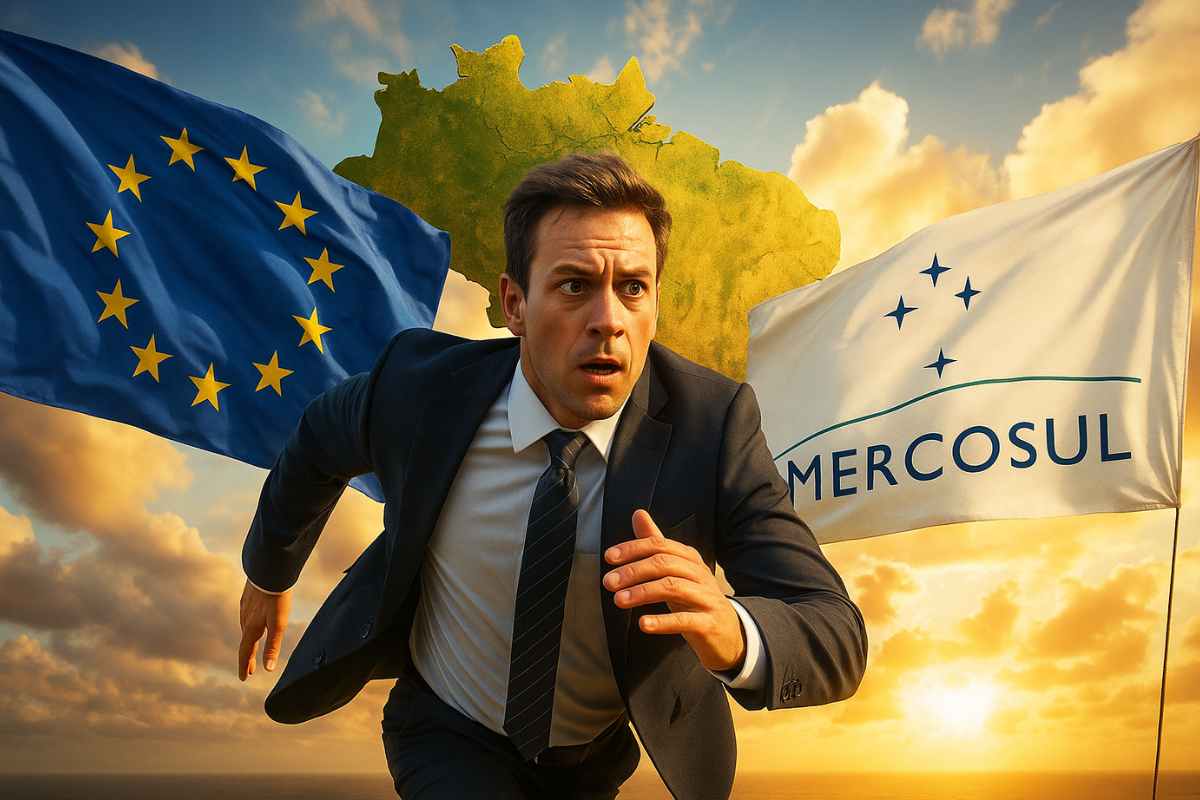
On the Eve of the Summit in Foz do Iguaçu, the Government Accelerates the Mercosur–European Union Agreement, Selling the Promise of the World’s Largest Free Trade Zone and Facing Criticism Over Competitiveness, the Environment, Regulatory Sovereignty, and How Much Brazil Could Lose in This Sensitive Geopolitical Chessboard for the Industrial and Agricultural Sectors
In a speech delivered in Johannesburg, South Africa, President Luiz Inácio Lula da Silva set a date and a stage to try to turn the page on 25 years of negotiation: December 20, in Foz do Iguaçu, with Brazil holding the presidency of Mercosur, as a symbolic moment to sign the Mercosur–European Union agreement. The promise is to unlock a project that connects two blocs responsible for about 722 million inhabitants and a combined GDP of approximately $22 trillion, in the words of the government itself, presented as possibly the largest trade agreement on the planet.
At the same time that it markets the signing of the Mercosur–European Union agreement as a historic step, the Planalto knows that every detail of this move will be scrutinized by businessmen, ruralists, unions, and Congress. The Brazilian government’s urgency to finalize the agreement before the end of the year confronts an ongoing debate about who wins, who loses, and how much negotiating space Brazil actually has in this massive free trade game.
Race to December 20 and the Government’s Political Calculation

The chosen date is not just a scheduling commitment.
-
A new Brazilian shopping center worth R$ 400 million will be built in an area equivalent to more than 4 football fields, featuring 90 stores, 5 cinemas, a supermarket, a college, and parking for 1,700 cars, potentially generating 3,000 jobs.

-
Larger than entire cities in Brazil: BYD is building a 4.6 km² complex in Bahia with a capacity for 600,000 vehicles per year, but the discovery of 163 workers in conditions analogous to slavery has shaken the entire project.

-
With an investment of R$ 612 million, a capacity to process 1.2 million liters of milk per day, Piracanjuba inaugurates a mega cheese factory that increases national production, reduces dependence on imports, and repositions Brazil on the global dairy map.

-
Brazilian city gains industrial hub for 85 companies that is equivalent to 55 football fields.


Linking the Mercosur–European Union agreement to the leaders’ summit in Foz do Iguaçu creates a clear political roadmap: Brazil intends to use the rotating presidency of Mercosur to deliver a concrete result after a quarter of a century of ups and downs at the negotiating table.
Lula has been publicly advocating, in forums such as CELAC, that Mercosur and the European Union give a definitive “yes” to international trade at their summits.
By reaffirming in Johannesburg that he plans to travel only to Brasília or Foz do Iguaçu until the end of the year, the president signals the highest priority to signing the Mercosur–European Union agreement, treating the act as a symbol of external prominence at a time when the country seeks to consolidate its image as a global interlocutor.
What’s at Stake in the Mercosur–European Union Agreement

After 25 years of negotiations, the blocs concluded the main text of the Mercosur–European Union agreement last December, which still needs to go through two decisive stages: formal signing and approval by national legislatures and the European Parliament.
In other words, the announcement of December 20 is more of a political trigger and less of a final point in the story, as each country will have its own internal debate about whether to ratify the pact.
On the European side, the Commission presented the free trade agreement and opened the process for Parliament and member states to evaluate adherence.
On the Mercosur side, governments also need to submit the text to their respective Congresses.
In this scenario, the signing advocated by Lula does not end the process but inaugurates a phase in which each clause of the Mercosur–European Union agreement will be used as ammunition by groups both for and against large-scale trade opening.
The Largest Free Trade Zone in the World and Brazil’s Place in It
When describing the pact, Lula emphasizes a point that helps clarify the ambition of the project: the Mercosur–European Union agreement would create one of the largest free trade zones in the world, connecting hundreds of millions of consumers and trillions in GDP.
In official rhetoric, this represents an opportunity to increase exports, diversify markets, and position the country in more sophisticated value chains.
In practice, this means opening doors for Brazilian products in a European market with high purchasing power, while also increasing domestic competition with goods from the European Union.
Brazil commits to playing in a much larger field, with more stringent rules, and the central question is whether it can transform the Mercosur–European Union agreement into a platform for productive upgrading or risks deepening already existing dependencies.
On One Side, Excited Exporters; on the Other, Sectors Fearing Extra Pressure
The government communicates the Mercosur–European Union agreement as a showcase to reinforce the presence of exporters from agribusiness, industrial goods, and services, banking on scale gains and regulatory predictability.
For these groups, the perspective of broader and more stable access to the European market is seen as a chance to solidify long-term contracts.
On the other hand, critics warn of the risk that Brazil may accept commitments that limit the space for industrial policies, weaken less competitive sectors, or impose regulatory standards that are difficult to meet in the short term, especially on environmental issues and traceability.
The lingering doubt is whether the haste to stamp the signature of the Mercosur–European Union agreement reduces the margin for fine-tuning adjustments that protect more vulnerable segments of the Brazilian economy.
Milei, Absences, and Noises Within Mercosur Itself
The political equation involves not only Brasília and Brussels.
The internal cohesion of Mercosur itself comes into play when trying to pin down a date for the Mercosur–European Union agreement.
Until Lula’s speech, the president of Argentina, Javier Milei, had not confirmed his presence at the summit in Foz do Iguaçu, after stating that the group harmed the majority of citizens.
This type of noise exposes a fragility: Brazil rushes to sign the Mercosur–European Union agreement while some regional partners still send contradictory signals about the strategic value of the bloc.
If adherence does not advance in a minimally coordinated manner, the risk increases that the process will stall in national legislatures, raising political wear without delivering the promised benefits to the productive sector.
Approval in Parliaments and Internal Debate About What Brazil Could Lose
Even if Lula achieves the ideal scenario of a photo in Foz do Iguaçu, with leaders of both blocs announcing the signing, the script necessarily passes through a long and complex stage: the approval of the Mercosur–European Union agreement in the parliaments, starting with the Brazilian Congress.
It is at this stage that the discourse of “the largest trade agreement in the world” will be confronted with the annexes, reservations, and market opening schedules.
Lawmakers aligned with the government are likely to defend the pact as a tool for modernization and competitive insertion.
In contrast, the opposition and more cautious sectors promise to focus on the potential losses for certain production chains and on sensitive points of regulatory sovereignty.
The implicit question in each vote will be how much Brazil is willing to give up today, in tariffs and rules, to try to reap trade and investment gains in a longer-term horizon.
Historical Opportunity or Calculated Risk Too Much?
Seen from afar, the Mercosur–European Union agreement appears to be a perfect showcase to present Brazil sitting at the table of major global agreements, discussing free trade, climate, investments, and value chains.
Looking closely, the picture is more complex, with internal disputes, partner resistances, environmental demands, and the challenge of explaining to society who gains what, within what timeframe and at what cost.
If the government can combine transparency in the clauses, protection for more vulnerable sectors, and a clear strategy to use the agreement as a lever for competitiveness, it can transform December 20 into a positive milestone for foreign and economic policy.
If it fails in this balance, the haste to sign the Mercosur–European Union agreement may be remembered less as a historical turning point and more as a calculated risk taken too soon on a board that wasn’t ready yet.
And you, do you think Brazil should prioritize finalizing the Mercosur–European Union agreement now or hold off to renegotiate sensitive points before signing?








-

2 pessoas reagiram a isso.