





 English
  Francês
  Alemão
  Italiano
  Japonês
  Norueguês
  Portuguese
  Spanish
  5 min of reading
  15 comments


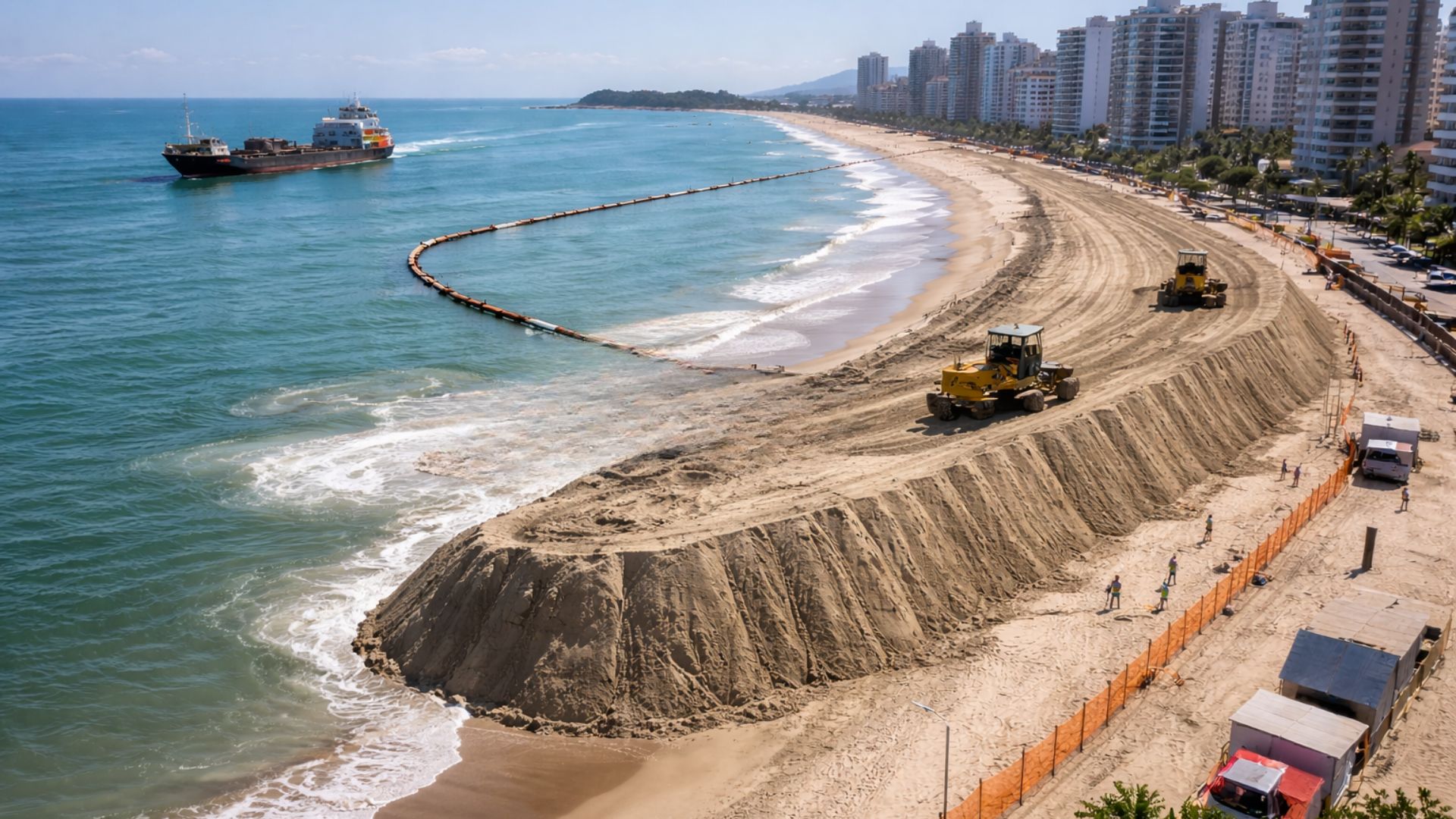


Million-Dollar Intervention Mobilizes Dredger 24 Hours, Removes 379,000 m³ of Sand 10.5 km from the Coast and Marks the Fourth Major Anti-Erosion Project in Balneário Piçarras, Reigniting the Debate on Public Costs and the Longevity of the Expansion.
Balneário Piçarras, on the North Coast of Santa Catarina, has begun a new stage of widening the Central Beach to tackle coastal erosion and expand the sandy area by about two kilometers, in the stretch between the jetties that define the shoreline, with the forecast for depositing 379,166.76 m³ of sediments.
The announced investment during the execution exceeds R$ 40 million and combines resources from the Beach Maintenance Fund (Fumpra) with the municipality’s own funds, while bidding documents recorded an estimated value of R$ 38,288,895.54 for the service.
The work has gained the rhythm of continuous operation, with work day and night, and the city hall began to communicate a deadline for completion of up to 60 days, even though the planning of the bidding had worked with a broader maximum limit in part of the public disclosures.
-
Explorers find Roman treasure trapped between rocks on the seabed for nearly 1,600 years and reveal a desperate attempt to hide 53 gold coins during the invasions of the Empire.

-
Archaeologists discover Roman vase buried for over 2,000 years with more than 175 intact gold and silver coins, revealing a desperate strategy to protect wealth during the collapse of the Empire.
-
With 241 meters, 48 thousand tons, and a structure designed to accompany aircraft carriers at sea, the Chinese ship that refuels fleets in motion was born to push Beijing away from the coast and has become the hidden gear of its naval projection.

-
“Discreet” city in the interior of SP stands out among the smartest in Brazil thanks to a national ranking.

Widening of the Central Beach Advances in Sections and Alters the Coastal Routine
Differently from smaller interventions, the project relies on a logistics chain in open sea, involving dredging, transportation, and controlled deposition of sand, with temporary closures to allow each section to be executed and then reopened to the public.

According to the city hall, the services progress in segments of approximately 300 meters, with barriers and signage to separate machines and bathers, a strategy designed to reduce conflicts on a central beach that concentrates commerce, residents, and tourists throughout the year.
In recent weeks, the administration reported that the work has reached about 30% completion and that, in 20 days of work, approximately 850 meters had already gone through the widening process, with progressive releases as each area is completed.
Dredger 24h, Mining Site 10.5 km Away, and Continuous Operation in Open Sea
The operation is carried out by the dredger Amazone, mentioned in local coverage as responsible for extracting sediments from a seabed site and making repeated trips to the coast, maintaining the cycle of removal, transportation, and discharge as the basis of the accelerated schedule.
According to disclosed information, the mining site is located about 10.5 kilometers from the Central Beach, near Ponta da Vigia, in Penha, which requires defined routes and constant monitoring to ensure that the material removed and deposited meets licensing parameters.
The city hall also reports that each operation transports approximately 6,000 cubic meters of sand, with the possibility of up to four movements per day, while emphasizing that the sediment must maintain characteristics compatible with the original beach sand to avoid undesirable impacts.

In the budget, there are two references that appear side by side in the public debate, as it is not always the same number being discussed: the bidding notice published the estimated total amount at R$ 38,288,895.54, and the execution has been communicated as an investment exceeding R$ 40 million.
The contract was homologated with a value of R$ 38,280,000.00 in disclosures about the bidding result, and the difference compared to the amount over R$ 40 million is usually attributed, in communications and coverage, to the set of costs and additions reported during the work.
Fourth Intervention Reignites Debate on Erosion and Public Costs
The current re-composition is treated as the fourth major intervention on the Central Beach, following actions recorded in 1998, 2008, and 2012, a sequence that helps explain why the theme reappears frequently whenever storms and higher tides pressure the urbanized shoreline.
This repetition fuels two simultaneous readings in the city: on one hand, the work is presented as a protective measure for infrastructure and a reorganization of tourism use; on the other, it reinforces the discussion about public costs and the real durability of the widening.

In official communication, the municipality has begun to display live cameras to monitor the progress of the service, with continuous broadcasting, in an attempt to increase transparency about closures, releases of sections, and movement of heavy equipment along the beach.
The municipal secretary of Works, Arthur Ribeiro, stated to ND Mais that “the progress of the work already represents 30% of the total planned,” highlighting the efficiency of planning and execution, while the city hall insists that the continuous operation aims to deliver the new profile of the shoreline within the announced deadline.
Environmental Certification and Tourist Image at Stake
In addition to the debate on erosion, the intervention occurs in a city that has been associating its coastal management with environmental certifications, with sections of Balneário Piçarras recognized by the Blue Flag Program for the 2025/2026 season, according to records from the program itself.

In local disclosures on the topic, the city hall and regional media reported that the certification has come to cover different sections along the shoreline of the municipality, including the Central Beach, composing the narrative that the quality of management and infrastructure has become part of the tourism positioning.
On the construction site, the immediate effects are evident in the routine: areas are closed to receive the material, leveling, and finishing, and then released, in a back and forth that tries to balance the technical necessity of the work with the maintenance of public use of the main postcard.
In the end, what sustains the interest and controversy are the same numbers that make the intervention hard to ignore, with 379,000 m³ of sand projected, offshore mine at 10.5 km, dredger operating in a continuous cycle, and costs that, in practice, place coastal engineering at the center of local politics.
When the next storms test the new design of the Central Beach, what will weigh more on the city’s perception: the larger sandy area and the feeling of protection of the shore, or the demand for results that dispense a new round of public investment?







Eu resolvo o problema .
Muito suspeito.
Tanto dinheiro gasto em algo tão insignificante
Causando impacto ambiental tremendo e os resultados serão desastrosos, qual foi a empresa que fez o estudo de impacto ambiental?