





 Portuguese
  English
  Spanish
  12 min of reading
  0 comments


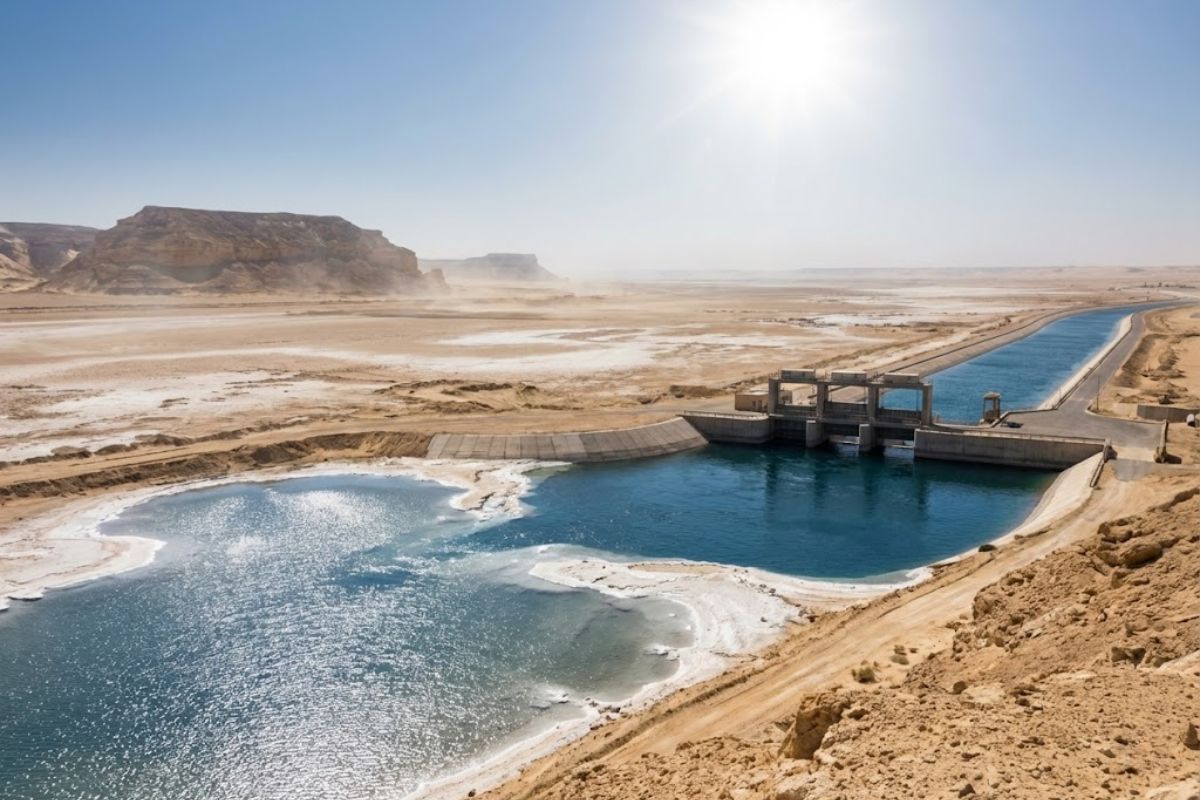
With the Qattara Depression Reaching Up to 433 Feet Below Sea Level, Egypt Revisits Flooding the Desert With Mediterranean Water. A Contract from April 11, 2023, Provides for a Feasibility Study, but Extreme Evaporation May Concentrate Salt, Alter Ecosystems, and Hinder Benefits.
The debate on flooding the desert has returned to the forefront of discussions in Egypt after the announcement of a feasibility study in 2023 to bring water from the Mediterranean to the Qattara Depression, a giant basin that lies up to 433 feet below sea level and is currently marked by salt, shallow lakes, and swamps.
The promise, according to BlueLife, is to transform the altitude difference into hydropower generation, creating a constant flow as water enters and evaporation removes volume. The risk, however, is structural: heat may accelerate evaporation, concentrate salt, and push the reservoir toward an increasingly salty lake, with difficult-to-reverse environmental impacts.
-
Florianópolis will receive a million-dollar BRT that will begin construction in 2026 with nearly 400 million in funding from the federal government and the Inter-American Development Bank, and the map already shows the routes for the exclusive bus corridors.
-
Without a blueprint, without an engineer, and using scrap from the dump, a father spends 15 years building an 18-room castle for his daughter, featuring tram tracks, 13 fireplaces, and over 700 m², which may now be demolished.
-
A megaproject worth R$ 89 billion is advancing in Iraq and promises to change the game in global trade by creating a new corridor between Asia and Europe, reducing traditional routes and repositioning the country as a logistics powerhouse.
-
Goodbye bedside table: floating shelves become a trend in 2026 by freeing up space in the bedroom, improving circulation, bringing visual lightness, and integrating technology without taking up floor space.


The Qattara Depression and the Scale of the Plan

The Qattara Depression appears in the middle of the Sahara like an open geographical wound, described as an uninhabited and extremely hostile expanse.
Starting from the African Mediterranean coast and going about 80 km into the Libyan desert, one arrives at this Qattara Depression with an estimated area of about 7,000 square miles, almost the size of New Jersey.
It already houses saline lakes and swamps, and the proposal to flood the desert envisions filling this basin to a level where it becomes a vast body of water, cited as covering about 7,700 square miles, slightly smaller than Lake Winnipeg.
It is precisely the fact that the Qattara Depression is below sea level that supports the idea: if there is a stable connection to the Mediterranean, water can flow in without needing pumping to overcome gravity.
Even before discussing turbines, the project requires a central definition: what water level is intended to be maintained and what will be the balance between inflow and evaporation.
Without this balance, flooding the desert ceases to be a power plant and becomes a salinization experiment on a continental scale.
The Idea Is Not New: 1912, 1927, and the Role of John Ball

The hypothesis of using the Qattara Depression as an energy source dates back to 1912. In 1927, English geologist John Ball, who led the mapping of the area, described in more detail how to convert the elevation difference between the sea and the basin into hydropower.
In practice, the proposal is simple in theory: open a path for Mediterranean water to enter the desert, gain speed and fall toward a lower level, and capture some of that energy with generation equipment.
The history shows that flooding the desert has always seduced engineers by bringing together, in one design, infrastructure, energy, and land occupation.
But it also shows that the costs have never been easy to balance, whether due to cost or risk.
CIA, Eisenhower, and the Climate and Jobs Argument
In 1957, the CIA delivered a document to President Eisenhower proposing to flood the Qattara Depression.
The document listed four main advantages: the grand and tranquil aspect of the new lake, a change in the local climate, job creation for years, and the possibility of people living in the region after construction.
This episode reveals that the project was never just technical.
When discussing flooding the desert with Mediterranean water, the discourse often mixes energy, development, and land reorganization, including climate expectations that depend on models and difficult-to-verify assumptions.
Frederick Bassler, Landmines, and the Cost of Bringing the Sea Inland
Starting in 1964, Frederick Bassler led an international advisory board tasked with studying how to implement the so-called Sea of Qattara and where to obtain funding.
For nearly 10 years he was the main advocate, but feasibility stumbled at the basics: bringing water from the Mediterranean into the desert would be costly and complex, and opening a canal or drilling a tunnel seemed out of scale.
There were also security obstacles. Large areas would need to be cleared of landmines and unexploded ordnance remnants from World War II, described as still scattered across northern Egypt.
In linear projects, such as canals and pipelines, each unsafe stretch becomes a delay, cost, and operational risk.
The Nuclear Phase and Why It Was Rejected
One of Bassler’s proposals to reduce costs was to use nuclear explosions known as peaceful to excavate the canal.
The plan cited 213 wells along the route, each with a device of 1.5 megatons, about 100 times the power of the bomb dropped on Hiroshima.
The design fit within the Atoms for Peace program launched in 1953, which aimed to project nuclear energy as a tool for construction and industry.
The objections were numerous.
Estimates cited the need to evacuate at least 25,000 people, and there were fears that shockwaves could disturb the Red Sea Rift, about 280 miles from the proposed site, with tectonic risk.
Additionally, there were fears of changes in ocean currents, coastal erosion, and the inevitable question of radioactivity in the new lake.
Faced with this set of risks, the Egyptian government rejected the proposal, even though it acknowledged that the nuclear route would drastically reduce costs compared to traditional excavation.
The Return in 2023 and the New Feasibility Study
After decades of the idea resurfacing and receding, Egypt signed a contract on April 11, 2023, with EGIT Consulting to conduct a new study and reevaluate whether the project could be realized with current technologies.
The logic is to review numbers, excavation estimates, costs, and operational scenarios.
The sensitive point is that flooding the desert is not just opening the door to the Mediterranean.
It is creating an inflow, drainage, control, and generation system that works under extreme heat, with high evaporation and a lake that tends to concentrate salts over time.
Canal, Tunnel, or Pipeline: Where Engineering Stalls
For Mediterranean water to reach the Qattara Depression, the proposal describes the need to carve out a gigantic canal or drill a tunnel between 34 and 60 miles, depending on the route.
To the north, the depression meets the Elifa Plateau, a rocky ridge described as about 660 feet above sea level.
Opening a sea-level passage through solid rock is presented as an extreme challenge, one that will become a career-defining reference for those in charge.
The desert also imposes instability: the ground may degrade or collapse, and the combination of loose sand and clay may clog pumps and cause trench walls to collapse.
Alternatively, the proposal mentions tunnels beneath the plateau with modern drilling machines, or even a gas pipeline northeast to the Nile, stretching at least 199 miles.
In any route, the bottleneck is the cost of overcoming geology, distance, and maintenance.
Drilling Machines and Local Experience with Tunnels
The recent discussion about flooding the desert has placed more weight on tunnel drilling machines, structures described as underground factories on tracks.
At the front, a rotating cutter head presses against the rock, breaks the material, and pushes the debris back, allowing continuous advancement.
Egypt has already used this type of equipment.
In the construction of tunnels under the Suez Canal, a model with an internal diameter of 37 feet and an external diameter of 41 feet was cited, approximately the height of a four-story building.
In the Cairo Metro, two tunnels of nearly 12 miles were mentioned, aligned with concrete rings 19 feet in diameter, with excavation depths ranging from 24 to 131 feet.
This history is used as an argument that the country has the specialists and logistics to operate machines under conditions similar to those expected in the Qattara Depression.
Evaporation as a Motor and as a Threat
The basis of the project is a paradox: intense evaporation is both what makes generation feasible and what can jeopardize the reservoir.
The proposal describes that the Qattara Depression is approximately 197 feet below sea level, while the feasibility description also mentions values of up to 433 feet, both used to highlight the available drop.
If the connection with the Mediterranean allows for continuous entry, the water flows inward and, as it stabilizes with evaporation, creates a permanent flow that can move turbines and produce electricity.
The numbers cited in the energy design are high.
The first plant, Qattara 1, conceived in the mid-19th century according to the account, would have a production of 670 megawatts.
A second phase would add another 1,200 megawatts. With the addition of a pumped-storage plant, total capacity could reach more than 4,000 megawatts, adding up to about 5,800 megawatts, comparable to six modern nuclear reactors.
This ambition depends on a fine balance: if evaporation exceeds replenishment capacity, the lake shrinks and concentrates salt; if replenishment exceeds evaporation, control becomes a security and edge issue.
Pumped Storage and the Role of Two Reservoirs
Among the cited alternatives is to create an artificial reservoir on the plateau above the Qattara Depression and operate an underground station with ramps and tunnels.
The design envisions two sets of equipment: common turbogenerators to generate electricity when water flows downward, and turbine pump motor generators that operate bi-directionally, pumping water up when there is excess electricity and releasing it back when there is a shortage.
The proposal cites an estimated base capacity of about 315 megawatts, with peaks that could reach 1,500, varying depending on the duration of the peak and the energy needed to pump.
In theory, this would turn flooding the desert into a giant battery, adjustable to price and demand fluctuations.
Desalination in the Middle of the Sahara and the Numbers Already in Operation
The same design suggests using some of the energy for desalination.
The Mediterranean water, as it flows into the lake, would pass through filters and reverse osmosis systems, or through electrodialysis, separating salts into ions through electric current and producing fresh water in the desert itself.
There is a comparison with the regional scenario: in neighboring Israel, about 90% of desalinated water is produced by five large plants along the Mediterranean coast, providing about half of the country’s drinking water.
In Egypt, 125 desalination facilities have been cited with a combined production of over 343 million gallons per day, with a plan to reach 2.4 billion gallons per day by 2050.
In this context, flooding the desert would be presented not only as energy but as a water platform, with direct impact on irrigation, industry, and cities.
The Lake Increasingly Salty and the Risk of Irreversibility
The most repeated problem is the chemical fate of the reservoir.
Even if the Mediterranean entry is continuous, the climate remains desert-like, and evaporation removes water while leaving salt behind.
Over time, the lake tends to become hypersaline, a mass of increasingly salty water, while the Qattara Depression deposits salts on the bottom and raises the base by dozens of feet according to the report.
This creates an environmental dilemma.
An hypersaline lake alters habitats, may kill species that do not tolerate salt, and complicates the reversal of the system without massive intervention.
The promise of flooding the desert, therefore, carries the risk of cementing a new saline landscape, with effects that may escape the control of a single project.
Salt, Lithium, and the Temptation to Transform Deposit into Asset
Salinization is also presented as an economic opportunity.
With a large lake and salt deposits, activities such as salt mining appear as a possibility.
The report mentions that in 2024, Saudi Arabia and the United Arab Emirates began exploring ways to extract lithium from salt deposits, a metal essential for electric vehicle batteries.
The implicit reading is that if flooding the desert generates a basin with concentrated salt, it may become a source of inputs beyond energy.
This does not solve the environmental issue but helps explain why the project resurfaces: it tries to stack benefits to justify costs.
Climate, Rain, and Promises Dependent on Models
Another cited bet is regional climate change. Presented projections claim that, with water evaporating, humidity would increase, and even rain could appear, cooling and moistening the region over time.
This line also connects flooding the desert to the idea of jobs and settlements, with estimates that millions of people could live in the region in the coming decades.
The same narrative points to positive chain effects, such as protecting soil against wind erosion, fish farming, and agricultural expansion.
However, in a scenario of an increasingly salty lake, the gain in humidity coexists with chemical degradation, and the comparison between promises and costs becomes the heart of the feasibility study.
Navigation and the Cost of Removing 35 to 70 Billion Cubic Feet of Rock
When discussing flooding the desert, the idea of navigation arises as a consequence.
The report observes that pumping seawater through pipes does not create a navigable sea. If cities and factories arise, the pressure for a real sea-level canal tends to grow.
The excavation numbers cited for such a canal are colossal: removing between 35 and 70 billion cubic feet of rock.
The presented comparison is that this volume is several times less than that removed annually by large open-pit mines, and that in the Powder River coal basin in Wyoming, a similar volume is extracted in about two years.
Even so, constructing a deep-sea port, internal canal networks, and locks would still be technically feasible and financially heavyweight.
Why Egypt Seeks Another Source: Fossils, Gas, and the Pressure for Energy
The energy backdrop is described with recent numbers. In 2023, oil, gas, and fuel oil accounted for 88% of the electricity produced in Egypt, and by 2024 this share would have risen to 89%.
The country is presented as an African leader in gas generation: in 2022, it accounted for nearly half, 45%, of the continent’s gas electricity. In 2023, the share of gas in the Egyptian matrix is cited at 84%.
The portrait includes declining production and increasing imports.
After discovering fields like Zor in the Mediterranean, the country even exported gas, but fields are drying up, and production is falling.
The report states that liquefied natural gas imports in the second quarter of 2025 reached 62 billion cubic feet, compared to 3.5 billion a year earlier, raising costs and the risk of external dependency.
In this environment, flooding the desert reemerges as a promise of large-scale domestic energy, albeit controversial.
Hydropower Is Still Small, and the List of Already Explored Dams
Today, Egypt’s hydropower plants generate about 7% of the country’s energy, while another 5% comes from wind and solar energy.
The declared goal is to reach 42% of electricity from clean sources by 2030. The cited hydropower system includes four main stations: the old Aswan dam, the Esna Dam, the High Aswan Dam, and the Nagamadi Dam.
In 2016, a new station was said to have joined the group at the Assad dam.
The High Aswan Dam is described as having a theoretical capacity of about 2.1 gigawatts but with limitations when the level of the Nile is low.
As the hydropower potential of the Nile has been maximized since the completion of the High Aswan Dam in 1968, the Qattara Depression project appears as a fifth alternative and by far the most unusual.
The Contrast with Subterranean Agriculture: Green Circles in the Sahara
Even without flooding the desert, Egypt is already trying to push life into arid regions. One cited example is the Shark Elna Project, described in images as giant green circles in southwestern Egypt, associated with center pivot irrigation.
Below the Sahara lies the Nubian sandstone aquifer, an ancient layer that accumulated fresh water millions of years ago and sustains farms where there is no rain.
Each circle is described as nearly 2,600 feet in diameter, with a well in the center pumping water to pipes that spin and spread irrigation.
The cited crops include potatoes, wheat, and chamomile.
The project is said to have started in 1991 and is now managed by the National Company for Land Recovery and Agriculture under the Egyptian Armed Forces, with expansion announced in 2021 from 172 square miles to 2,180.
This contrast reinforces the logic of the debate: flooding the desert is the hydraulic and energy version of a broader strategy to occupy the void.
The contract from April 11, 2023, reopens an old discussion with new tools, but does not change the physical dilemma that has always surrounded flooding the desert: extreme heat, high evaporation, and salt accumulation tend to push the system toward an increasingly salty lake.
If Egypt wants to transform the Qattara Depression into energy and water infrastructure, the feasibility study will have to treat the reservoir as an organism in permanent balance, not as a project that ends at inauguration.
To keep up with the next steps, it’s worth observing what connection routes with the Mediterranean will be considered, how the project intends to measure and control evaporation and salinity, and what environmental safeguards will be proposed to mitigate difficult-to-reverse impacts.
If Egypt decides to flood the desert with Mediterranean water in the Qattara Depression, do you consider it acceptable to coexist with high evaporation and an increasingly salty lake?






-

-

-

-

7 pessoas reagiram a isso.