





 Portuguese
  English
  Spanish
  4 min of reading
  0 comments


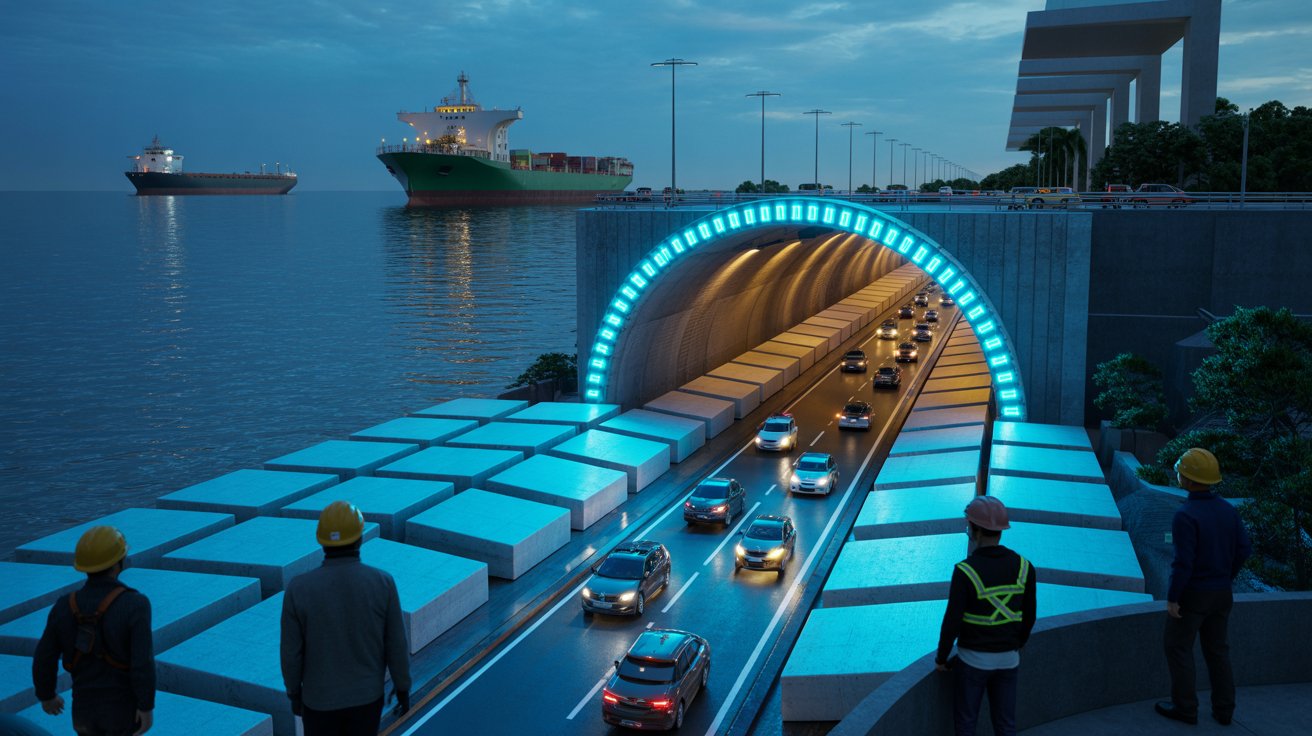
Government’s Decision to Build a Submerged Tunnel Instead of a Bridge Between Cities Surprises and Intrigues. This Choice Promises to Transform Regional Mobility with Innovative Infrastructure, Challenging Traditional Models in Brazil.
Connecting neighboring cities through a monumental bridge is usually the most common solution to overcome natural obstacles, such as rivers and canals.
However, in Santa Catarina, this logic has been upended with a bold and innovative choice.
Instead of erecting a bridge, the state government opted for a submerged tunnel, an unprecedented project in Brazil that promises to transform mobility and the region’s economy. But what was the reason for this unexpected decision?
-
The government requests the Federal Revenue Service for a new system to automate the income tax declaration, reducing errors, time, and bureaucracy for millions of Brazilians.

-
Friends have been building a small “town” for 30 years to grow old together, with compact houses, a common area, nature surrounding it, and a collective life project designed for friendship, coexistence, and simplicity.

-
Pix in installments, international Pix, and contactless payment without internet: the Central Bank revealed the new features coming to the tool that is already used by almost every adult in Brazil.

-
This small town in Germany created its own currency 24 years ago, today it circulates millions per year, is accepted in over 300 stores, and the German government allowed all of this to happen under one condition.


Strategic Decision to Avoid Structural Restrictions
According to NSC Total, the coordinator of the mobility project, João Luiz Demantova, explained that the decision to abandon the bridge was due to structural restrictions imposed by naval traffic and the proximity of the local airport.
The Itajaí-Açu River, through which large ships transit to the ports of Santa Catarina, would require the bridge to have a height of 65 meters at its highest point to not interfere with navigation. However, this requirement clashed with an aerial limitation.
The Navegantes Airport, located nearby, imposes a maximum height of 45 meters for any construction in the aircraft approach area. This conflict made the construction of the bridge unfeasible.
Submerged Tunnel: The Viable and Innovative Alternative
Faced with this impasse, the government of Santa Catarina turned to an innovative solution. The submerged tunnel will allow crossing beneath the river without interfering with air or maritime traffic, ensuring efficient infrastructure for the region.
Although it is a rare model in Brazil, the technology has already been successfully applied in other countries.
The project foresees that pre-cast blocks will be submerged and sealed at the bottom of the river, creating a secure underground corridor for vehicles.
This technology has been used in various parts of the world to solve similar problems, ensuring safety and efficiency in the crossing between cities separated by waterways.
Comparisons with Other Projects in Brazil
Brazilian experience with submerged tunnels is still limited. Currently, a similar project is being developed to connect Santos and Guarujá in São Paulo, but it faces various delays and financial challenges.
As a result, Santa Catarina has the opportunity to lead a new infrastructure model, potentially becoming a reference for future projects in other regions of the country.
The expectation of the state government is that the bidding for the Public-Private Partnership (PPP) responsible for the work will be launched in the first half of next year.
In addition to providing a new solution for mobility, the tunnel has the potential to boost the region’s economic development, reducing travel time between Itajaí and Navegantes.
Economic Benefits and Regional Impact
The choice of the submerged tunnel represents more than a technical solution. It is a strategy to strengthen the local economy and improve the logistical infrastructure of Santa Catarina.
The Port of Itajaí, one of the most important in Brazil, could benefit directly from this faster and more efficient connection.
Additionally, the project has the potential to generate thousands of direct and indirect jobs during its construction.
The positive impact is also expected to be reflected in real estate appreciation and the growth of local commerce.
The improvement in travel between cities is likely to attract new investments, boosting sectors such as tourism, services, and industry.
Challenges and Future Concerns
Despite the expected benefits, the project faces significant challenges. The engineering of a submerged tunnel requires detailed planning to ensure structural safety and the durability of the work.
There are also environmental concerns, as the intervention in the riverbed may affect the local ecosystem.
Another point of attention is the adherence to timelines and costs. Large-scale projects in Brazil often face delays and budgets exceeding the planned estimates.
Transparency in the execution of the project will be essential to ensure that the expected benefits materialize.
The Future of Mobility in Santa Catarina with the New Tunnel
The submerged tunnel between Itajaí and Navegantes could become a landmark in Brazilian infrastructure, inaugurating a more efficient model of connection between cities.
The initiative positions Santa Catarina at the forefront of engineering and may inspire similar solutions in other regions of the country.
The local population, in turn, awaits the next steps with anticipation. Will the project be executed on schedule? Will costs be maintained within the expected range? Will the economic impact be as positive as anticipated? These are questions that only time will answer.








Seja o primeiro a reagir!