





 Portuguese
  English
  Spanish
  4 min of reading
  0 comments


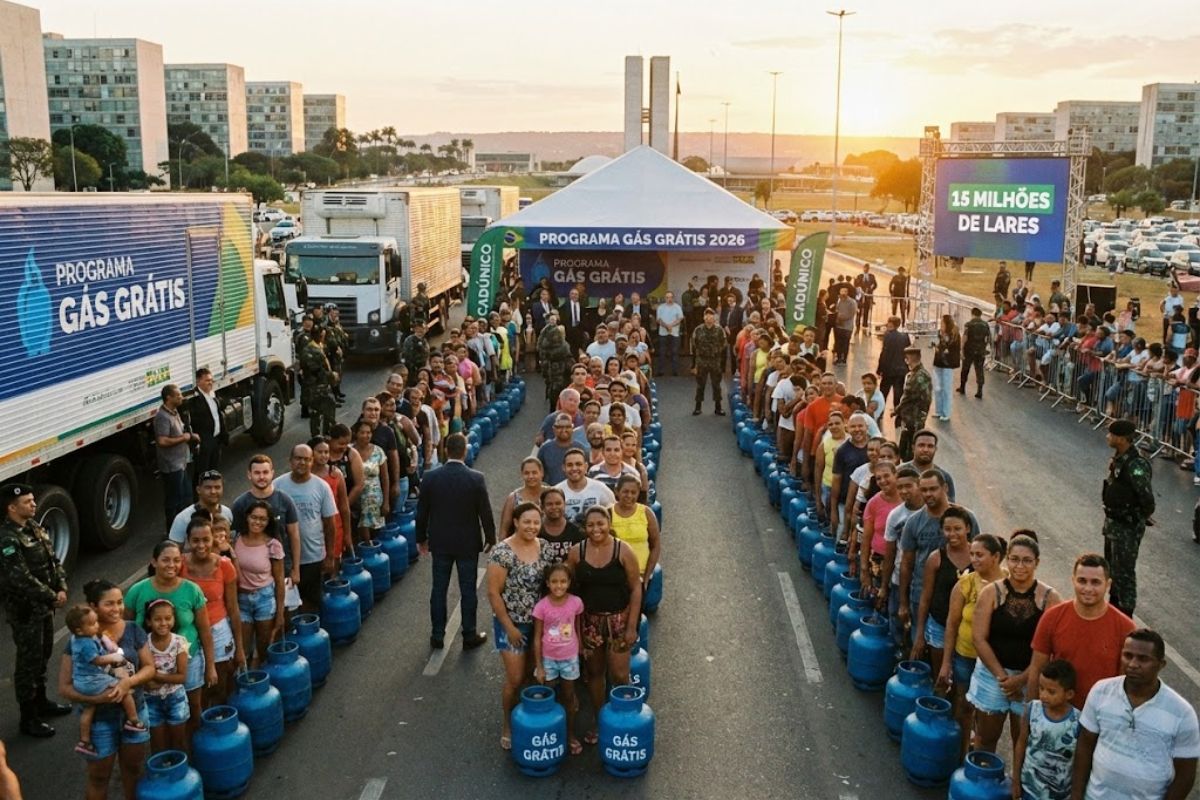
The Free Gas from the Gas for the People Program Begins to Serve All Capitals on Monday, January 26, 2026, with Withdrawal at Authorized Resellers via CPF or Bolsa Família Card, Prioritizing Families from CadÚnico and Promising Up to 15 Million Households by March Nationwide
The free gas becomes effective in the capitals starting January 26, 2026, and expands the urban coverage of Gas for the People, including 17 more capitals in the immediate scope. The measure targets low-income families from CadÚnico, focusing on those already receiving Bolsa Família, to ensure cylinders at no cost and reduce pressure on household budgets.
The expansion announced by the Ministry of Social Development aims to include 950,000 new families in the short term. The reported schedule expects full implementation by March 2026, with the goal of reaching 15 million families in the 5,571 municipalities, bringing the concept of free gas from the capitals to medium-sized centers and smaller cities.
What Changes with Free Gas in the Capitals
The turning point is the change in model: Gas for the People will now distribute cylinders for free in a more direct manner, replacing the previous bimonthly aid format. In practice, the promise is to shorten the gap between eligibility in CadÚnico and the withdrawal of the cylinder, with operations anchored in authorized resellers.
-
A new Brazilian shopping center worth R$ 400 million will be built in an area equivalent to more than 4 football fields, featuring 90 stores, 5 cinemas, a supermarket, a college, and parking for 1,700 cars, potentially generating 3,000 jobs.

-
Larger than entire cities in Brazil: BYD is building a 4.6 km² complex in Bahia with a capacity for 600,000 vehicles per year, but the discovery of 163 workers in conditions analogous to slavery has shaken the entire project.

-
With an investment of R$ 612 million, a capacity to process 1.2 million liters of milk per day, Piracanjuba inaugurates a mega cheese factory that increases national production, reduces dependence on imports, and repositions Brazil on the global dairy map.

-
Brazilian city gains industrial hub for 85 companies that is equivalent to 55 football fields.


The arrival of free gas to all capitals has operational impacts because it concentrates a large part of the demand in urban areas with already structured logistics. At the same time, the declared plan is to scale delivery beyond the capitals, maintaining the same service rules and withdrawal mechanisms throughout 2026.
Who Can Receive Through CadÚnico and Bolsa Família
The reported eligibility combines registration in CadÚnico and a per capita income of up to half a minimum wage, cited as R$ 759. Within this framework, priority is given to families registered in Bolsa Família, who tend to be the frontline of the target audience for free gas.
The program allows for an annual variation in withdrawals based on family size: the described rule permits four to six cylinders per year. The central point is that free gas depends on active registration and correct identification of the family head, a condition that ties the benefit to CadÚnico and the routines of updating the record.
Where to Withdraw Cylinders and How Delivery Works
Gas for the People informs distribution through authorized resellers, with a network of over 10,000 service points across the country. The withdrawal of free gas can be done with the Bolsa Família card or the CPF of the family head, a relevant alternative for those who need to regularize service routines without depending on the card at the time of collection.
The design aims to speed up the delivery of cylinders in the capitals and reduce transportation barriers. In practice, the effectiveness of free gas depends on three simultaneous fronts: availability of accredited points, availability of cylinders for withdrawal, and clarity in communication about accepted documents.
Goal of 15 Million Households by March 2026
The reported timeline is March 2026, when the government expects the program to be fully implemented, with a potential reach of 15 million families and coverage across the 5,571 municipalities. This number is the main political indicator of free gas, as it links the expansion in the capitals to a national ambition for coverage.
The plan also highlights the recent inclusion of 17 more capitals, a short-term milestone that repositions the program as an urban-scale policy. If the network of resellers maintains the pace, the measure becomes the effective volume and regularity of withdrawals, rather than announcements of adherence.
Why the Government Bets on Free Cylinders
The rationale presented is to alleviate the cost of gas in the budget and reduce the need for wood and charcoal, which are cited as less safe alternatives. In terms of public policy, the bet is that free gas improves living conditions by reducing household exposure to solid fuels and stabilizing recurring expenses.
The practical effect depends on the fit between CadÚnico, Bolsa Família, and the routines of the capitals: when the registration is up-to-date and the accredited point is accessible, the free cylinder tends to become a tangible benefit. For those outside CadÚnico, the main barrier remains registration and proof of per capita income.
Throughout 2026, the main demand is likely to be execution transparency: how many cylinders have been delivered, in which capitals there were bottlenecks, and whether the goal of 15 million families by March was achieved as per the schedule. If you live in one of the capitals, has free gas improved your routine or are there still gaps in points and information for withdrawal?







-

-

-

-

15 pessoas reagiram a isso.