





 Português
  Inglês
  Espanhol
  4 min de leitura
  2 comentários


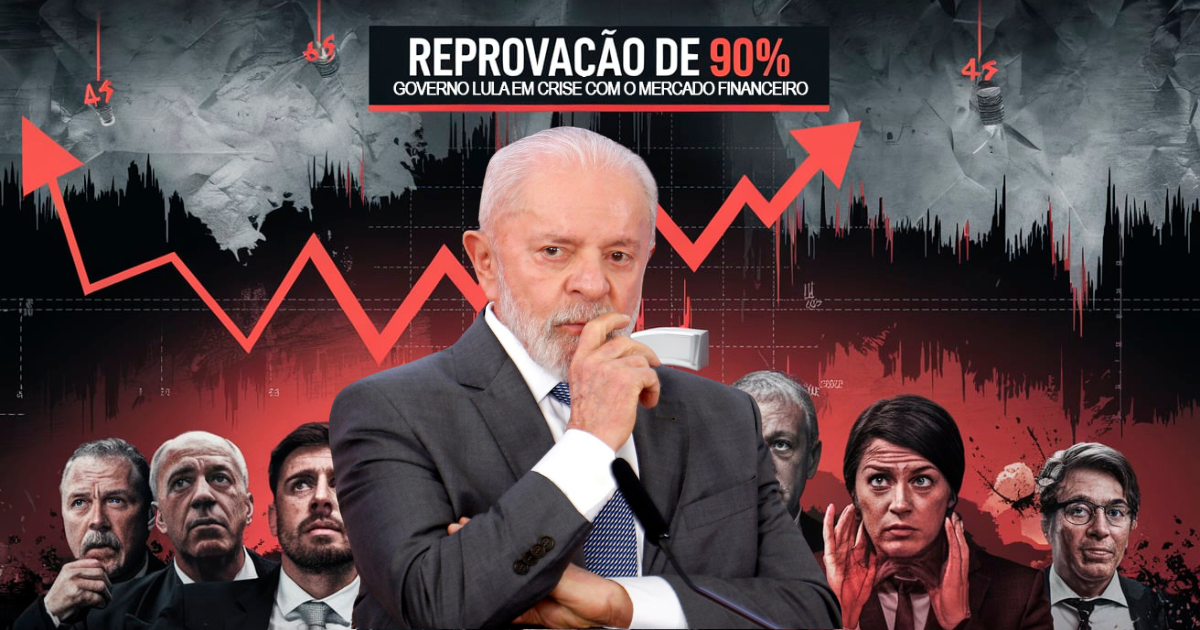


Lula’s Government Disapproval Reaches 90%, According to Quaest Survey, Reflecting Market Financial Distrust. Fiscal Policies, Like the New Economic Framework, Are Widely Criticized. It’s Time to Question: Will the Government Be Able to Recover Lost Trust?
A survey released by Quaest this Wednesday (04) revealed that the disapproval of the Lula government (PT) among managers, economists, and financial analysts reached an impressive 90%.
This alarming data calls into question the economic measures of the current administration, generating a wave of skepticism about the country’s future. But what lies behind this almost unanimous dissatisfaction?
According to the survey, commissioned by Genial Investimentos, the numbers reflect the negative perception regarding the government’s recent fiscal decisions.
-
Brazilian city gains industrial hub for 85 companies that is equivalent to 55 football fields.

-
Peugeot and Citroën factory in Argentina cuts production by half and opens a layoff program for more than 2,000 employees after Brazil drastically reduced purchases of Argentine vehicles.

-
A Brazilian city gains a factory worth R$ 300 million with the capacity to process 200 thousand tons of wheat per year, a mill of 660 tons/day, silos for 42 thousand tons, and an industrial area of 276 thousand m².

-
Havan will leave the shopping mall in Blumenau to inaugurate something that the chain has never done before: a megastore in half-timbered style in the Historic Center of the city, which is expected to be completed in May and change the landscape of local retail.

The survey interviewed 105 financial market professionals based in São Paulo and Rio de Janeiro between November 29 and December 3, 2024.
The margin of error is 3.4 percentage points, but the results already provide a clear picture: only 3% of respondents rate the government positively, while 7% consider the management regular.
A Growing Disapproval
Compared to the last survey, conducted in March of this year, disapproval has more than tripled.
At that time, only 26% of agents disapproved of the Lula government, with 6% approval and 30% of regular evaluations.
This abrupt increase is attributed, according to the director of Quaest, Felipe Nunes, to the impact of recently presented fiscal measures that did not meet market expectations.
Among the most criticized points is the spending cuts package announced by the government last week.
Financial agents have questioned the viability of these measures and the real impact they can have on economic stabilization.
Popularity Versus Fiscal Responsibility
Another concerning data point from the survey indicates that 86% of respondents believe Lula is more concerned with maintaining his popularity than ensuring the fiscal balance of the country.
Only 29% believe that the government shows a real commitment to public accounts.
The distrust extends to the National Congress, which has lost its role as a “fiscal actor,” according to participants.
One reason for this is the perception that, while the exemption from income tax for those earning up to R$ 5,000 has a high chance of being approved, taxation on incomes over R$ 50,000 is unlikely to pass legislative scrutiny.
Haddad’s Performance
The Minister of Finance, Fernando Haddad, has also suffered a setback in his popularity.
His approval rating dropped from 50% in March to 41% in December, while negative evaluations rose from 12% to 24%.
Additionally, 61% of respondents stated that Haddad’s political strength is lower than at the beginning of the term, reflecting a significant decline in confidence in his ability to lead economic policy.
The fiscal package, a key component of his economic strategy, was deemed “unsatisfactory” by 58% of respondents and only “somewhat satisfactory” by the rest.
This negative perception reinforces skepticism regarding the effectiveness of the adopted measures.
The New Fiscal Framework
Another widely criticized aspect was the new fiscal framework, which replaced the old spending ceiling implemented during Michel Temer’s government.
For 58% of respondents, the new model lacks any credibility, while 42% consider it only marginally trustworthy.
The majority of specialists believe that the framework will not be sustainable in the long term, raising concerns about the future of the Brazilian economy.
Moreover, 96% of respondents assessed that the country’s economic policy is headed in the wrong direction, with only 4% indicating it is on the right track.
For 2025, pessimism prevails: 88% believe the economy will worsen, 10% that it will remain stable, and only 2% hope for improvement.
Investments in Flight
The distrust in the government is also affecting resource allocation.
After the announcement of the fiscal package, 67% of respondents stated they plan to increase their investments abroad, while 30% intend to maintain them at the same level, and only 3% consider reducing them.
Despite this, some government measures were well received. The end of “fictive death” – pensions paid to families of expelled military personnel – was viewed positively by 99% of respondents.
However, this isolated decision was not enough to alter the overall perception of uncertainty.
An Economic Policy Under Question
The crisis of confidence in Lula’s government represents an unprecedented challenge. With the financial market growing increasingly skeptical, the administration faces the difficult task of balancing fiscal responsibility and popularity.
While the new fiscal framework and spending cuts spark debate, it remains to be seen whether the actions taken by the government will be sufficient to regain investors’ trust and resume the path of economic growth. How do you assess the Lula government so far?









A mídia, como sempre trabalha contra o Brasil. Não bastou o que fizeram em 64, agora querem jogar o país novamente no caos. Cabe perguntar: quais interesses estão por trás disto?
Desde que me entendo por gente, nunca entendi os economistas, que estão sempre insatisfeitos querendo mais e mais, se o país está ferrado mas eles estao ganhando, se dando bem, arrumam uma maneira de fazer alguma crítica para se darem melhor, e o país está bem e consequentemente eles ganhando muito mais, também tecerão críticas, orquestradas, para que ganhem mais. O povo, ah esse povo que se ****, fique sem trabalho, morra de fome, doente, sem lazer. Onde já se viu um governo tirar 8 milhões de pessoas da situação de fome, isso é uma audácia que eles não permitem jamais, já o contrário….