





 Português
  Inglês
  Espanhol
 6 min de leitura
  0 comentários


The Largest Municipal Student Housing Assistance Program in Brazil, the University Rent Program Opens Second Announcement on November 18, 2025, Pays a Fixed Subsidy of R$ 700 and Connects Niterói Center, Peripheral Youth and Higher Education Retention with Less Dropout and Support for Low-Income Students in the Region
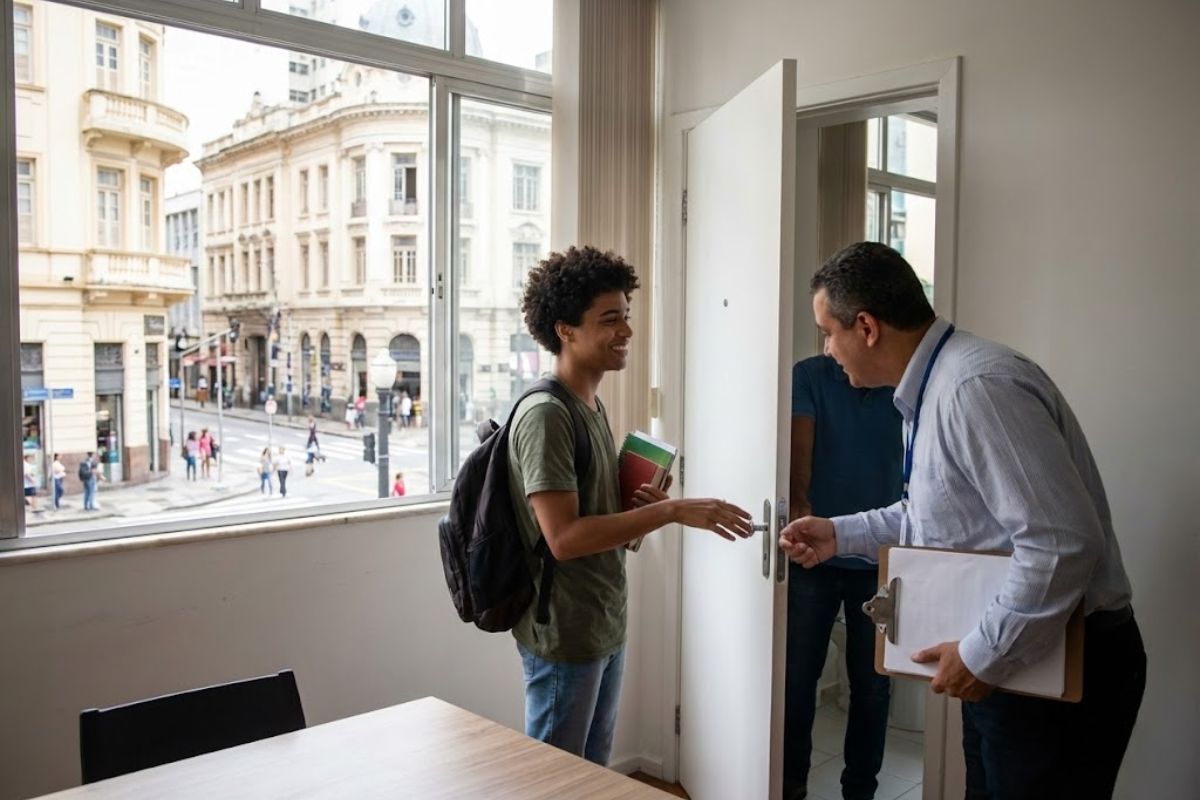
On November 18, 2025, at Caminho Niemeyer, the City Hall of Niterói launched the 2nd Announcement of the University Rent Program, recognized as the largest municipal housing assistance program for students in Brazil. The new phase guarantees R$ 700 per month to low-income students from public and private institutions, so they can afford housing in the city center and maintain their study routine in higher education.
In the first phase, held in July 2025, 650 students were selected. Now, the second announcement aims to reach more than a thousand students, with registrations open until December 2, 2025, results to be announced on December 19, 2025, and the first payment scheduled for February 2026, consolidating the University Rent Program as a continuous tool for university retention.
How the University Rent Program Works and Who Can Participate
The University Rent Program is structured as a direct monthly subsidy for housing costs in designated areas of the municipality.
-
Brazilian city gains industrial hub for 85 companies that is equivalent to 55 football fields.

-
Peugeot and Citroën factory in Argentina cuts production by half and opens a layoff program for more than 2,000 employees after Brazil drastically reduced purchases of Argentine vehicles.

-
A Brazilian city gains a factory worth R$ 300 million with the capacity to process 200 thousand tons of wheat per year, a mill of 660 tons/day, silos for 42 thousand tons, and an industrial area of 276 thousand m².

-
Havan will leave the shopping mall in Blumenau to inaugurate something that the chain has never done before: a megastore in half-timbered style in the Historic Center of the city, which is expected to be completed in May and change the landscape of local retail.

The R$ 700 monthly benefit is intended for low-income students who need to live close to educational institutions located in Niterói, reducing travel time and fixed costs that often strain the family budget.
To participate in the selection process, the student must be enrolled in an in-person higher education course, at a public or private institution, be from a family with a gross income equal to or less than three minimum wages, not receive any other financial subsidy of the same nature, and be over 18 years old on the date of the announcement publication.
These criteria define the program’s focus on young people who, without assistance, would have a real difficulty staying in college.
The selection is formalized through a public announcement and follows a schedule defined by the City Hall.
Applications are made exclusively online, at the official University Rent Program website, where the candidate submits documentation, proves income, enrollment, and residency situation.
The screening seeks to cross socioeconomic information with the availability of spots, within the threshold of a thousand new grants planned for the second announcement.
Impact on the Lives of Low-Income Students
At the launch ceremony, Mayor Rodrigo Neves emphasized that the University Rent Program is one of the most symbolic public policies aimed at the youth of the municipality.
He stressed that many of the beneficiaries come from lower classes and see the program as a chance to be the first in the family to complete higher education, associating the benefit with the reduction of inequalities and the consolidation of academic trajectories.
Individual stories illustrate this impact. Edson Luiz de Oliveira Neves Coelho, 20, a resident of São Gonçalo and a pedagogy student at UFF, has already gathered all the documentation to compete for the second announcement.
For him, living in São Gonçalo and studying in Niterói means hours daily in transport, less study time, and almost no space for leisure and culture.
With the University Rent Program, Edson sees a concrete possibility of moving to the center, gaining quality of life and expanding access to the city’s cultural programming.
The program’s effectiveness is also evident in the experiences of already selected students.
Carm Suze Jean, 25, a Haitian who came to Brazil to study Pharmacy at UFF, benefited from the first announcement.
She reports that the University Rent Program was essential to cope with financial difficulties and the inability to receive regular help from her family abroad, allowing for a more stable life and focus on studies.
Revitalization of the Center and New Urban Dynamics in Niterói
In addition to the direct effect on student retention, the University Rent Program plays a strategic role within the project for the revitalization of Niterói’s center.
The program encourages properties used by scholarship recipients to concentrate in an area that includes the center and parts of the neighborhoods of São Domingos and São Lourenço, bringing new permanent residents to a traditionally marked area with heavy daytime traffic and nighttime emptiness.
As a result, the center begins to receive a constant flow of young university students, who consume local services, use public facilities, and help create routines of urban space usage beyond business hours.
The student housing assistance policy thus ties into objectives of safety, territorial occupation, and economic dynamization, reinforcing the idea of a vibrant and multifunctional city.
The initiative’s design shows that the University Rent Program is not just a financial transfer, but integrates an urban strategy that brings together university, housing, and service networks, focusing on reduced mobility, qualified permanence, and the use of existing infrastructure.
University Rent Program as a Youth and Education Policy
From the perspective of municipal management, the University Rent Program is presented as a youth and education policy with high transformative power.
According to the municipal coordinator of Youth, João Pedro Boechat, the program represents “a dream coming true” for more than a thousand young people, who will be able to experience a new city experience, with better quality of life and the certainty that Niterói believes in education.
By subsidizing the housing of low-income students, the program addresses one of the main bottlenecks of university retention in Brazil.
Rent, transportation, and food costs often lead young people to drop out, reduce study hours to work more, or abandon their course.
Niterói’s model directly addresses this variable, associating municipal resources with the higher education educational policy.
For the mayor and his team, the University Rent Program encapsulates the city’s commitment to reducing inequalities and to the higher education of new generations.
The initiative also reinforces the municipality’s image as a regional university hub, capable of attracting students from other cities, states, and countries, based on a combination of universities, culture, and housing support.
Applications, Deadlines, and Next Steps of the Program
The second announcement of the University Rent Program is already underway, with applications open until December 2, 2025.
Interested parties must access the official program website, fill out the electronic form, and attach all required documentation, including proof of income, enrollment in an in-person higher education course, ID, CPF, and other requested requirements.
The results are expected on December 19, 2025, by which time students will know if they have been granted one of the thousand new spots.
Those selected will receive the first payment of the R$ 700 monthly subsidy in February 2026, according to the schedule set by the City Hall of Niterói.
From then on, monitoring the use of the benefit and updating data will become part of the program’s routine.
With the addition of the 650 students from the first phase and the thousand students planned in the second announcement, the University Rent Program solidifies as a national reference in municipal student housing assistance.
The combination of direct income transfer, focus on low-income students, and urban revitalization strategy places Niterói in a unique position in the debate over local policies for higher education in Brazil.
In light of this scenario, in your opinion, should the University Rent Program be expanded to other Brazilian municipalities with similar student housing assistance models, or should the priority be to invest in more free spots at public universities?










-

Uma pessoa reagiu a isso.