





 Português
  Inglês
  Espanhol
  5 min de leitura
  3 comentários


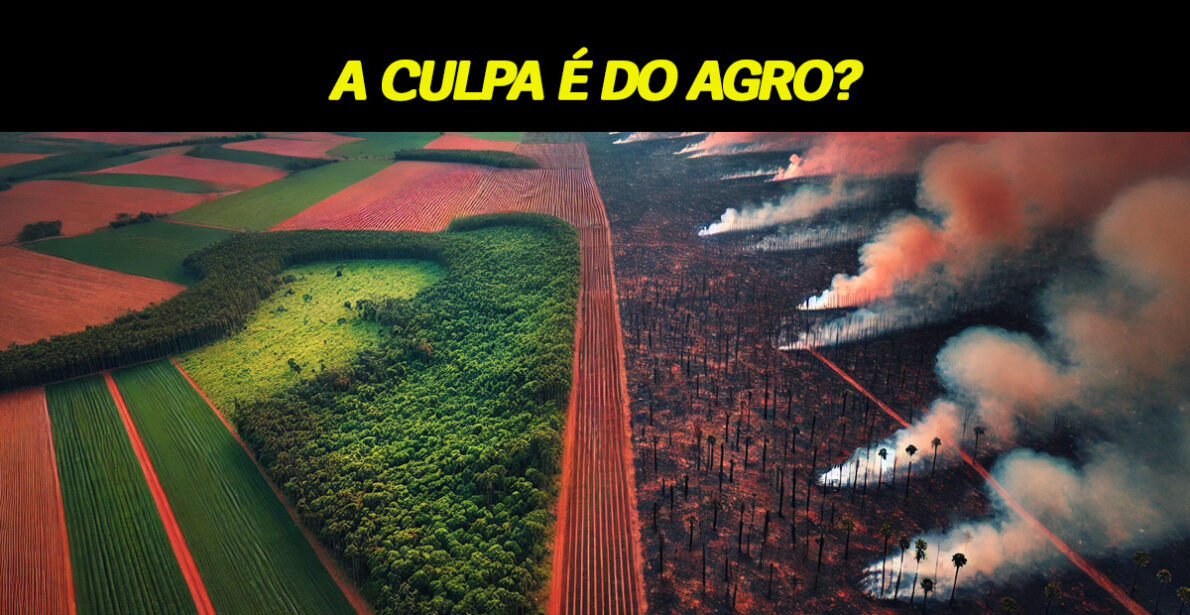

Brazil Is on Fire. It’s Not Just About the Images of Burning Forests Circulating on Social Media, But a Deeper Environmental Crisis Affecting Millions of Brazilians’ Health.
The air in large cities like São Paulo has become practically unbreathable, and the sky has taken on an apocalyptic hue, due to the criminal wildfires occurring in various regions of the country.
For many, the environmental issue seems distant, but the impacts are becoming increasingly close and visible. The real question is: who is behind this unrelenting fire?
According to Sabrina Fernandes, a political economist and doctor in sociology, the destructive power of agribusiness in Brazil is one of the main causes of this environmental devastation.
-
Brazilian city gains industrial hub for 85 companies that is equivalent to 55 football fields.

-
Peugeot and Citroën factory in Argentina cuts production by half and opens a layoff program for more than 2,000 employees after Brazil drastically reduced purchases of Argentine vehicles.

-
A Brazilian city gains a factory worth R$ 300 million with the capacity to process 200 thousand tons of wheat per year, a mill of 660 tons/day, silos for 42 thousand tons, and an industrial area of 276 thousand m².
-
Havan will leave the shopping mall in Blumenau to inaugurate something that the chain has never done before: a megastore in half-timbered style in the Historic Center of the city, which is expected to be completed in May and change the landscape of local retail.


In a publication on the website Intercept Brasil, she highlights that the relationship between the sector and the environment is far from sustainable.
For her, agribusiness has managed to convince a large part of the population that it is the main force of the Brazilian economy, providing food and boosting the trade balance.
However, she argues that this view is limited. “While agribusiness profits, it destroys ecosystems and impoverishes alternative sectors that could ensure more sustainable food production,” says the economist.
According to her, the problem is that the current model of monocultures and intensive pesticide use poisons the land and generates dependence on commodity exports, affecting food production for domestic consumption.
The Illusion of Food from Agribusiness
According to Fernandes, there is a myth that agribusiness feeds Brazil, but the reality is that much of the production is aimed at the external market.
At the same time, small producers who could supply the domestic market with healthier and more sustainable products face a series of challenges. “Without government support and adequate infrastructure, family farming struggles to survive,” she states.
The difference between the investments in agribusiness and family farming is striking. As the economist pointed out, the 2024/2025 Safra Plan allocated R$ 76 billion to family farming, while agribusiness received R$ 400.59 billion.
This discrepancy, according to her, highlights the dependency that the Brazilian government still has on the sector, even in the face of negative impacts on the environment.
Environmental and Political Crisis
Fernandes also emphasizes that the environmental crisis in Brazil is intrinsically linked to the political and economic crisis. According to her, the Lula government, even though it has adopted more progressive policies regarding the environment, still needs to break with the established power of agribusiness.
“It’s not enough to put out fires; it is necessary to address the root causes of this destruction,” declares the economist, who still says that the problem is that agribusiness has significant political influence.
For her, during the Jair Bolsonaro government, this alliance was clear, with the then Environment Minister, Ricardo Salles, being one of the main facilitators of the so-called “boiada” that destroyed environmental protection areas. Now, according to her, even with stronger environmental policies, the power of agribusiness continues to dictate rules.
The Challenge of Ecological Transition
One of Sabrina Fernandes’ main criticisms of the Lula government is the lack of an environmental policy that genuinely confronts the power of agribusiness.
According to her, the government’s ecological transition initiatives are limited and often shaped by “green capitalism,” which only paper over the problem without addressing the structural causes of the crisis.
“We need a popular, agroecological, and ecofeminist agrarian reform, that confronts the predatory logic of agribusiness and enables small producers to thrive without relying on monocultures and pesticides,” emphasizes the economist. She also highlights that, without profound changes, Brazil will remain trapped in a cycle of environmental destruction and economic dependency.
Violence in the Fields and Its Impacts
Another point raised by Fernandes is the violence that permeates life in the countryside, primarily, according to her, against indigenous peoples, quilombola communities, landless rural workers, and settled workers.
“The advance of agribusiness is not only through environmental destruction but also through violence against those who resist this model of production,” highlights the economist, who argues that this violence is often made invisible by the general public, which does not recognize the human impact of the expansion of agribusiness.
“We are talking about a silent war, where the agrarian elite allies itself with organized crime to maintain its power,” says Fernandes, who also criticizes the so-called energy transition promoted by the Brazilian government.
Although the term suggests a move towards more sustainable energy sources, the economist argues that, in practice, this transition has served more as an energy diversification, without truly breaking from fossil fuel dependency.
In this sense, she points out that agribusiness also benefits from this diversification, as many of the “ecological solutions” promoted by the sector aim only to clean its image, without actually reducing its environmental impacts.
“The carbon market, for example, is one of those false solutions that allow agribusiness to continue profiting while perpetuating destruction,” argues Fernandes.
For the Economist, Agribusiness Owes Us. And You?
Finally, Sabrina Fernandes says that the real debate that Brazil needs to face is about the toxic relationship between agribusiness and the Brazilian state.
According to her, we cannot continue subsidizing a sector that enriches at the expense of environmental destruction and the exploitation of rural workers.
In this sense, she states that Brazil “needs to break with agribusiness” to face the ecological and social crises that worsen each year, and this includes policies that strengthen family farming, agrarian reform, and agroecology.
“Agribusiness owes us, not the other way around. We are the ones who pay the price for their profit,” the economist concludes.
What do you think about the economist’s opinion, reader? Share your thoughts in the comments!








Rapaz que mulher mais sem noção,de onde ela tirou isso , e só ela ler as matérias e ver quem tá incendiando tudo ,como ser estudada uma pessoa dessa.
Economista ou militonta?
A ineficiência e inútil quadrilha está colocando fogo no Brasil inteiro e a culpa é do agro… lembrando que o Lules em campanha deixou muito bem claro que ele acabaria com o AGRO no país…