





 Português
  Inglês
  Espanhol
  2 min de leitura
  0 comentários



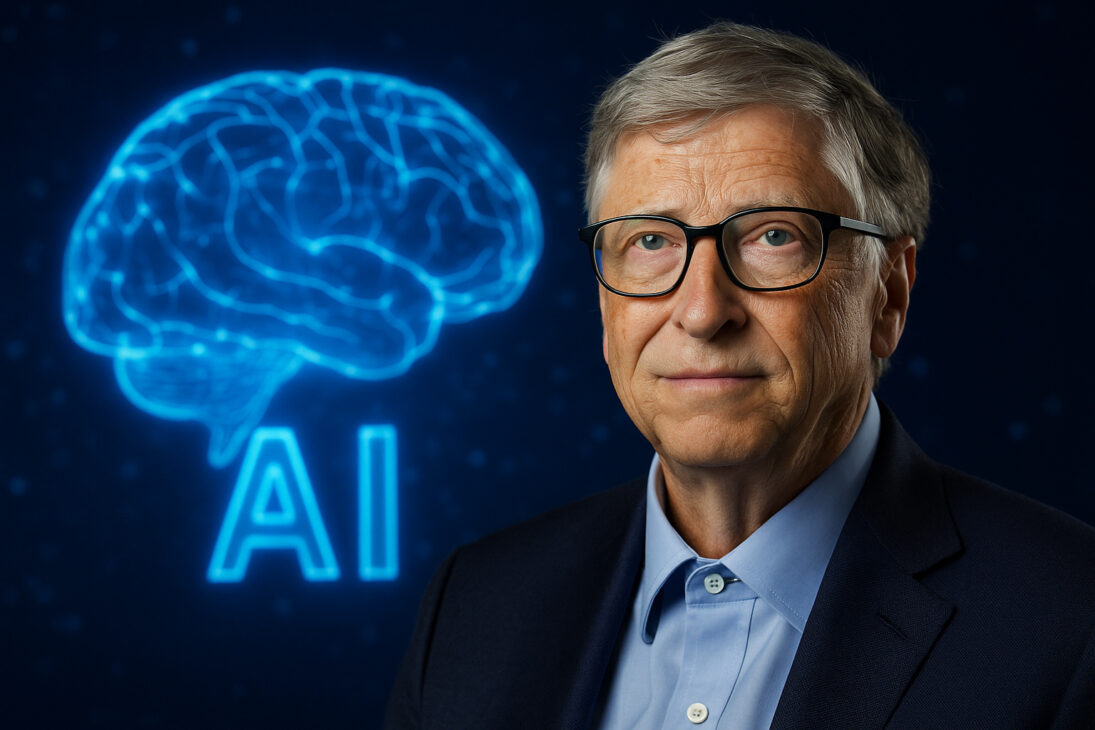
See Bill Gates’ Projection for This Year
The forecast made by Bill Gates in 2024 sparked discussions among experts in various sectors. The warning triggered widespread debate around the world.
According to the Microsoft founder, reported by Bloomberg News in January 2024, the advancement of artificial intelligence by 2025 will bring profound changes.
These changes will affect economic sectors, consumption patterns, and the job market.
Therefore, industry experts highlight that by December 2025, companies must adapt production models and invest in smart technologies.
Reuters pointed out in March 2024 that governments are paying attention to these transformations.
Various countries are creating regulations that will come into force by the second half of 2025.
These rules aim to balance innovation, ethics, and privacy.
Artificial Intelligence Grows at Record Pace in 2025
Data from renowned agencies like the Financial Times and BBC News show historic advancements in 2024.
The artificial intelligence fueled billion-dollar investments in new technologies.
By the end of 2025, over 60% of operational tasks could be automated.
Companies of all sizes are discussing plans to reskill professionals, according to The Guardian in April 2024.
Silicon Valley giants like Google and Amazon announced partnerships in May 2024 to accelerate research in generative AI.
Despite the enthusiasm, international organizations like the European Union informed in June 2024 of new guidelines for sensitive data.
These standards are expected to be released by September 2025 to ensure responsible use.
Social and Economic Impact Is a Global Agenda in 2025
Bill Gates’ projection also reignited discussions about socioeconomic impacts.
In February 2024, Forbes highlighted that new jobs will arise, mainly in programming and cybersecurity.
Industrial automation will also gain prominence in future hiring.
However, a study by the International Labour Organization, published in July 2024, warned about potential declines in traditional sectors.
These sectors will need to invest in digital transformation by the first quarter of 2025.
A report from the World Economic Forum released in August 2024 reinforced the importance of inclusive public policies.
These policies will reduce inequalities and support the migration of professionals to tech areas.
-
Mercor paid $1.5 million per day for doctors, lawyers, and former Goldman Sachs bankers to teach artificial intelligence to do their jobs, and in 17 months, it went from zero to $500 million in annual revenue while its own contractors accelerated the replacement of their own work.

-
Casio Unveils Moflin, Robotic Pet With Artificial Intelligence Designed To Provide Emotional Comfort And Simulate A Permanent Affectionate Bond

-
Google Maps Revolutionizes GPS Navigation With Gemini Artificial Intelligence, Ask Maps Feature, and Advanced 3D Visualization for Route and Travel Planning

-
China Warns the U.S. of a “Terminator” Style Apocalypse: Military AI Rivalry, Sanctions Against American Startup, and Fear of Algorithms Deciding Who Lives or Dies Place the World on the Brink of a Nightmare That Seemed Like Fiction

Global Companies Quickly Adapt to Meet Changes
Technology companies are therefore accelerating training to align operations with the new scenario. In addition, the New York Times pointed this out in September 2024.
Meanwhile, multinationals like Tesla and Apple, according to CNBC in October 2024, have already presented prototypes of AI solutions.
These innovations, therefore, cater to the automotive and personal devices sectors.
Governments, consequently, are discussing tax incentives to encourage innovation without compromising fundamental rights.
By November 2025, new legislations are expected to be voted on in blocs like the European Union and Mercosur.
These changes, therefore, are seen as strategic to drive sustainable growth.










Seja o primeiro a reagir!