





 Portuguese
  English
  Spanish
  4 min of reading


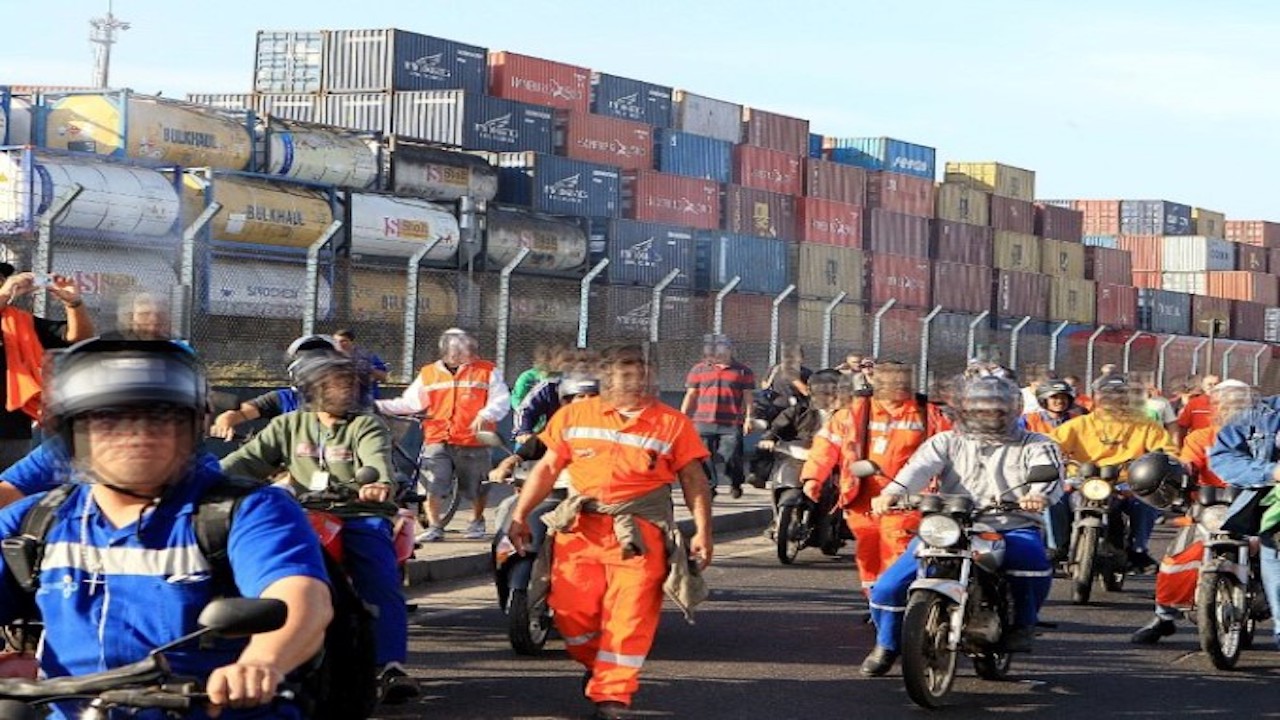
Port Workers Prepare Strike Against Port Terminal Leases by the Federal Government. Ports Auctioned in 2021 Generated a Total of R$ 1.8 Billion in Investments with an Estimated 26,993 New Jobs
After the leasing of 12 port terminals in 2021 that generated a total of R$ 1.8 billion in investments, the federal government’s concession plan still foresees the privatization of four more ports this year and, in protest against the privatization of ports, Brazil’s port workers are organizing a 12-hour strike next Friday (28), the day that celebrates Port Workers’ Day.
Also Read
- Indefinite Strike of Truck Drivers Next Sunday Against the Increase in Fuel Prices Set by Petrobras
- The Largest Steel Industry in Brazil and Latin America Calls for Unexperienced Candidates in RJ for Apprenticeship Vacancies in Maintenance Mechanics, Electrical Engineering, Operators, and More!
- Job Openings for Elementary and High School to Work at an Ethanol Plant in São Paulo
- Gasoline and Diesel Prices Could Drop to R$ 3.00 Cheaper If Senate and Congress Create Fund with Profits Obtained by the Government from the High Dollar and Oil Prices to Subsidize Fuel Adjustments
- New Wind Turbine Wall Can Hide from View, Integrates Perfectly into Urban Environments, Is Safe, and Produces Over 10,000 kWh
Port Workers Will Strike in Protest Against the Privatization of Ports
Despite the strike, the government continues with the privatization processes, where, by February 9, 2022, there will be a public consultation by the National Agency of Waterway Transportation (Antaq) to receive contributions regarding the concession auction of the Port of São Sebastião. Technical documents and legal drafts are available on Antaq’s page.
After the public consultation period, a hearing will be held to discuss the contributions received by the agency, with no date set yet.
-
Historic bankruptcy of Centauro shocks the market, and the century-old company puts more than 500,000 products, machines, and complete infrastructure up for online auction.

-
New shoe factory in Ceará is expected to create 400 jobs and strengthen the local economy.
-
No one imagined it, but a mixture of sawdust with a mineral that fights fires surprises scientists with a result that changes the course of fire-resistant construction.

-
From empty land to a high-end house, wooden construction uses a lightweight system, metal structure for the foundation, ventilated ceramic cladding, and special windows to create an efficient and comfortable living space throughout the year.

The privatization auction of the port is expected to take place at the B3 stock exchange, with no date defined yet. According to the draft of the concession notice, the contract term will be 25 years, extendable for another five.
In a document signed by the coordinator of the Organized Port Intersyndical of São Sebastião, Robson Wilson dos Santos, the union leaders argue that “handing over port authority to the private sector is a gross mistake against the country’s economy, as it will transfer an activity that is fundamentally a state responsibility to the private sector, which only seeks profit and not the management of public welfare and policies of a country.”
The category also fears the privatization model that the Brazilian government may adopt. The union leaders claim that the government wants to copy the Australian model, transferring port authority to the private sector. “This model did not work in Australia and has led to what they now call ‘port inflation’, given the abusive increases in port tariffs on all services provided, imposing a significant increase in living costs on the Australian people,” they note in the document.
Currently, the port is operated by Companhia Docas de São Sebastião, the administrator and Port Authority of the Port of São Sebastião.
Privatization of Docas do Espírito Santo (CODESA)
The Unified Port Wharf Syndicate (Suport-ES) also supports the strike and will halt operations on the same day (28), which is expected to occur from 7 AM to 7 PM. The movement is due to the announcement of the privatization of Docas do Espírito Santo (CODESA).
The category mainly advocates for job security and better career plans. Another demand from port workers would be related to a 12-month stability period, during which dismissals without cause would be prohibited, a timeframe considered insufficient.
The winner of the CODESA auction, scheduled for March 25, will assume the administrative functions of the ports, in addition to indirect exploitation for a period of 35 years, extendable by another five.
It is worth mentioning that January 28, the date chosen by the category for the halt, celebrates “Port Workers’ Day.” The date refers to the opening of Brazilian ports to friendly nations in 1808.
Port Concessions
This year, among the main projects expected to be delivered to the private sector, the following stand out: Port of Espírito Santo, Itajaí (SC), Port of São Sebastião (SP), and finally, the Port of Santos (SP), which, with investments generated by the private sector, could become the largest in the Southern Hemisphere.
The first auction is expected to be of the Companhia de Docas do Espírito Santo (Codesa), responsible for the administration of the ports of Vitória and Barra do Riacho, with an estimated R$ 783 million in private investments for a 35-year concession contract with the possibility of extension for another five.
For the second quarter of 2022, the privatization of the Port of São Sebastião is planned, with estimated investments of R$ 574 million. “With the concession/privatization of the ports, the expectation is that there will be a positive impact on the port sector with the potential for economic development, investment realization, and greater efficiency in port activities. However, as this is new for the sector, some challenges may arise during the process, such as regulation, competition, and the determination of port tariff prices,” emphasizes Alexandre Aroeira Salles, a Ph.D. in Law and founding partner of the Aroeira Salles law firm, in an interview with Jornal Jurid.
The terminals leased in 2021 generated a total of R$ 1.8 billion in investments and R$ 813.7 million in grants. The estimate is the creation of 26,993 new jobs.









Seja o primeiro a reagir!