





 Português
  Inglês
  Espanhol
  5 min de leitura
  0 comentários



Discover How to Start and Grow in the Renewable Energy Career, an Expanding Sector That Combines Purpose, Innovation, and Sustainability to Transform the Future of the Planet.
In recent years, the renewable energy career has stopped being just a future trend and has become a urgent necessity.
Due to global discussions about global warming, decarbonization of the economy, and sustainability, professionals from various fields are seeking to understand how to operate in this rapidly growing sector.
Therefore, whether you are a beginner or someone in transition, this guide shows the paths and possibilities of this promising area.
-
Renewable energy advances over protected areas in Brazil, and a survey by the Energy Transition Observatory reveals silent impacts that challenge environmental conservation and pressure sensitive traditional territories.

-
Rio Grande do Sul accelerates energy transition: State invests in renewable technologies and consolidates decarbonization strategies and pathways to attract billions in new industrial investments.

-
With 160,000 m² of collectors, an area larger than 20 football fields, Silkeborg, in Denmark, hosts a solar thermal plant that heats 19,500 homes and could become the largest solar heating plant in the world.

-
A study reveals the expansion of renewable energy procurement in Brazil and shows how companies are taking advantage of opportunities to reduce expenses, ensure energy efficiency, and strengthen strategic environmental commitments.


What Is Renewable Energy and Why Is It So Important?
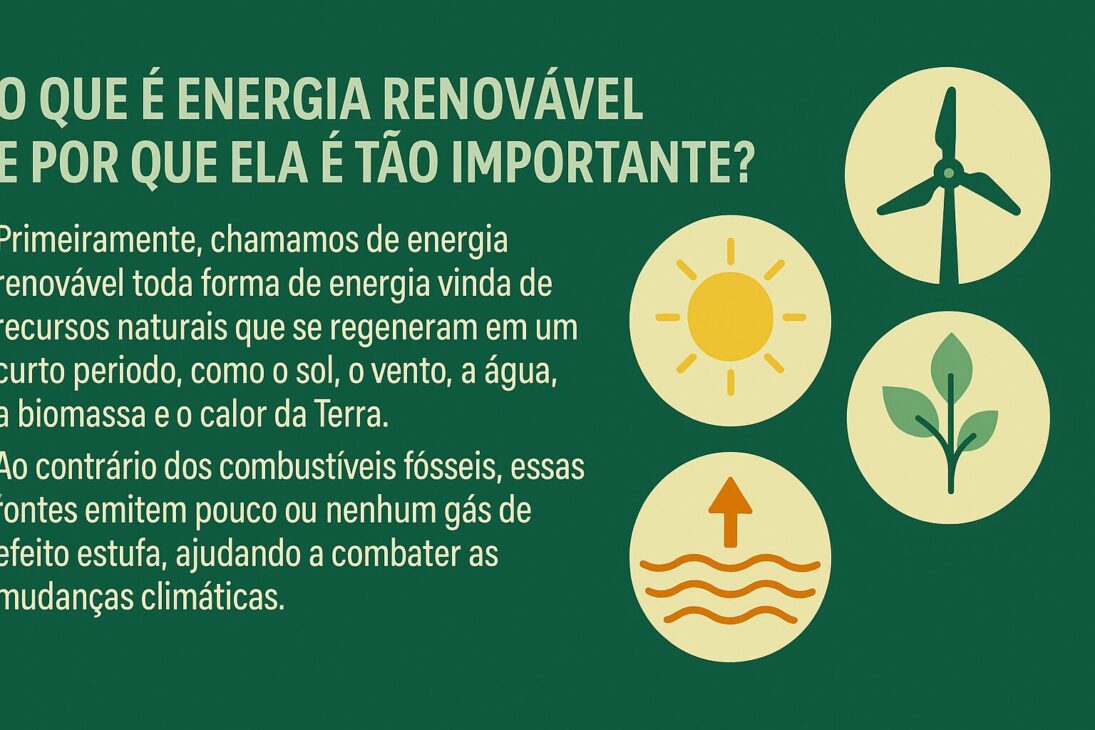
First, we refer to renewable energy as any form of energy derived from natural resources that regenerate over a short period, such as sun, wind, water, biomass, and the Earth’s heat.
Unlike fossil fuels, these sources emit little to no greenhouse gases, helping to combat climate change.
Additionally, ancient civilizations already used solar energy to heat spaces.
For example, water-powered mills assisted in food production since the Middle Ages, demonstrating the sustainable use of natural resources long ago.
However, the prominence of renewable sources only began to grow in the late 20th century, with technological advancements and increased environmental concern.
According to the International Energy Agency (IEA), since the 1990s, the development of renewable energy has gained global scale, driven by public policies and technological innovations.
The Origin of the Energy Transition
Indeed, the Industrial Revolution, which began in the 18th century, boosted the use of coal as the primary energy source. Then, oil and natural gas dominated the global energy landscape.
Although these resources spurred economic growth, they also caused serious environmental impacts.
On the other hand, in the 1970s, oil crises and the first environmental alerts prompted the world to rethink its energy matrix.
Countries like Germany and Denmark led investments in clean energy and created public policies focused on the sector, accelerating the transition.
As highlighted in the United Nations Environment Program (UNEP) report from 2019, there was a significant increase in the research and implementation of renewable technologies from that period onward.
The Growth of the Sector and Its Opportunities
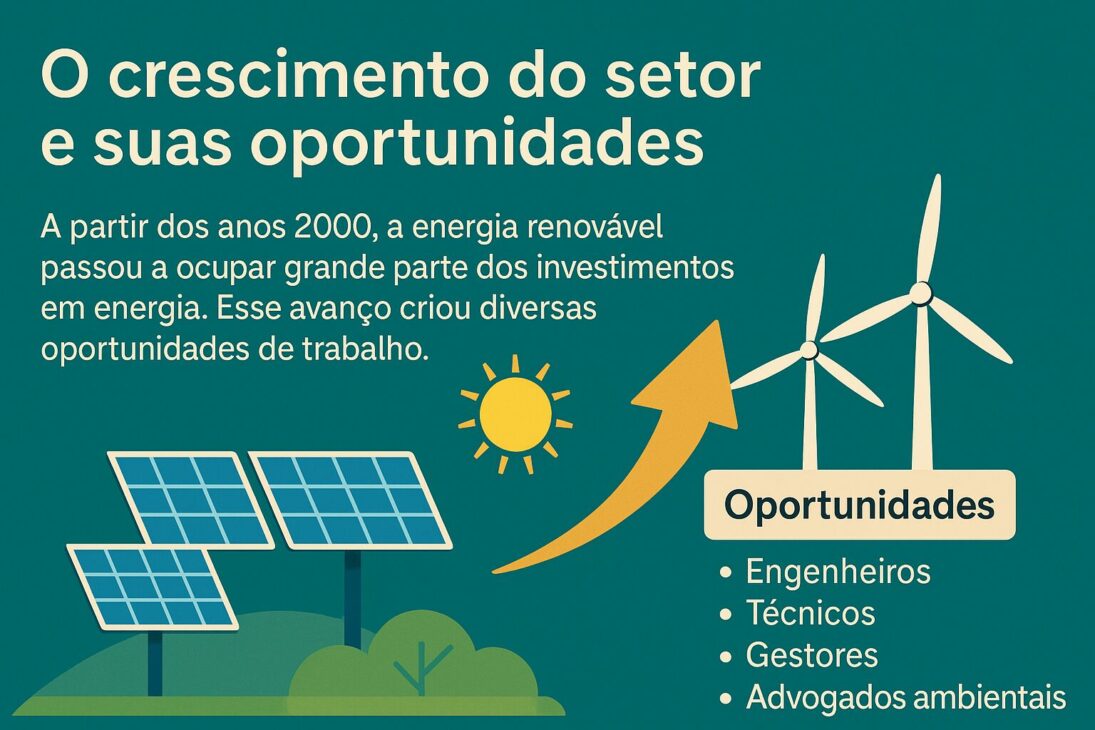
Thus, starting in the 2000s, solar and wind technologies became more accessible and efficient.
As a result, renewable energy began to occupy a large portion of energy investments.
According to the IEA, in 2023, about 90% of the new electrical capacity installed worldwide came from renewable sources.
Consequently, this advancement created various job opportunities.
Engineers, technicians, managers, analysts, environmental lawyers, and sustainable marketing professionals found space to operate with innovation and purpose.
How to Enter the Renewable Energy Career?
Therefore, the sector offers various paths for those who wish to work.
There is no single ideal course or qualification.
The most important thing is to align your profile with market possibilities.
For instance, engineers work on the development of solar and wind systems.
Managers handle the planning of sustainable projects. Environmental professionals participate in licensing and impact studies.
In this way, the diversity of roles shows that the renewable energy career extends beyond engineering.
Qualification and Continuous Learning

Moreover, constant updating boosts your career.
Various technical courses, extensions, and specializations help those who wish to stand out.
Recognized certifications, such as the NABCEP (North American Board of Certified Energy Practitioners) for solar energy and programs from the Renewable Energy Academy (RENAC) in Germany, also add value to your resume.
In this sense, companies in the sector value professionals with technical knowledge, strategic vision, soft skills, and commitment to environmental causes.
Therefore, those who combine technical knowledge with purpose tend to grow quickly in this market.
Working with Purpose: More Than Just a Job
Indeed, many professionals see a career in renewable energy as a mission.
Working in this sector is contributing to a fairer and cleaner future.
After all, the energy transition does not happen only with technology but depends on engaged and prepared people.
Thus, skills like communication, collaboration, and social responsibility weigh heavily in hiring.
Therefore, the ideal profile combines knowledge with a proactive attitude and commitment to sustainable results.
The Main Challenges of a Renewable Energy Career
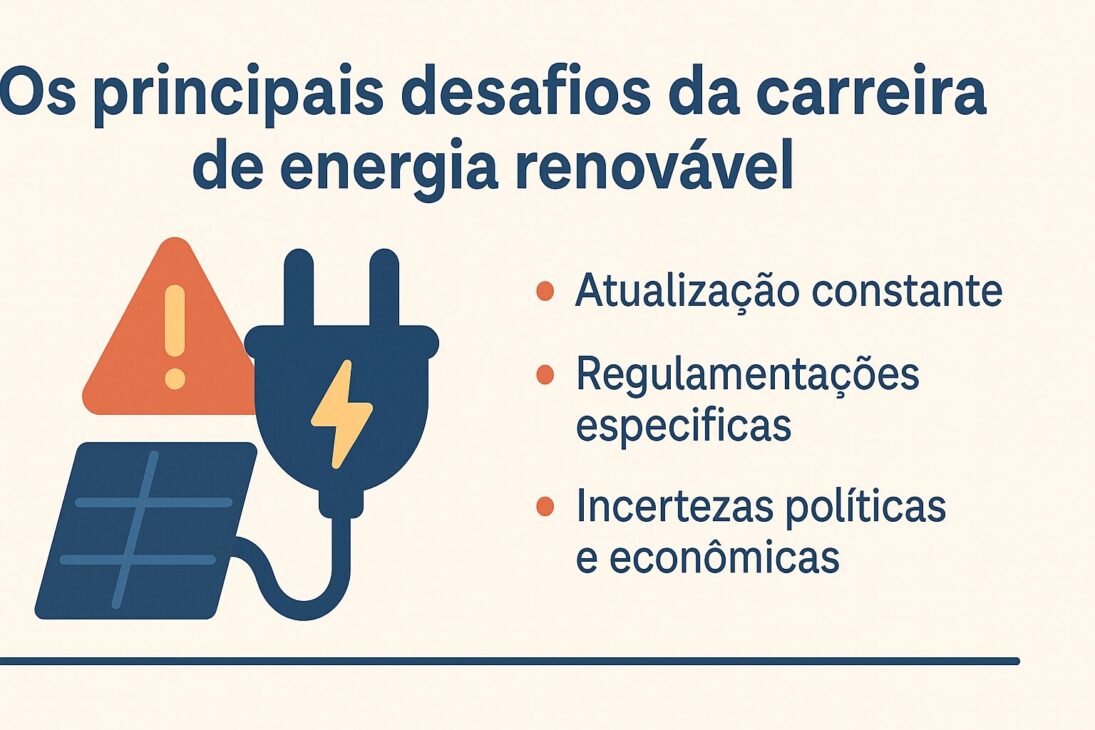
Although the sector is promising, like any growing area, there are also obstacles.
The biggest challenges involve the need for constant updates, knowledge of specific regulations, and, in some countries, political and economic uncertainties.
However, the opportunities are vast: high demand for professionals, rapid growth, innovative projects, and the chance to work with a positive impact.
Thus, a career in renewable energy requires preparation, but rewards those who choose this path.
Renewable Energy in Brazil
In this context, Brazil already has more than 80% of its electrical matrix formed by renewable sources, mainly hydroelectric plants.
However, the current highlight goes to solar and wind energy, which are advancing rapidly, especially in the Northeast.
According to data from the Ministry of Mines and Energy (MME) of Brazil, from 2024, the growth of these sources in the country exceeded 20% in the last five years.
Consequently, these changes generate jobs in regions previously underdeveloped economically.
Companies install solar and wind farms in smaller towns, promoting local growth and valuing technical and specialized professionals.
The Future Is Now
In summary, the renewable energy career represents one of the most promising paths of the 21st century.
It combines innovation, purpose, and responsibility for the planet.
Therefore, the sector embraces different profiles and opens doors for those who wish to work with impact and build a sustainable future.
If you seek professional purpose, updated knowledge, and the chance to be part of a real transformation, this is the right time.
The energy transition is underway, and the market needs people like you — committed, prepared, and willing to make a difference.











Seja o primeiro a reagir!