





 Português
  Inglês
  Espanhol
  6 min de leitura
  0 comentários



Discover How to Start or Strengthen Your Career in the Job Market with Timeless Strategies That Work for Both Beginners and Experienced Professionals.
Building a career in the job market transforms lives and spans generations.
Whether you are a beginner looking for your first job or a professional trying to reinvent yourself, understanding the paths that lead to a solid career makes all the difference.
For that, it is essential to observe both the present and the past, recognizing the evolution of the market and how to position oneself strategically.
-
Employee Fired After Accumulating 114 Days of Medical Leave in One Year, Labor Court Upholds Company’s Decision

-
Employee Fired While Treating Depression Wins in Court and Vale Is Required to Rehire Him Following Decision Based on the CLT and INSS Benefits

-
Workers Should Be Aware! March 6 Will Be The Fifth Business Day Of March And The Final Deadline For Companies To Pay Salaries According To The CLT

-
2026 FGTS Anniversary Withdrawal Is Released According to Birth Month, Sets Amounts by Balance Range, Establishes Deadlines for March and April, and Changes Rules in Case of Dismissal


For centuries, work served merely as a means of survival. Professions were, for the most part, passed down from father to son, keeping family traditions.
According to the Oxford University Museum of the History of Science website, work in the Middle Ages was essentially agrarian and familial, with little or no social mobility.
However, with the Industrial Revolution in the 18th century, this scenario changed radically. Cities grew, industries expanded, and new occupations emerged.
According to the UNESCO website (United Nations Educational, Scientific and Cultural Organization), the Industrial Revolution, which began in 1760, was a fundamental milestone in the transformation of the job market.
People began migrating from the countryside to cities in search of opportunities in factories and industries.
The growing demand for labor in industries led to the emergence of new professions and a redefinition of labor relations.
This change, therefore, inaugurated the modern concept of professional career. The idea of progressing in a specific field and achieving stability became part of the dream of many people.
Thus, work began to make up the individual identity and shape life goals.
How the Job Market Has Transformed Over Time
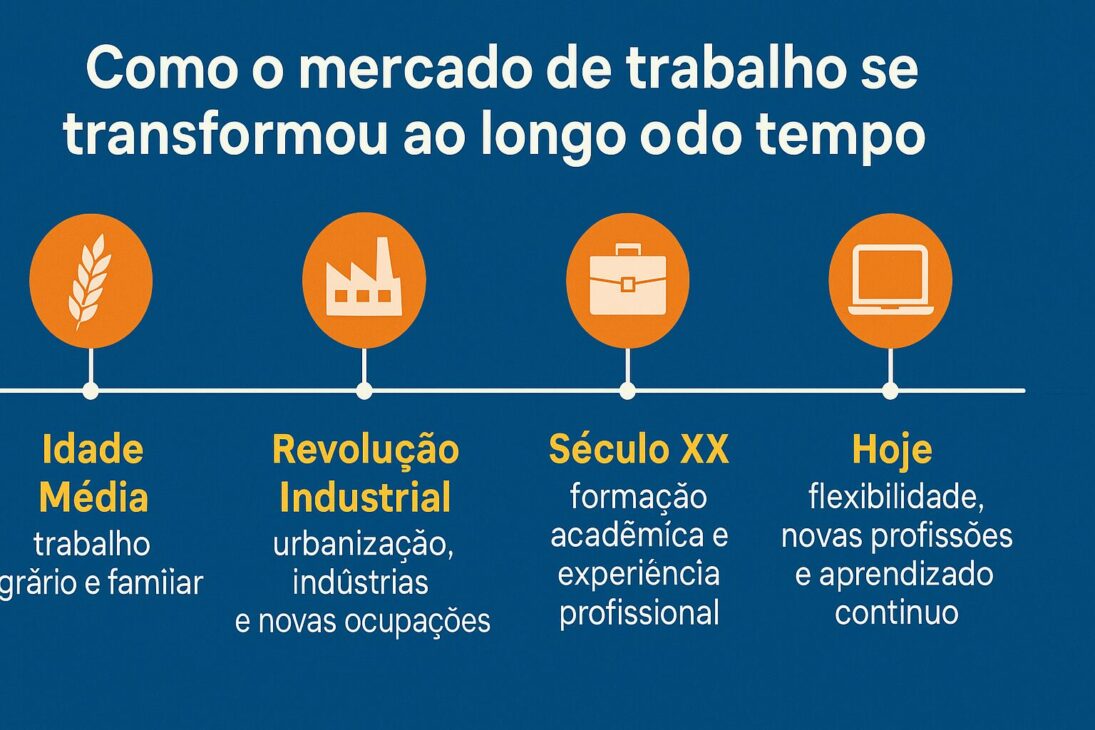
During the 20th century, academic training and professional experience began to be valued. Large companies, for example, required technical qualifications and proof of skills, creating a more competitive environment.
According to the Brazilian Institute of Geography and Statistics (IBGE), in Brazil, industrialization, which occurred between the 1940s and 1960s, was one of the main drivers of the expansion of job vacancies, especially in cities.
Thus, the career began to be viewed as a structured plan, with well-defined stages and a focus on growth.
From the 1990s onwards, globalization and digitalization profoundly impacted the job market, creating new opportunities and requiring new skills from workers.
According to the International Labour Organization (ILO) report of 1995, the globalization of the job market led companies to hire more qualified professionals, in addition to requiring flexibility from employees and adaptation to new work models.
With the advancement of the internet and technological innovations in the 1990s, the market changed again. New professions emerged, while others ceased to exist.
The IBGE website points out that, with the popularization of the internet in the 2000s, new opportunities arose in the fields of IT, digital communication, online marketing, among others.
Today, professionals need to learn continuously to stay updated. Linear paths have given way to diverse and flexible journeys, where reinvention has become a fundamental skill.
According to human resources consulting McKinsey & Company, in its 2020 report, the demand for qualified professionals in various fields, especially in technology, is a trend that is expected to continue until 2030.
Therefore, proficiency in foreign languages, especially English, and knowledge of digital tools have become important differentiators.
Moreover, emotional intelligence and clear communication began to weigh as much as technical skills.
First Steps for Those Starting in the Job Market
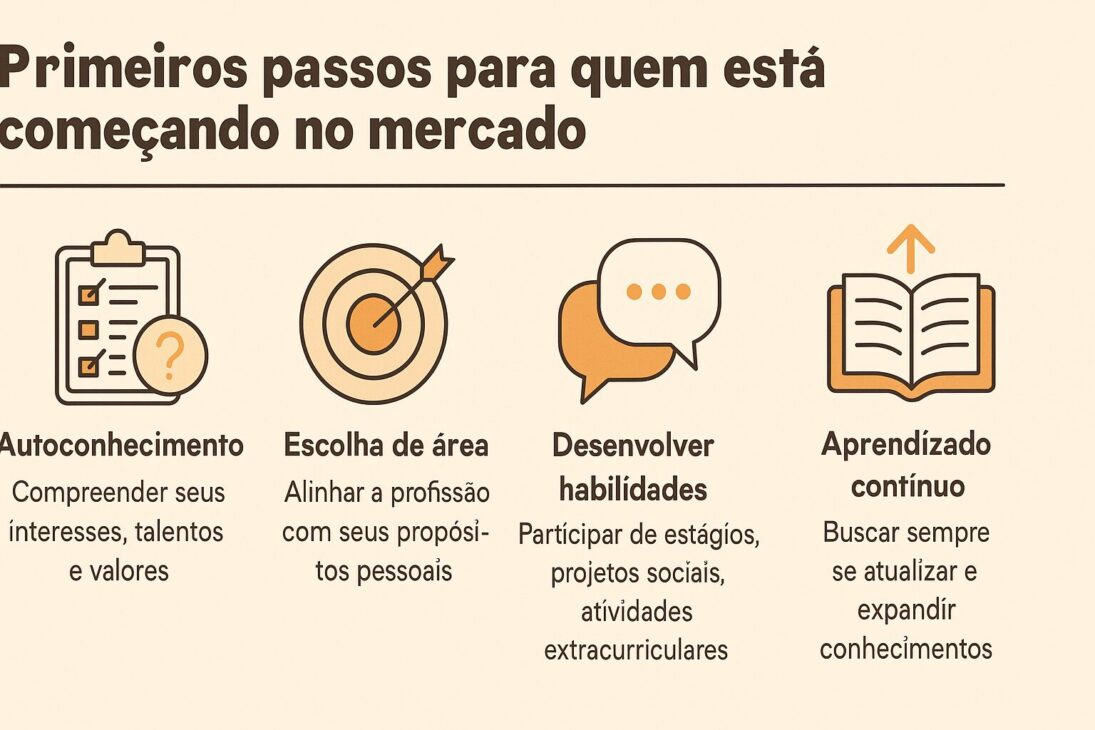
Taking the first steps in the market can seem daunting. Many young people wonder which area to pursue, which course to choose, or how to gain experience.
According to the Institute for Applied Economic Research (IPEA), a study conducted in 2021 indicated that 47% of Brazilian youth are in search of their first professional experience, with much of them facing difficulties due to a lack of formal qualifications or previous experience.
Although there is no single answer, self-knowledge is an excellent starting point. Understanding your own interests, talents, and values helps make more conscious choices.
Therefore, avoiding following a profession solely for status or family pressure is essential.
Choosing an area aligned with your personal purposes provides more motivation and satisfaction in the long term.
According to Harvard University, research shows that when professionals feel connected to their work and find meaning in what they do, their productivity increases significantly.
Additionally, companies increasingly value so-called soft skills — skills such as communication, empathy, initiative, and teamwork.
The Forbes website reported in 2020 that 75% of employers consider interpersonal skills more important than technical skills in candidates.
Through internships, social projects, or extracurricular activities, it is possible to develop these skills and strengthen your professional profile.
Continuous Learning and Professional Development
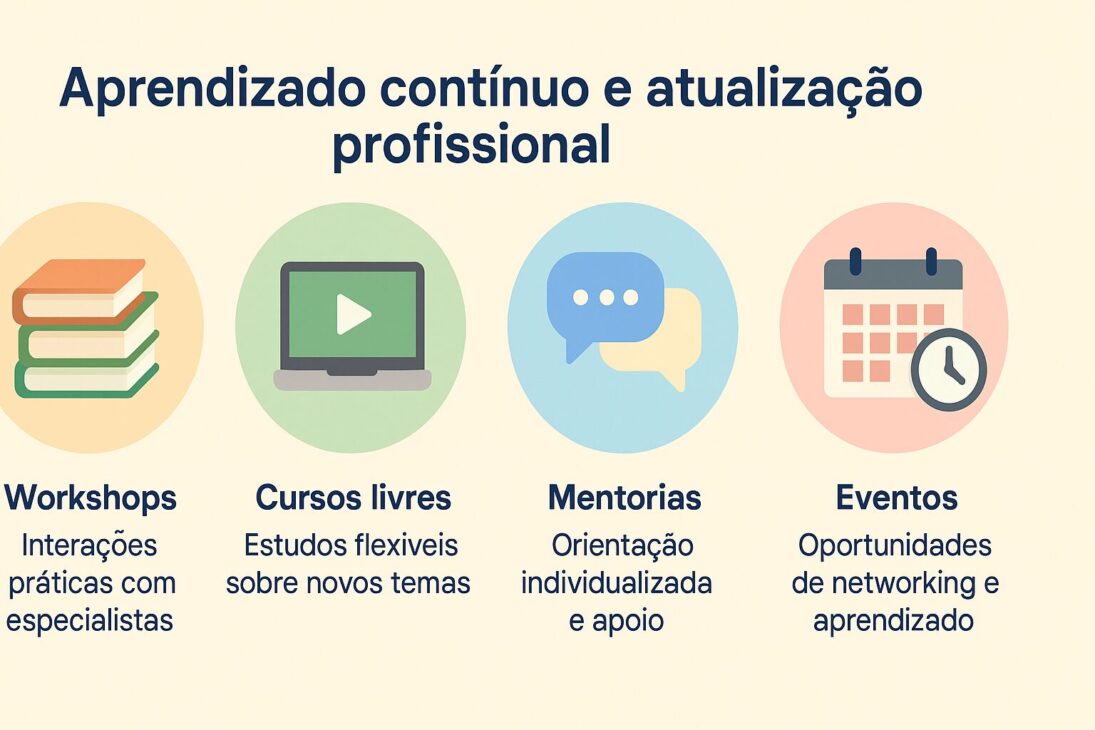
Staying in constant learning has become essential for career growth. Nowadays, it is not enough to complete a higher education course and stop there.
According to the Fundação Getúlio Vargas (FGV) website, a 2021 study revealed that 85% of Brazilian companies consider it essential for their employees to engage in continuous learning, especially regarding new technologies.
Workshops, free courses, mentoring, and events are valuable opportunities to expand knowledge and open doors.
Stanford University, one of the most renowned in the world, advocates that education should not stop at university but be a continuous process throughout one’s professional life.
For experienced professionals who wish to evolve or change fields, adapting to changes is crucial. The market demands flexibility, curiosity, and willingness to learn new things.
The Harvard Business Review website highlights that successful companies encourage their employees to constantly update themselves to maintain competitiveness.
Conversely, those who do not update themselves risk stagnation. Changing fields or starting a new professional trajectory requires planning, study, and courage.
Many people actually discover new purposes after years in the same profession.
Starting over may seem challenging; however, it often leads to significant discoveries and personal fulfillment.
Accepting that a career does not need to follow a single direction allows for exploring new paths with greater freedom.
According to the ILO, this flexibility is one of the factors that most impact the globalized job market.
In some cases, returning to study or taking a step back is necessary for greater growth later on.
Most importantly, however, is to act with awareness and confidence.
Purposeful Career: More Than Just a Job
Work and career are not synonyms. While work represents an activity for generating income, career involves purpose, growth, and fulfillment.
Having a job is important; however, building a career ensures progress, stability, and long-term recognition.
According to the International Labour Organization (ILO) website, in the current context, the search for purpose in work has been a growing trend.
More and more workers worldwide seek meanings beyond financial remuneration, wishing for their activities to have a social impact and personalize their journeys.
However, the market still presents inequalities. Factors such as gender, race, social class, and place of origin impact access to opportunities.
According to the Global Inequality Report 2022 from the World Economic Forum, there is a persistent gender inequality in many job markets around the world, hindering equal access to the best opportunities.
For this reason, it is important to strengthen actions that promote inclusion and equality in companies and in society.
After all, a just career needs to ensure that everyone has the conditions to evolve, regardless of their starting point.
Another increasingly valued aspect is the balance between personal and professional life.
Many people, for example, seek more than financial success — they desire quality of life, time with family, and emotional well-being.
According to Gallup, a survey conducted in 2020 revealed that **55% of workers consider the balance between professional life.










Seja o primeiro a reagir!