





 Portuguese
  English
  Spanish
  6 min of reading
  0 comments


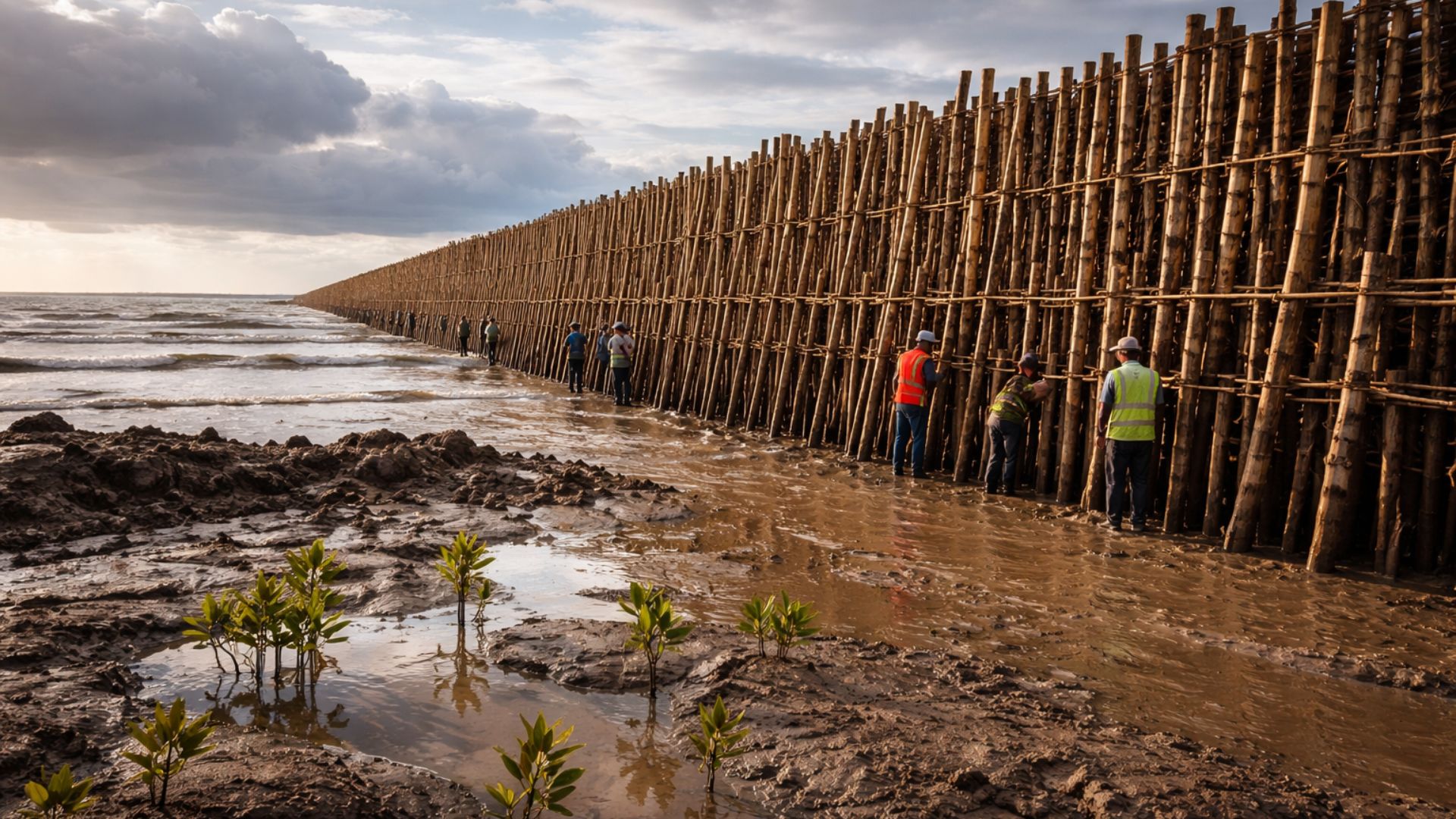
Simple Bamboo Structures Installed on the Coast of Guyana Helped Retain Sediments, Raise the Ground, and Allow the Natural Regeneration of Mangroves in an Area Previously Considered Critical for Erosion and the Impact of the Atlantic Waves, Transforming a Local Experiment into a Coastal Defense Reference.
The recovery of the mangrove in Lusignan, on the east coast of Demerara, gained prominence after official reports from Guyana recorded that an intervention of 275 meters of bamboo and brush barriers helped retain sediments, raise the ground, and pave the way for natural regeneration of coastal vegetation.
The case has come to be treated as an example of lightweight infrastructure applied in a vulnerable stretch of coastline, where previous attempts at restoration had not worked. The weight of this result grows when one observes the geography of the country.
The Guyanese administration itself reports that more than 90% of the population lives in low-lying coastal areas susceptible to flooding, protected by about 370 kilometers of coastal defenses, of which 80 kilometers correspond to structures ranging from earthen embankments to concrete walls.
-
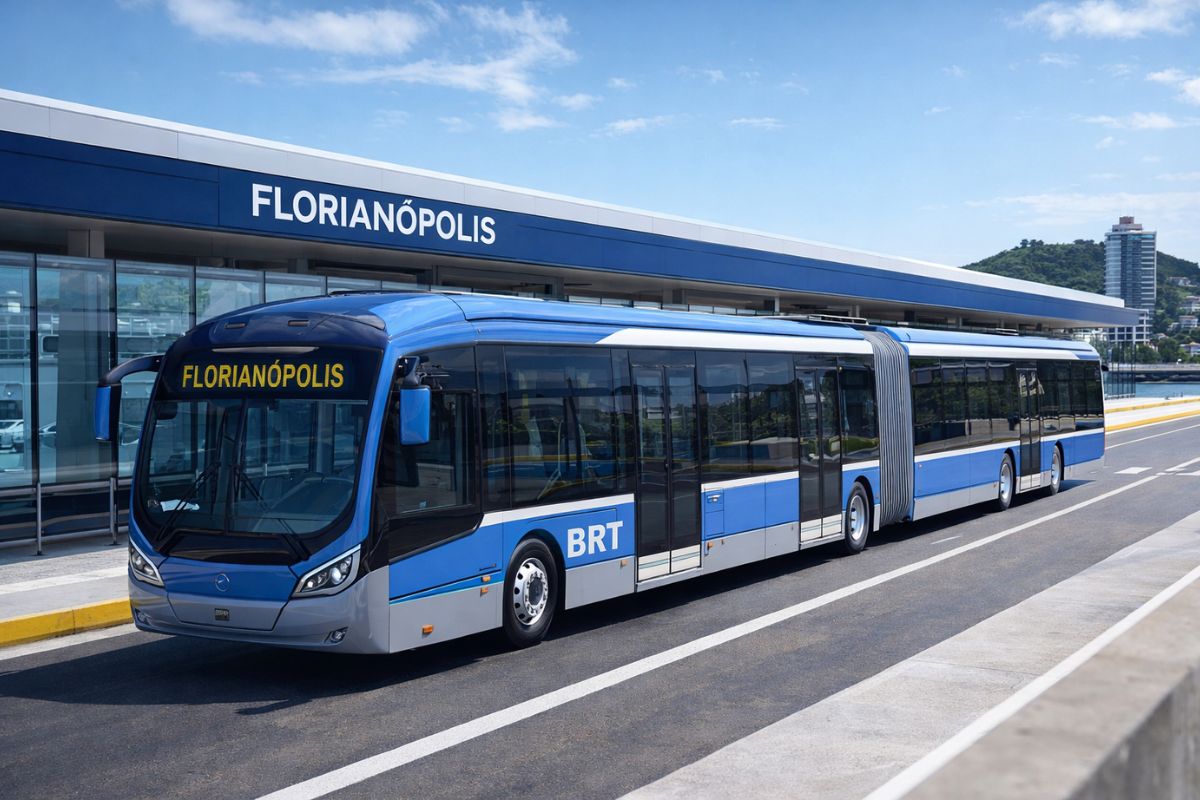
Florianópolis will receive a million-dollar BRT that will begin construction in 2026 with nearly 400 million in funding from the federal government and the Inter-American Development Bank, and the map already shows the routes for the exclusive bus corridors.
-
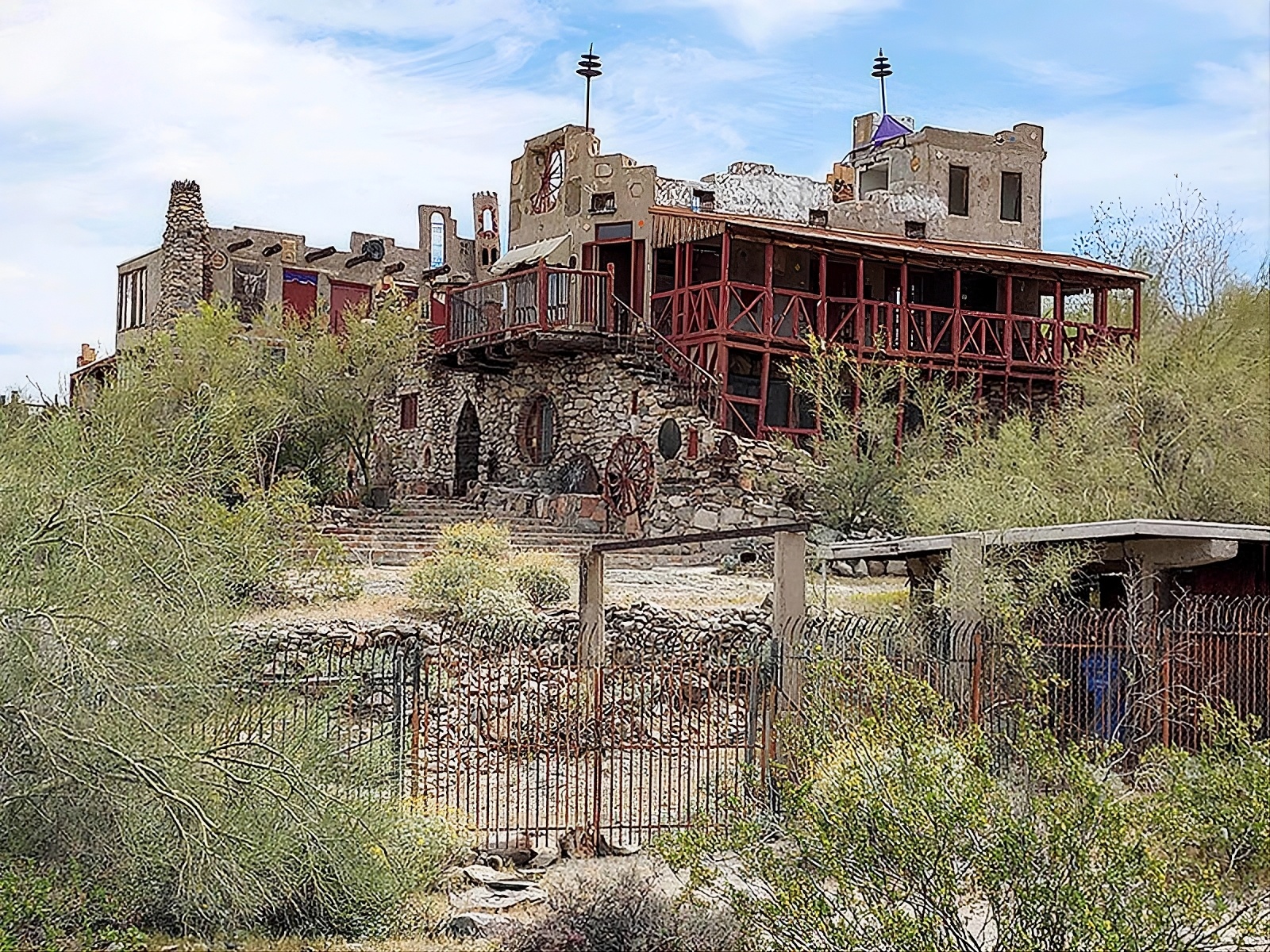
Without a blueprint, without an engineer, and using scrap from the dump, a father spends 15 years building an 18-room castle for his daughter, featuring tram tracks, 13 fireplaces, and over 700 m², which may now be demolished.
-
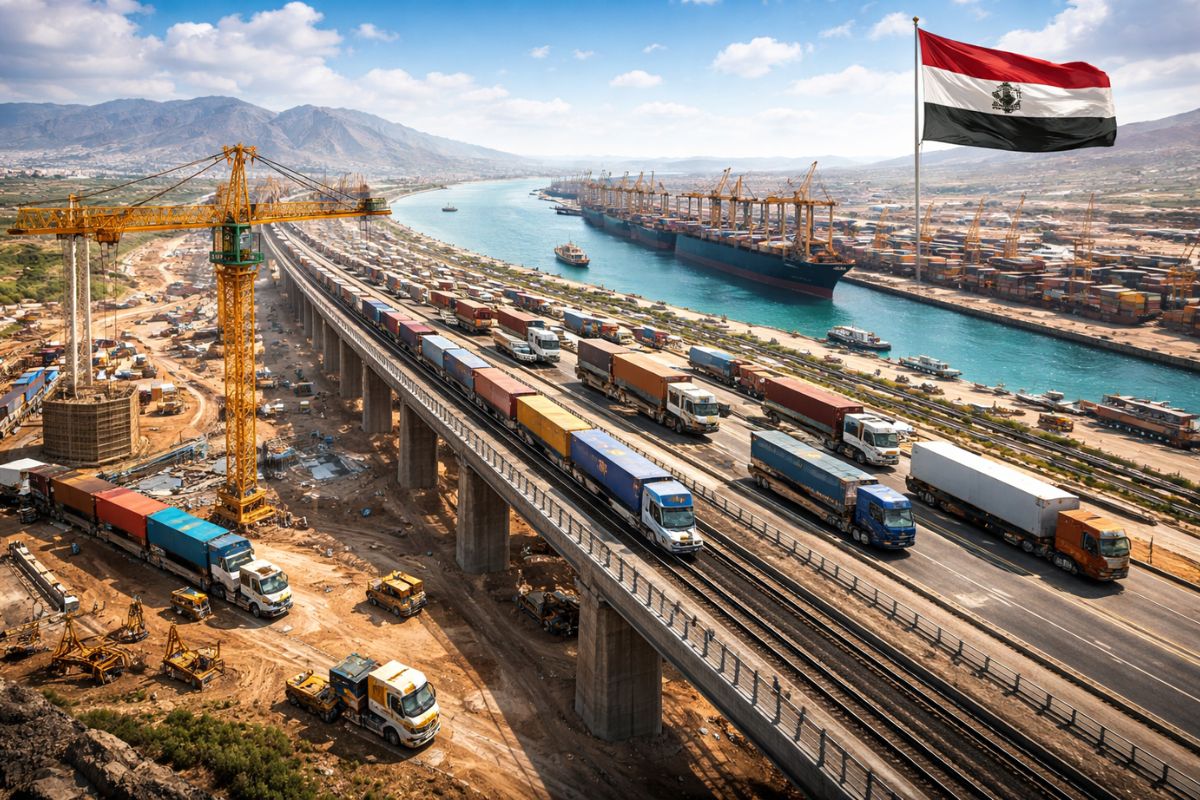
A megaproject worth R$ 89 billion is advancing in Iraq and promises to change the game in global trade by creating a new corridor between Asia and Europe, reducing traditional routes and repositioning the country as a logistics powerhouse.
-
Goodbye bedside table: floating shelves become a trend in 2026 by freeing up space in the bedroom, improving circulation, bringing visual lightness, and integrating technology without taking up floor space.


In this context, mangroves are treated by the government as an essential part of protecting the coastal strip, alongside traditional engineering works.
Initial Restoration Attempt Failed
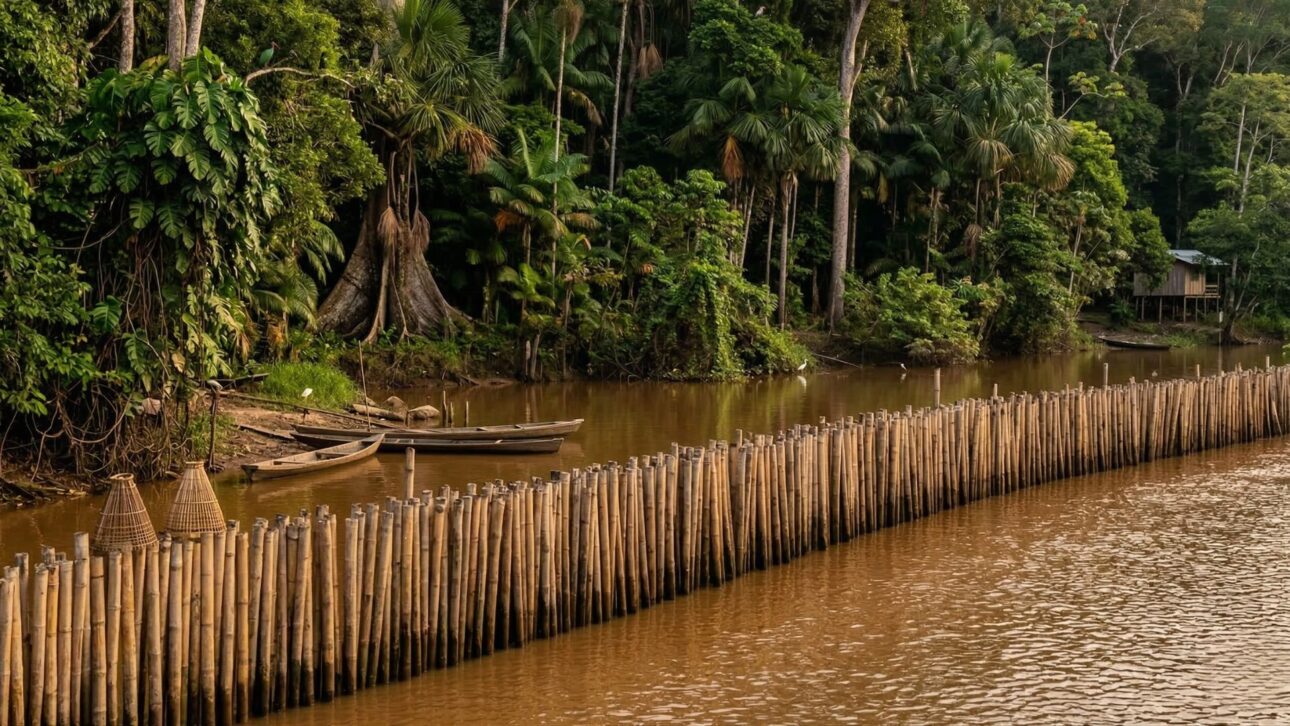
Lusignan was already considered a sensitive area before the installation of the barriers.
In the 2016 annual report, the National Agricultural Research and Extension Institute, NAREI, described the locality as a village facing the Atlantic, with residences and agricultural areas to the south, between Annandale and Good Hope.
The coastal front already had rip-rap, earthen embankments, and a narrow strip of mangrove, but the surface soil was visually classified as soft to medium clay, a condition that hindered the spontaneous regrowth of vegetation.
Prior to that, restoration had followed a more direct and less effective path.
According to NAREI, the planting of seedlings conducted in 2014 failed because the elevation of the ground was insufficient to support mangrove growth, as well as varying across the area.
This diagnosis appears again in a technical report from the North Brazil Shelf Mangrove Project, which summarizes the history of Lusignan and points out that the coastal environment there was subjected to high wave energy, which reduced the chances of success of an intervention based solely on planting.
The decision then was to change the logic of restoration.
Instead of insisting on introducing seedlings in still inadequate ground, the project began to focus on creating physical conditions for the ecosystem to re-establish itself.
The declared objective by NAREI was to favor accretion, consolidate the substrate, and reduce erosion until the coastal edge reached a level considered compatible with the natural regeneration of black mangrove, Avicennia germinans, and the grass spartina.
Coastal Engineering Adapted to the Waves of the Atlantic
The solution adopted in Lusignan did not automatically replicate the models used in other points of the Guyanese coast.
The 2016 report states that the design had to be altered due to the severity of the waves in that stretch.
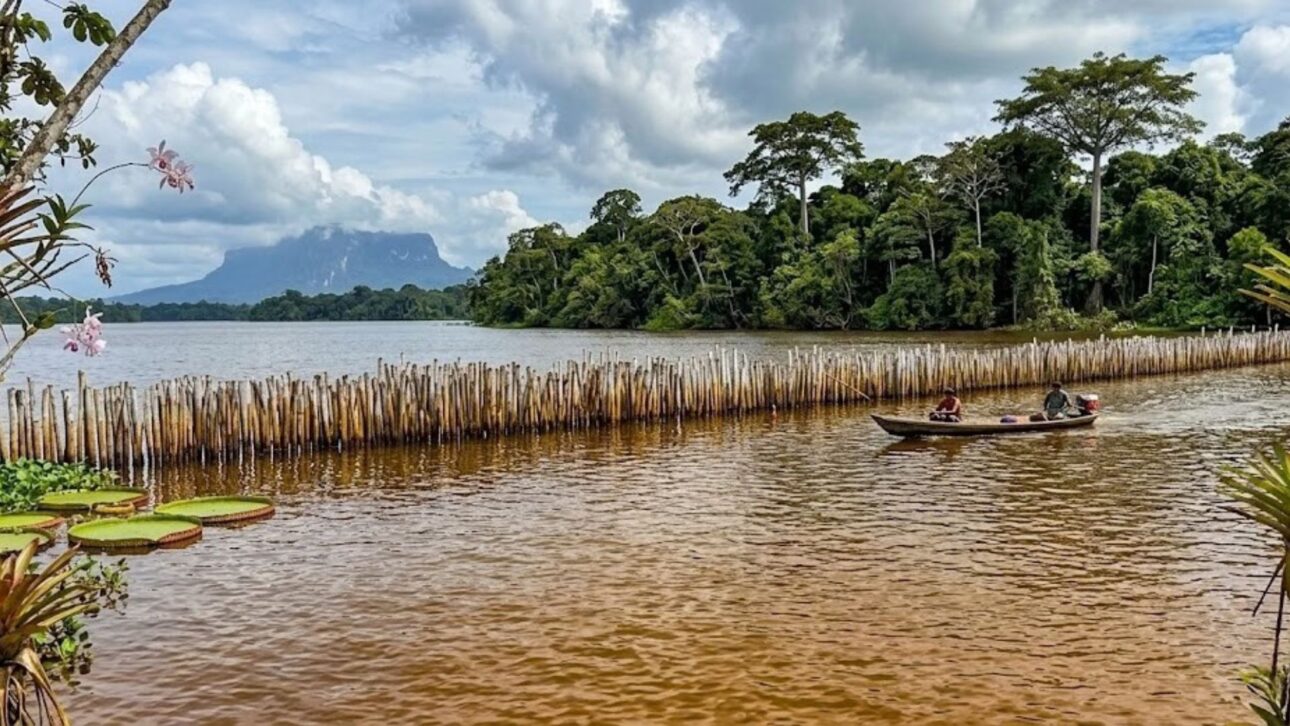
The main adaptation was the installation of anchor stakes formed by groups of bamboo driven into a layer of rigid clay, capable of receiving the lateral loads generated by the sea and transferring them to a more stable base.
There was also a change in the internal filling of the structure.
NAREI reports that, instead of just accommodating bamboo bundles as filling, the project began to drive these elements in groups, forming sets about 10 feet deep, of which 4 to 5 feet remained above the surface.
The function was to reduce the force of the waves, the velocity of the water, and the currents acting on the coastal edge, without resorting to a completely rigid barrier.
In practice, the system functioned as a permeable infrastructure capable of slowing down the energy of the sea.
It was not designed to block the ocean completely but to diminish its intensity and increase the retention of fine material on site.
This difference helps explain why the work came to be seen as a lower physical impact alternative, capable of working in favor of sediment dynamics rather than just imposing a hard containment over a naturally unstable coast.
Simple Structure and Community Participation
Another point highlighted in official documents was the lower operational cost compared to heavy interventions.
NAREI recorded that the barriers in Lusignan and Walton Hall were executed with minimal use of equipment, locally available materials such as bamboo, and local labor.
The agency also reported that the contractor employed workers from the community itself, in an attempt to generate immediate economic benefit and enhance the sense of ownership regarding the work.
Before the installation of the stakes, the project also underwent technical soil checks.
The same report states that shear strength tests and other in situ analyses were conducted to ensure the lateral stability needed for the structure.
This care appears as part of the effort to maintain the character of a low-cost solution without compromising the minimum safety required in a stretch exposed to more severe waves.
Monitoring Revealed Natural Return of the Mangrove

<p.That which, in 2016, appeared in documents as expectation began to be confirmed in the following years.
In the 2020 annual report, NAREI states that park ranger reports in Lusignan recorded natural regeneration of black mangrove and spartina, as well as accumulation of mud on site.
The same document reports that monitoring flights were conducted to track the extent of forest growth.
According to technical records, the area has begun to show extensive natural regeneration as a result of the previously built bamboo barrier.
This sequence makes the case particularly relevant for Guyana’s coastal policy.
First, there was the failure of planting in still inadequate ground.
Then came the adaptation of engineering to the wave regime, with anchoring in rigid clay and a more resistant structure.
Only after these changes did signs begin to appear that the environment itself had regained part of its reconstruction capacity, with accumulated sediment and vegetation re-establishing itself without large-scale new planting.
Mangroves Gain Central Role in Coastal Defense
The experience of Lusignan fits into the broader strategy adopted by the country to protect its low coast.
The Guyanese government had already been advocating alternatives to so-called hard structures, including the restoration of mangroves as a defense tool against flooding.
During the inauguration of the NAREI Mangrove Center in 2023, Prime Minister Mark Phillips reinforced the need to combine built barriers with restoration and management of these ecosystems within an approach described as green-grey infrastructure.
At the same time, Guyana reported that its recent restoration efforts added more than 500 hectares of coastal mangroves in different regions.
With this, national coverage has surpassed 21,000 hectares of mangroves distributed along the coastal strip.
In this design, the case of Lusignan ceased to be just a localized experiment and became a practical demonstration of how simple interventions can help restore a natural protection capable of reducing the impact of the sea on coastal communities.




-

Uma pessoa reagiu a isso.