





 Portuguese
  English
  Spanish
  5 min of reading
  0 comments


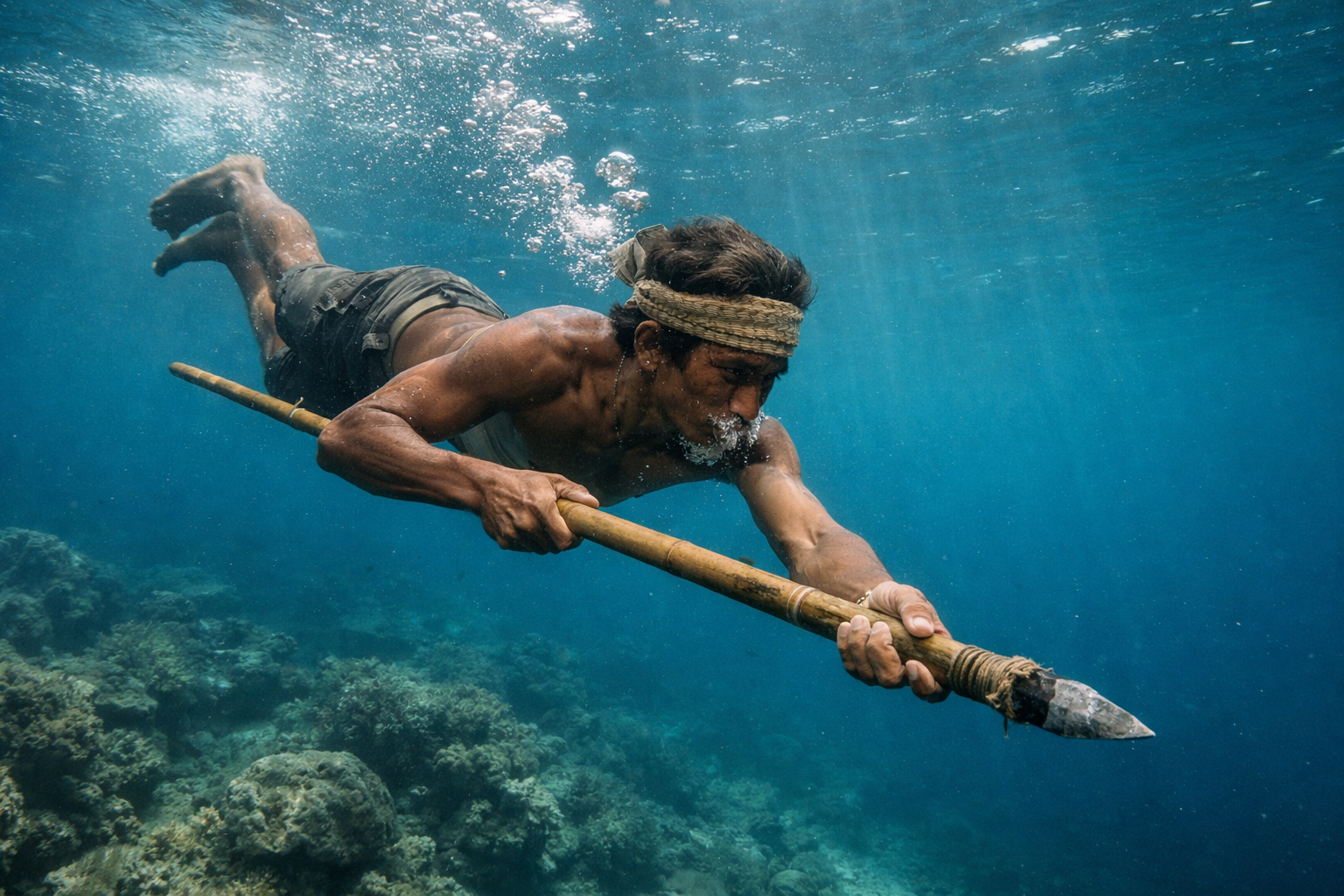
Scientific Studies Reveal How a Nomadic People from Southeast Asia Developed Rare Biological Adaptations That Challenge the Limits of the Human Body and Reinforce the Theory of Natural Selection
How long can an ordinary person stay underwater without breathing? For most, just a few seconds is enough to cause discomfort. However, for the Bajau people, this question takes on a completely different dimension. They remain submerged for up to 13 minutes, reach depths of 60 meters, and perform these dives without oxygen tanks, using only simple masks and rudimentary weights.
This information was revealed by widely reported international scientific studies, including research conducted by the University of Copenhagen, the University of California, and scientific institutions in Berlin, which analyzed the genetics, lifestyle, and physiological adaptations of this extraordinary people.
Over the centuries, the Bajau have not only learned to dive. They evolved for it.
-
A “silent skill” is allowing Brazilians to earn up to R$ 22,000 per month without a degree and become indispensable for companies that rely on millions of data to survive.

-
Researchers at the Toyota Research Institute found that if a human uses robotic arms to flip a pancake 300 times in an afternoon, the robot learns to do it on its own the next morning, and this is currently the most promising method to solve the biggest bottleneck in modern robotics.

-
Goodbye iron: a common item in households is starting to lose space to technology that smooths clothes in minutes without an ironing board and with less energy consumption.

-
Antarctica reveals an unusual clue high in the Hudson Mountains, and what appeared to be just an isolated rock began to expose a secret hidden under the ice for ages.

Who Are the Bajau, the Sea Nomads Who Challenge Human Biology
First, it is essential to understand who these people are. The Bajau people have lived for at least a thousand years in the maritime regions of Southeast Asia, including areas of southern The Philippines, Indonesia, and Malaysia. Historically, they became known as “sea nomads” or “gypsies of the sea,” as they live in floating houses, boats, or stilt houses built over flooded areas.
Estimates suggest that there are around 11,000 Bajau scattered throughout the region. Although part of the population has migrated to solid ground in recent decades, many still maintain the traditional lifestyle, deeply connected to the ocean.
Furthermore, almost everything they consume comes from the sea. Fishing is not just food, but also the only source of income, as the Bajau trade fish and seafood for other essential goods through bartering. Thus, the ability to hold their breath for long periods is not a sporting talent but a matter of survival.
For this reason, they dive up to eight hours a day, spending about 60% of that time underwater. In practical terms, this means more than four hours daily underwater.
Natural Selection in Action: The Genetic Mutation That Changed the Bajau Body
The explanation for such resilience lies not only in training. According to a study published in 2018, the Bajau exhibit specific genetic mutations that altered the functioning of their bodies over generations.
The main highlight is the spleen, an often underestimated organ. While it acts in the immune system, filtering blood and recycling red blood cells, it also plays a crucial role when the body faces oxygen scarcity.
During diving, the human body automatically activates the so-called diving response. In this process, the heart rate decreases, blood vessels constrict, and the spleen contracts, releasing oxygenated red blood cells into the bloodstream.
In the Bajau, this mechanism is enhanced. Ultrasound examinations have shown that they possess significantly larger spleens than those of neighboring non-diving populations. More importantly: this difference appears in both divers and Bajau who do not dive, indicating that it is a genetic adaptation, not just a result of training.
Researchers identified more than two dozen distinct genetic mutations, including changes in the PDE10A gene, which regulates thyroid hormones that directly influence spleen size. The larger the spleen, the greater the release of oxygen during contraction, which explains the biological advantage of the Bajau.
This finding represents one of the rarest documented examples of natural selection in modern humans.
Technique, Practice, and Survival at Extreme Depths

Despite their favorable genetics, scientists emphasize that the performance of the Bajau does not rely solely on mutations. Continuous training and traditional diving techniques also play a fundamental role.
When a human dives at great depths, the water pressure can cause the collapse of pulmonary blood vessels. In extreme cases, this leads to vessel rupture and death. However, the Bajau have learned, over generations, to control their descent and ascent, reducing these risks.
Moreover, they use extremely simple equipment: wooden goggles, handmade masks, and weight belts. There are no oxygen tanks, special clothing, or modern technology. Still, they can reach depths that many professional divers cannot.
This balance between genetic adaptation, refined technique, and daily practice explains how they challenge limits that, for most of the world’s population, would be deadly.
Discoveries That Could Save Lives Outside the Ocean
Interestingly, the impacts of this study extend well beyond anthropology. The diving response observed in the Bajau resembles a medical condition known as acute hypoxia, characterized by a rapid loss of oxygen in the body.
This condition is associated with deaths in surgical centers and medical emergencies. Therefore, understanding how the Bajau body copes with a lack of oxygen could pave the way for new treatments, medical protocols, and prevention strategies.
Thus, what began as an investigation of an isolated people has turned into a relevant contribution to modern medicine.
What the Bajau Teach About Evolution and the Future of Humanity
In the end, the Bajau are more than exceptional divers. They represent a living proof that natural selection proposed by Charles Darwin continues to operate in humans.
Even without knowledge of genes or DNA, Darwin described a mechanism that is now confirmed at the molecular level. The Bajau survived because they adapted. And, generation after generation, their bodies changed to meet the extreme demands of the environment in which they live.
This story reveals something deeper: humanity is not disconnected from evolution. In extreme environments, the human body still finds ways to transform, resist, and survive.
If the environment can shape the human body in this way, what other extreme adaptations might still exist without science having discovered them?
Source: Unknown Facts







-

-

-

-

-

-

28 pessoas reagiram a isso.