





 Portuguese
  English
  Spanish
  5 min of reading
  3 comments


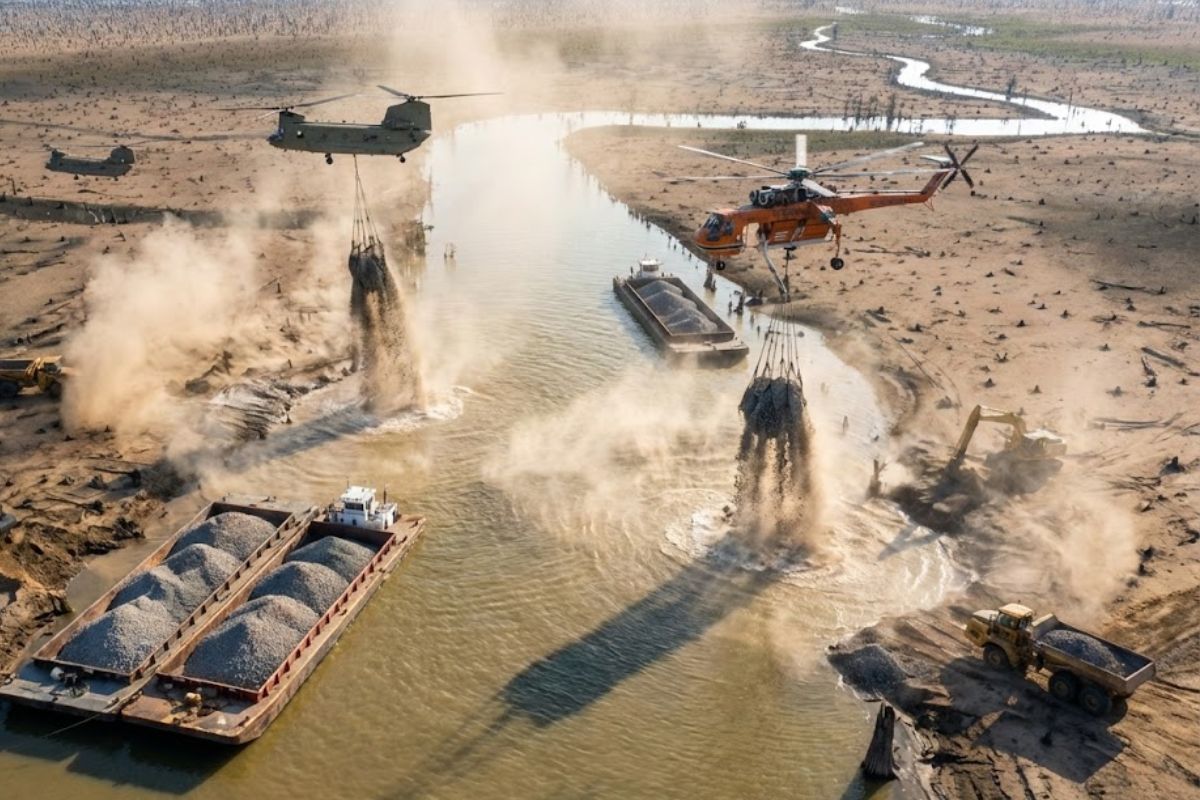


Helicopters Dump Hundreds of Tons of Gravel into Historic Arkansas Lake, Transforming the Submerged Bottom into a Real Laboratory for Large-Scale Environmental Restoration.
Conway Lake, in the state of Arkansas, has entered a decisive phase in its history by becoming the center of a large-scale aerial environmental intervention. Helicopters have started dumping hundreds of tons of gravel directly onto the lake bed in an attempt to correct decades of silent degradation that compromised fish spawning and the stability of the aquatic ecosystem.
Built in 1948, the lake was at the time the largest reservoir ever created by a state agency dedicated to wildlife. For decades, it supported sport fishing, biodiversity, and recreational activities, becoming an environmental symbol of central Arkansas. Over time, however, natural and structural processes began to undermine its ecological functionality, almost invisibly to those observing only the surface.
A Lake That Looked Healthy but Was Sick Beneath

For more than 70 years, the lake bed has accumulated a thick layer of fine sediments, forming a muddy and unstable substrate.
-
China accelerates global science and may surpass the United States in 2 years with increased public investment, continuous growth, and direct impact on the global technological competition.

-
Scientific studies indicate that drought may be strengthening a much greater silent threat: more resistant superbugs.
-
Man builds functional 5-meter submarine in his garage using gas cylinders, PVC pipes, and a refrigerator motor, and navigates with the vessel on a lake in Colombia.
-
Millions of people have been eating yam for centuries without knowing that this humble tuber contains a compound called diosgenin, which scientists have now discovered can improve memory and help control blood sugar levels.

This type of bottom profoundly alters the dynamics of aquatic life.
Eggs deposited in this environment sink, become deprived of oxygen, and eventually suffocate, drastically reducing reproduction rates, even when there is an abundance of adult fish.
Despite still showing signs of productivity, Conway Lake has been losing, year after year, its capacity to sustain successful spawning.
The degradation was neither immediate nor spectacular, but progressive and silent, creating a scenario where reproductive collapse could occur without warning.
The Decision for a Radical Aerial Intervention

In light of this situation, environmental authorities opted for an unconventional strategy.
Rather than taking point-based or gradual actions, they decided to conduct a concentrated, rapid, and technically aggressive intervention.
Helicopters began transporting and dropping more than 270 tons of gravel at specific points on the lake bed, creating firm bottom areas capable of supporting nests and protecting eggs.

Each bag of gravel used in the operation weighs about 1,360 kilograms.
Hundreds of them were prepared in advance, with a minimum deposition goal of at least 200 bags, a number that may increase if operational conditions allow.
The choice of aerial transport was neither aesthetic nor symbolic but technical.
The lake bottom is so fragile that the use of trucks would require the construction of temporary roads, causing new environmental impacts and leaving large areas inaccessible.
With helicopters, it was possible to reach remote regions of the lake in just three days, something that would take weeks or even months by conventional means.
Reconstructing Spawning Beds to Save Endangered Species

The gravel dropped into the lake serves an essential function.
It creates firm, oxygenated, and stable surfaces, ideal for building nests and securing eggs.
Species such as black bass, sunfish, and different types of panfish, including bluegill and redear, directly depend on this type of substrate to complete their reproductive cycle.
Without this physical support, reproduction collapses even in seemingly favorable environments.
The intervention also aims to support the recovery of the leopard darter, an endangered species that has had its habitat severely reduced over the years.
The restoration of the lake bottom represents a concrete attempt to provide minimum conditions for the survival of these populations.
The Work Does Not End with the Helicopters Flying
After the aerial drop, teams return to the spawning sites to manually spread the gravel.
The lake bottom is filled with submerged roots, old stumps, and natural obstacles that prevent the use of machines.
The manual work, although slower, allows shaping the beds precisely and adapting the environment to the needs of local species.
Even so, the aerial logistics make all the difference.
In just a few days, it was possible to transport more material than would be feasible in weeks of land work.
This reduces indirect costs, limits additional impacts, and accelerates ecological recovery.
A Project That Goes Beyond Gravel
The restoration of Conway Lake is not limited to the deposition of gravel.
Plans include the installation of dozens of concrete tubes to create submerged refuges, as well as the implementation of specific concrete discs for spawning.
These structures replace old practices that have proven harmful to water quality over time.
The plan also includes broader structural improvements.
The lake’s level has been lowered to allow deep renovations, including the modernization of boat ramps, expansion of public access areas, and cleaning dozens of kilometers of waterways, making navigation safer.
The spillway, which has been experiencing frequent failures, will be replaced by a new system designed to operate for at least another 75 years, ensuring water stability and structural safety for future generations.
An Experiment on the Future of Environmental Restoration
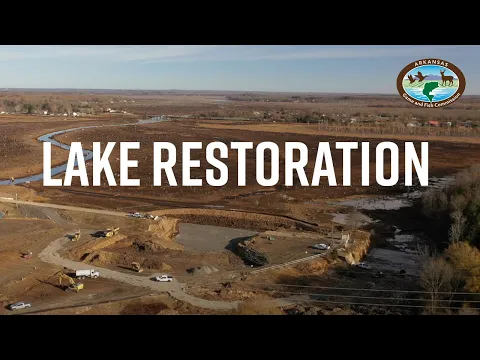

During the operation days, the lakebed remains closed off for safety reasons.
Helicopters repeatedly cross the sky, transforming what was once an invisible process of degradation into an environmentally impactful visual project.
This is one of the largest individual projects ever undertaken by the Arkansas Game and Fish Commission.
More than just recovering a specific lake, the initiative serves as a practical test for the future of environmental restoration in aging reservoirs.
What is being assessed, in practice, is whether intensive, concentrated, and well-planned interventions can recover degraded aquatic ecosystems within a short time frame before decline becomes irreversible.
In Conway Lake, the muddy bottom is being rewritten stone by stone, in a clear attempt to restore functionality, biodiversity, and balance to a system that seemed doomed to slowly disappear.
In your opinion, should radical actions like this become the rule to recover degraded lakes before silent degradation turns into definitive collapse?






Sim. Se bem organizado e com o Estado trabalhando junto com as equipes do meio ambiente e população local. Certamente será um sucesso.
Ninguém pensou em fazer o replantio da mata ciliar que foi obviamente destruída?
Claro que sim. E quanto mais cedo começar, melhor será o retorno.