





 Portuguese
  English
  Spanish
  6 min of reading
  0 comments


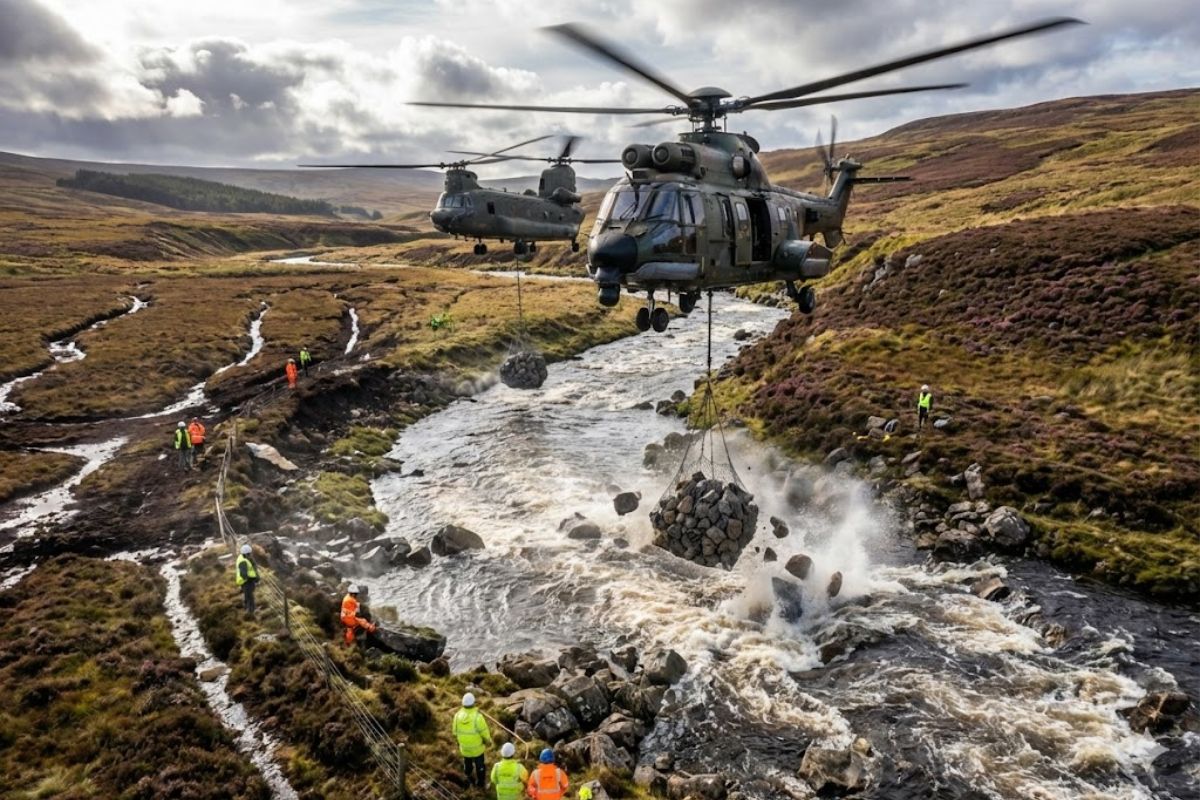
In the Rivers of North Pennines, in Northern England, conservation teams have been using helicopters since 2025 and are carrying out actions in 2026 to deliver stones, wood and other materials to remote areas, building leaky dams, slowing rectified flow, retaining peat sediments and increasing dissolved oxygen for local fish and invertebrates
The rivers of the North Pennines, in the United Kingdom, have become the stage for an unusual restoration operation: helicopters transport and dump tons of stones and natural materials in hard-to-reach stretches to recover lost rapids, oxygenation, and microhabitats after centuries of drainage and channelization.
The strategy combines aerial logistics and delicate interventions in sensitive peatlands, aiming to slow the accelerated water, retain carbon-rich sediments, and test whether aerial restoration can rebuild the natural dynamics of the rivers without destroying the fragile soil that supports this ecosystem.
Where It Happened and Why the North Pennines Caught Attention in 2025

The operation takes place in the North Pennines National Landscape, in northern England, an area of conservation known for its high-altitude landscapes, extensive peatlands, and waterways that originate and flow through sensitive terrain.
-
Millions of people have been eating yam for centuries without knowing that this humble tuber contains a compound called diosgenin, which scientists have now discovered can improve memory and help control blood sugar levels.

-
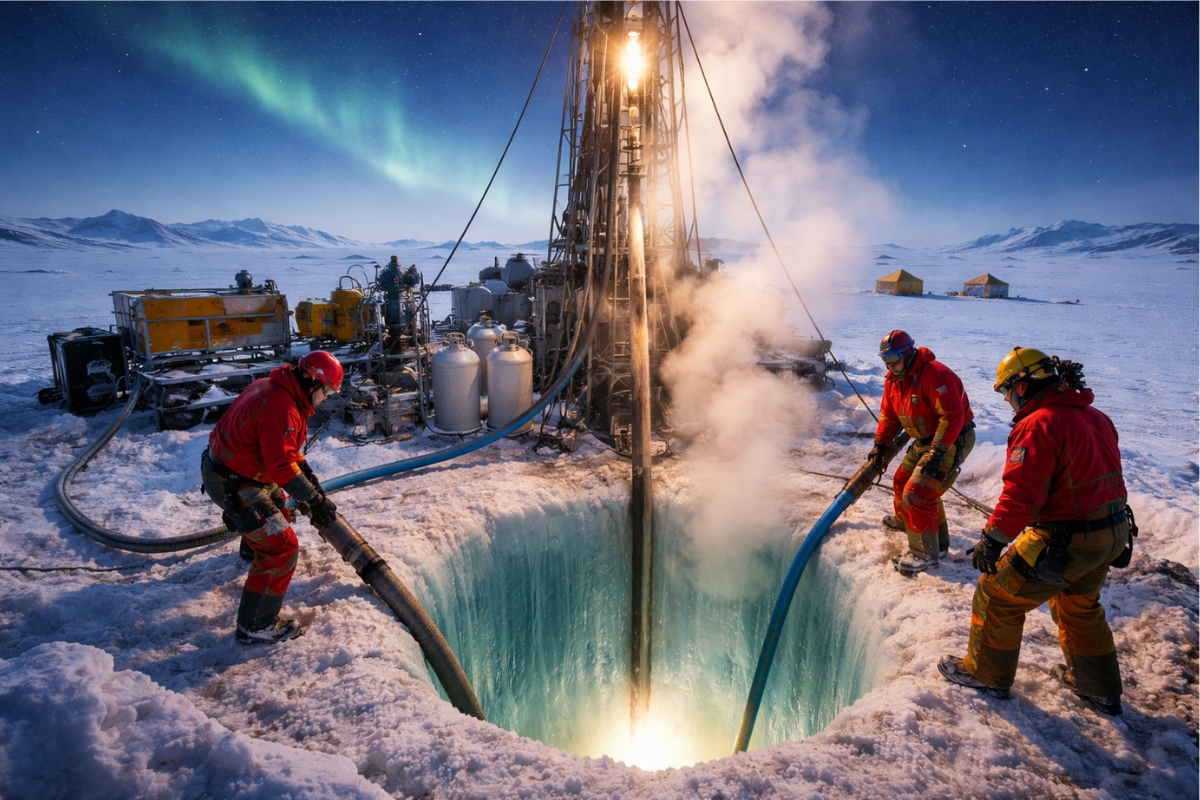
Scientists from an international project drill 1,800 meters of ice in Antarctica using hot water and discover details about one of the most intriguing places on planet Earth.
-
Seen from space, a colossal volcano nearly 5,000 meters high in Russia has released 1,600 km of smoke over the Pacific, forming “devil’s horns” of lava and revealing the brutal force of the Ring of Fire.

-
Expedition 501: Scientists drill into the ocean floor and discover a giant reserve of fresh water hidden beneath the sea, extracting nearly 50,000 liters and revealing an invisible system that could reshape the map of water scarcity.

The use of helicopters is described as a logistical solution for remote locations where opening roads, transporting trucks, or operating heavy machinery would cause soil compaction, crush native vegetation, and worsen erosion.
The technique has been widely used in 2025 and continues with ongoing projects in 2026, supporting a field schedule that tries to take advantage of weather windows and reduce impacts during critical periods for local wildlife.
The logic is straightforward: deliver large volumes of material without wheels and tracks passing over the peatlands.
What Helicopters Dump in the Rivers and How It Affects Water Flow

The central material is stone, but the package is not just that.
The teams transport stones, wood, and other restoration materials to marked points, where the goal is to recreate structures that a healthy river usually forms on its own over time.
When they fall and settle on the riverbed, the stones create roughness and obstacles, breaking the energy of the flow and returning variations in speed.
This redesign helps to undo the effects of rectification, when channels were left straight and fast.
In rectified rivers, the water gains speed, increases erosion, and washes sediments away.
With obstacles, the flow returns to have turbulence, backwaters, shadows, and small drops, which changes the physical environment where biodiversity tries to survive.
Rapids, Oxygenation, and Microhabitats: Why Stone Turned into a Biological Tool

The recreation of rapids has a mechanical function and a biological one.
The turbulence produced when the water passes over stones increases the air-water interface and raises levels of dissolved oxygen, a condition considered essential for fish and invertebrates.
At the same time, the stones create microhabitats: zones with faster and slower currents, refuge areas against predators and points where organisms can settle or reproduce.
The riverbed stops being a “carpet” and becomes a mosaic of niches, something that rectification and historical drainage tend to erase.
Peatlands and Carbon: The Climate Reason Behind the Hurry in 2026
In the North Pennines, restoring rivers is inseparable from restoring peatlands.
Degraded peatlands lose stability, erode, and can have their stored carbon carried away.
The intervention with stones and permeable barriers also targets sediment retention, preventing peat from being washed away and transported out of the system.
The described goal is to rehydrate and stabilize areas that, when drained, begin to emit gases and lose ecological function.
The restoration aims to retain water at the top of the landscape, maintain the water table high, and reduce erosion that transforms exposed peat slopes into continuous scars.
Leaky Dams: Small Dams That Don’t Block Everything, but Change Everything
A key piece of the method is the construction of leaky dams, described as permeable dams made of stone and wood.
They do not block the river like a traditional dam. They allow water to “leak” slowly but create enough resistance to reduce speed, hold sediments, and spread the flow.
These structures are used to slow the water in drainage channels and in stretches where rectification has increased the energy of the runoff.
The expected result is twofold: less erosion and more retention of organic material, which helps peatlands and improves habitat quality in the rivers connected to them.
Why Helicopter and Not Truck: Fragile Soil, Remote Access, and Speed of Execution
The choice of helicopter is presented with three practical reasons.
The first is the preservation of sensitive soil: compacted peatlands lose porosity, alter the flow of water, and accelerate degradation.
The second is access: there are areas without roads and with terrain that makes manual transport unfeasible.
The third is speed, crucial for executing works before severe weather changes and to reduce disturbance time in the environment.
There is a data point on operational scale cited for 2025 and 2026: on an average operating day, a helicopter can transport between 100 and 200 tons of stones, allowing for precise dumping at planned points.
This transforms a job that would take months by land into concentrated operational windows.
How Aerial Restoration is Done: Mapping, GPS, Precise Dumping, and Monitoring
The execution is described as a technical sequence.
First comes the diagnosis with digital mapping, including the use of technologies like LiDAR to identify areas of erosion and places where artificial channels and exposed slopes require intervention.
Then comes logistics: materials are accumulated at loading points on firm ground, such as nearby quarries, and carried in nets or suspended buckets.
The dumping is done with GPS marking, so stones and wood fall exactly where the structures need to be built.
Next, there is slope stabilization and replanting. The whole process is monitored in 2026, with the aim of measuring soil moisture, flow response, and the effectiveness of barriers, making adjustments when some structure fails or needs reinforcement.
Scope and Goals: 48,000 Hectares Restored and Continuity in the Plan 2026 to 2031
The effort in the North Pennines is described as large-scale by peatland standards: by 2025, the program would have restored about 48,000 hectares, an area compared to four times the city of Newcastle.
In 2026, continuity appears linked to a management plan from 2026 to 2031, maintaining the use of monitoring and mapping tools to guide where intervention is most urgent.
This volume helps to understand why aerial restoration gained traction.
When the area is vast, the environmental cost of opening land access can be too high, and aerial logistics becomes the way to move material quickly without destroying the very object of recovery.
Materials Besides Stone: Wood, Coir Rolls, Seeds, and Even Local Wool
The stones are the most striking image, but the list of cited inputs is broader.
Wood is included as a component of permeable structures and flow deflection.
Coconut fiber rolls are also mentioned, used as lightweight engineering support on banks and channels.
There is also an experimental front with local sheep wool rolls, described as an alternative to synthetic or imported fibers, reinforcing the idea of solutions compatible with the rural economy.
In the soil coverage phase, nurse crops enter, with a mixture of seeds and fertilizers to create an initial protective layer, and the planting of Sphagnum, the moss considered the engine of peatlands, associated with the ability to retain water and sustain ecosystem recovery.
What Is Being Tested: Whether Aerial Restoration Can Reverse Centuries of Wrong Drainage
The central experiment is to measure whether rapid interventions, made from above, can undo the accumulated consequences of historical drainage.
Drainage and rectification created deep and fast channels that export sediments and carbon out of the system, leaving exposed peat and impoverished rivers.
The bet is that by returning obstacles, increasing retention, and reducing speed, the system can start working in favor of the landscape: more water retained, less peat carried away, more oxygen in the water, more niches, more stability.
In practical terms, the test is whether aerial engineering can produce persistent effects in the rivers without requiring constant maintenance and without imposing collateral damage to fragile soil.
Do you think dumping stones by helicopters in the rivers of North Pennines can become a model for other regions of the United Kingdom, or do cost and complexity limit this type of restoration?








Seja o primeiro a reagir!