





 Português
  Inglês
  Espanhol
  5 min de leitura
  0 comentários


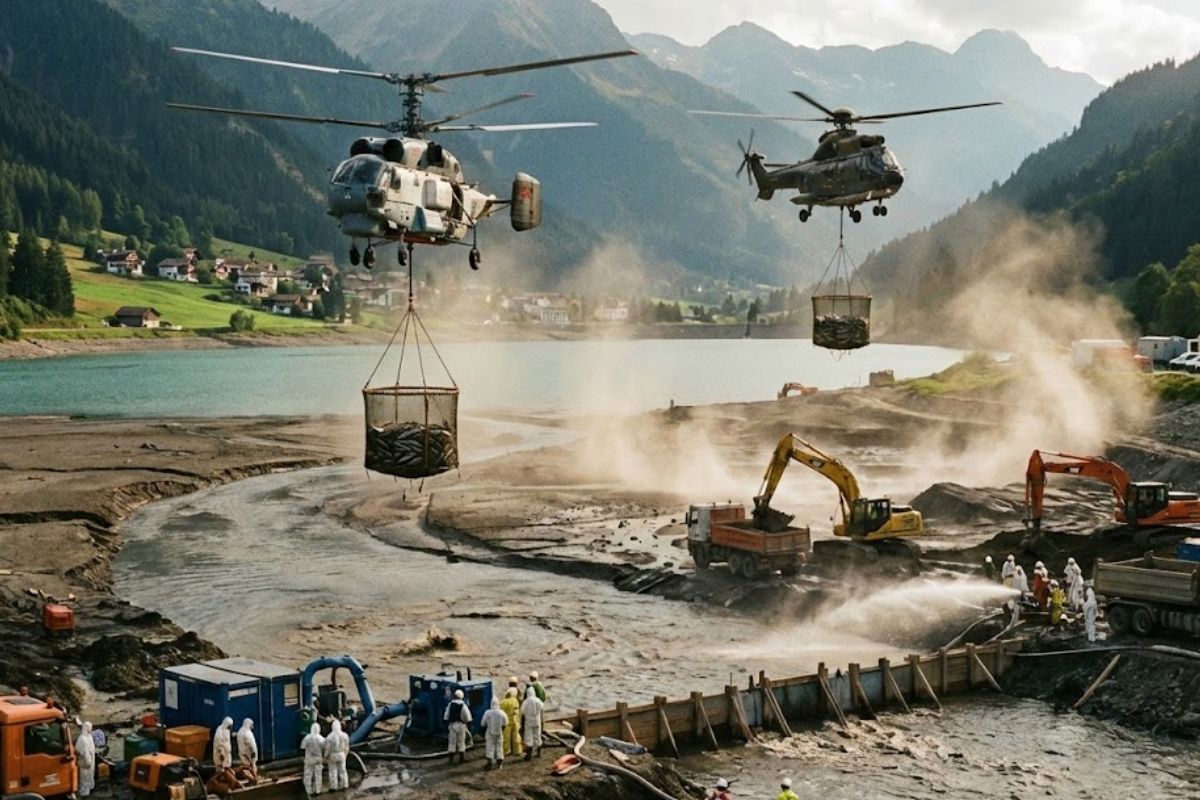
Operation on the Spöl River Removes Trout with Nets, Transported by Helicopter to Special Containers and Returned to Water Downstream, Creating Space to Empty Five Kilometers Contaminated Since 2016 at the Punt-dal-Gall Dam on Lake Livigno, and Remove Sediments with PCBs Before Cleanup Planned by 2026.
In the Swiss Alps, the Spöl River has become the center of an unusual operation: about 12,000 fish are being removed from the watercourse so that the riverbed can be emptied and cleaned after PCB contamination linked to maintenance work carried out in 2016. The measure takes place within the Swiss National Park, a place where human interventions are usually rare, but where environmental urgency has led to direct action to prevent polluted sediments from continuing to affect aquatic life.
The operation takes place in the area under the influence of the Punt-dal-Gall dam, which holds back the waters of Lake Livigno. The preparation for the remediation work is being carried out at the foot of this dam, under the coordination of the Engadin electricity company (EKW). The forecast is that by the beginning of 2026, the riverbed will finally be cleaned to remove polychlorinated biphenyls, substances associated with cancer risk that, according to the technical description of the case, reached the environment during the 2016 works.
What Contaminated the River and Why Cleanup is Now Inevitable

Contamination by PCBs, chemical substances that have been used in paints, insulating materials, and plastics, has been attributed to the maintenance episode that occurred nine years ago in the dam structure.
-
Found in one of the most radioactive places on Earth, this Chernobyl fungus may be doing something with radiation that no one has been able to explain to this day.
-
A bright yellow mushroom imported from Asia escaped from a cultivation farm in the United States in 2010 and is now aggressively spreading across 25 states, destroying entire communities of native fungi in American forests.

-
Buried under China, a colossal machine weighing 20,000 tons began operating as the largest neutrino detector on the planet and, in just 59 days, surpassed results that science took half a century to achieve.

-
Iran enters the center of a climate alert after the war emitted 5.6 million tons of CO2 in two weeks, surpassing the annual pollution of entire countries.


The effect spread over approximately five kilometers of the river, leaving the problem concentrated in the riverbed, precisely where sediments accumulate and where the current deposits fine material over time.
This detail changes everything: when pollution gets trapped in sediment, it doesn’t simply “pass” with the water.
It remains on the bottom, interacts with the ecosystem, and continuously threatens the environmental balance of a watercourse that sustains fish and other forms of life dependent on a stable habitat.
Therefore, the chosen strategy is not just to “wash” the river, but to remove the contaminated material and physically take it away from the area.
How Fish Are Being Removed and Why Helicopters Were Involved in the Operation

To initiate the decontamination, the first step is to ensure that the aquatic fauna does not get trapped in a section that will be lowered and subsequently emptied.
The trout from the river are being captured with nets and, after capture, transported by helicopter to special containers.
They are then returned to the water further downstream, allowing the contaminated section to be managed without causing mass mortality.
The logistics involve approximately twenty people, illustrating the effort to execute multiple steps simultaneously: capture, packaging, transport, return to the river, and operational control on site.
The operation relies on precision, as the goal is to transfer a large volume of fish efficiently, with proper handling and in the planned sequence of actions to avoid delaying the next step, which is the emptying and removal of sediments.
The Most Delicate Stage: Lowering the Level, Emptying the Bed, and Removing Sediments with PCBs

The strategy outlined by the responsible parties begins with a physical change in the behavior of the watercourse: the level of the river is reduced to facilitate capture.
Once the transfer of fish is completed, the phase that really alters the landscape for a period follows: the river will be emptied in that section so that sediment cleaning can begin.
The material removed will not remain in the region.
All contaminated sediment will be taken to Aargau for incineration, indicating controlled disposal outside the park to prevent the residue from re-entering the environment through improper disposal.
The declared expectation for the technical outcome is high: it is estimated that 90% to 95% of PCBs can be extracted from the sediment, particularly the finer fraction, which tends to retain contaminants more easily.
The decontamination of the river has a deadline: the forecast is that the work will be completed by the end of 2026.
The goal is for the process to help restore the ecosystem’s balance, as the removal of polluted material reduces continuous pressure on aquatic life and the environmental quality of the affected stretch.
A Century-Old National Park and a Rare Intervention in the History of the Place
The context makes the operation even more symbolic: the Swiss National Park has 111 years of history, being described as the only national park in the country.
Even with this tradition of protection, the local history shows that the territory has already been the stage for relevant debates and interventions, such as the construction of the dam, which in the 1960s was a matter of discussion, and the road through the Ofen Pass that crosses the park.
This helps explain why the case of the Spöl River has returned to the center of a debate: some see remediation as an environmental necessity while others see the weight of human intervention within a protected area.
Still, the central point presented is that contamination exists, is located in the riverbed, and needs to be removed for the ecosystem to have a chance for consistent recovery.
The Yet Unresolved Point: Who Pays and Who Takes Responsibility
Despite the environmental schedule being outlined, the financial part remains undefined.
It is unclear who will bear the costs, and this uncertainty appears as one of the most sensitive elements of the case, as it involves civil liability and financing decisions.
To expedite the work, the decision was made to separate the execution of the project from discussions about the costs and responsibilities related to pollution.
In practice, this means that the cleaning of the river progresses without wasting time on disputes while the contaminated sediment remains on the bottom.
The priority at this moment is to remove the problem from the riverbed and reduce the environmental risk, leaving the financial definition for a later stage, when the remediation process is already underway or completed.
Why This Operation Could Redefine the Future of the Spöl River
The expected impact is not limited to the removal of a contaminant.
In a mountain river within a national park, the integrity of the bed, the quality of the sediment, and the health of fish are part of the functioning of the ecosystem as a whole.
If the goal of extracting 90% to 95% is achieved and remediation is completed by the end of 2026, the Spöl River will have undergone one of the most significant interventions ever recorded in the park, but with a clear objective: to once again sustain life with less toxic pressure accumulated over the years.
And for you: when a river within a national park is contaminated, do you think a radical intervention like this is the only possible way?








-

Uma pessoa reagiu a isso.