





 Portuguese
  English
  Spanish
  3 min of reading
  0 comments


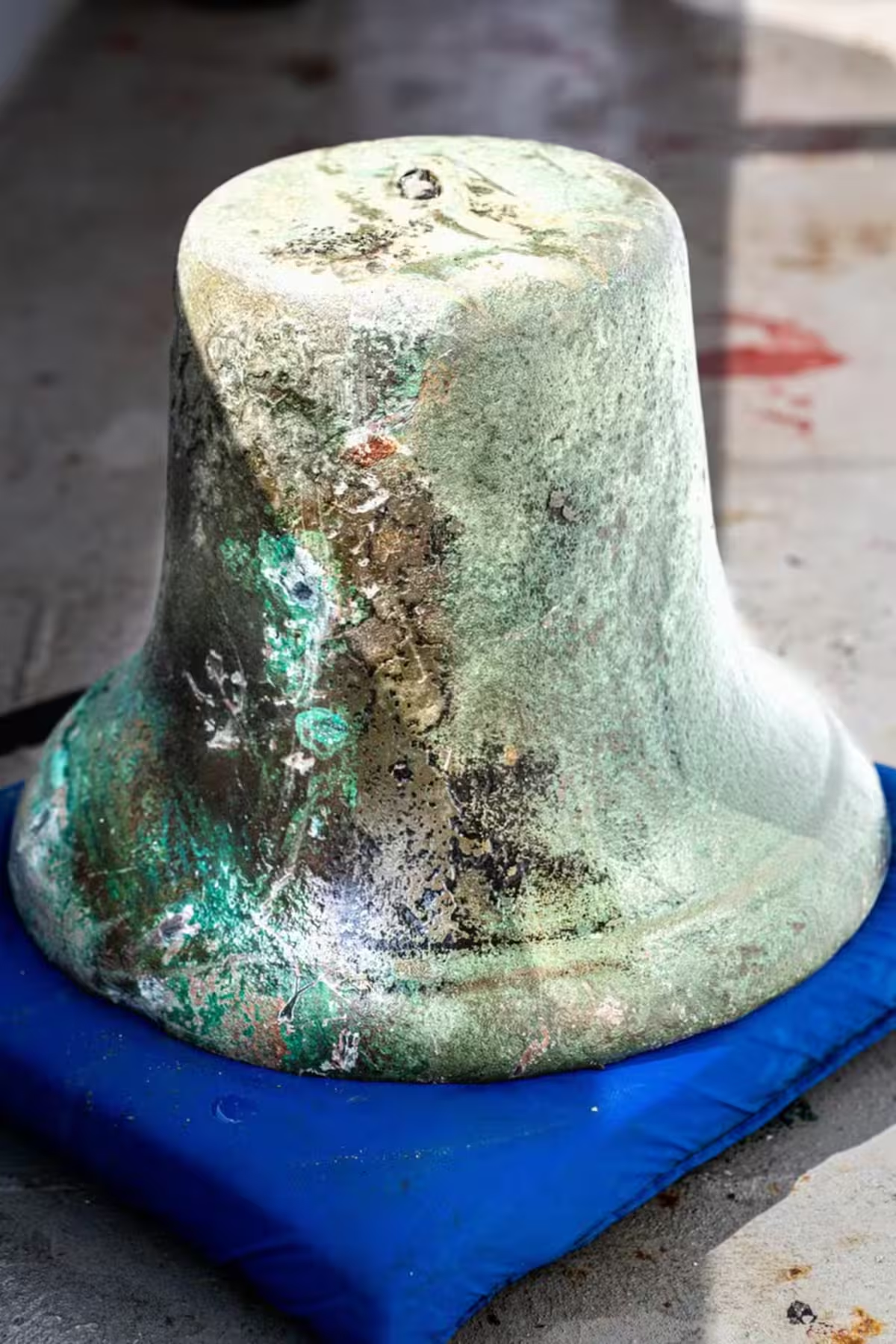
Alaska Residents Locate and Retrieve Bell From Shipwrecked 1908, Symbol of Forgotten Tragedy With 110 Dead
A group of volunteer residents from Alaska conducted an expedition that led to the discovery of a historical artifact. The group was able to locate and recover the bell from the ship Star of Bengal, which sank more than a century ago, killing 110 people.
The vessel sank in 1908, near Coronation Island in the Antarctic Ocean, in a tragedy considered the second deadliest in the naval history of the region.
The goal of the expedition was to map the wreck site and better understand who the victims were. Most of the dead were Asian immigrant workers employed in canneries.
-
Friends have been building a small “town” for 30 years to grow old together, with compact houses, a common area, nature surrounding it, and a collective life project designed for friendship, coexistence, and simplicity.

-
This small town in Germany created its own currency 24 years ago, today it circulates millions per year, is accepted in over 300 stores, and the German government allowed all of this to happen under one condition.

-
Curitiba is shrinking and is expected to lose 97,000 residents by 2050, while inland cities in Paraná such as Sarandi, Araucária, and Toledo are experiencing accelerated growth that is changing the entire state’s map.

-
Tourists were poisoned on Everest in a million-dollar fraud scheme involving helicopters that diverted over $19 million and shocked international authorities.


For those involved, the discovery of the bell represents a connection to these forgotten people at the bottom of the sea.
Shipwreck Left Dozens of Workers Trapped
The Star of Bengal was an 80-meter ship that left the city of Wrangell, Alaska, headed for San Francisco, United States. It was carrying canned salmon, supplies, and 96 factory workers. The vessel was navigating with the assistance of two tugboats.
During the journey, very strong winds affected navigation. The tugboats, due to their low power, were unable to maintain control, and the ship was driven to wreckage. The tragedy worsened when the workers were locked in the hold by the crew and were unable to escape.
The accident resulted in the death of 110 people, surpassed only by the sinking of the Princess Sophia in 1918, which had 343 deaths.
Discovery and Recovery of the Bell
In 2022, commercial diver Gig Decker located the wreck area. However, bad weather prevented full exploration at that time.
Now, in a new attempt, the team found the remains of the vessel, scattered over approximately four hectares. The hull was broken into three pieces.
According to marine archaeologist Evguenia Anichtchenko, the site had never been properly studied or mapped. “It’s one of those sites that has occupied people’s imagination for a long time but hasn’t really been studied or mapped and hasn’t received the archaeological attention it deserves,” she told the Anchorage Daily News.
The bell, one of the main pieces of any ship, was removed from the location. For the volunteers, it symbolizes the role of the workers who were part of the tragedy and whose stories were forgotten for over a century.
Recognition of Victims and Historical Injustice
The discovery of the bell reignited the discussion about the unequal treatment given to the victims of the shipwreck. Gig Decker highlighted that, at the time, most white crew members received a dignified burial, while Asian workers were left in the sea.
“I think everything culminates in the sinking of the Star of Bengal. The disproportionate number of canned factory workers who died in the shipwreck reflects how these people were treated and regarded.”
So far, the boarding recognition has identified 15 Japanese workers and about 4 Filipinos. None of the 66 Chinese immigrants who were on the crew have been identified.
The group is now seeking contact with researchers from the Chinese community in the United States and the embassies of China and Japan to explore ways to compensate the families of the victims.
Restoration of the Artifact and Preservation of Memory
Anichtchenko is collaborating with the Texas A&M University Maritime Archaeology and Conservation Center to restore the bell.
According to her, the piece contains salt in its pores that can cause what is known as “bronze disease” if not treated properly. The cost of the process ranges between US$ 6,000 and US$ 10,000, and the team is raising funds for this restoration.
Once restored, the bell will be taken to the Wrangell Museum in Alaska, where it will be displayed. The piece is expected to become a symbol of the tragedy and a way to honor the memory of the workers who died in the shipwreck.
With information from Revista Galileu.









Seja o primeiro a reagir!