





 Portuguese
  English
  Spanish
  5 min of reading
  0 comments


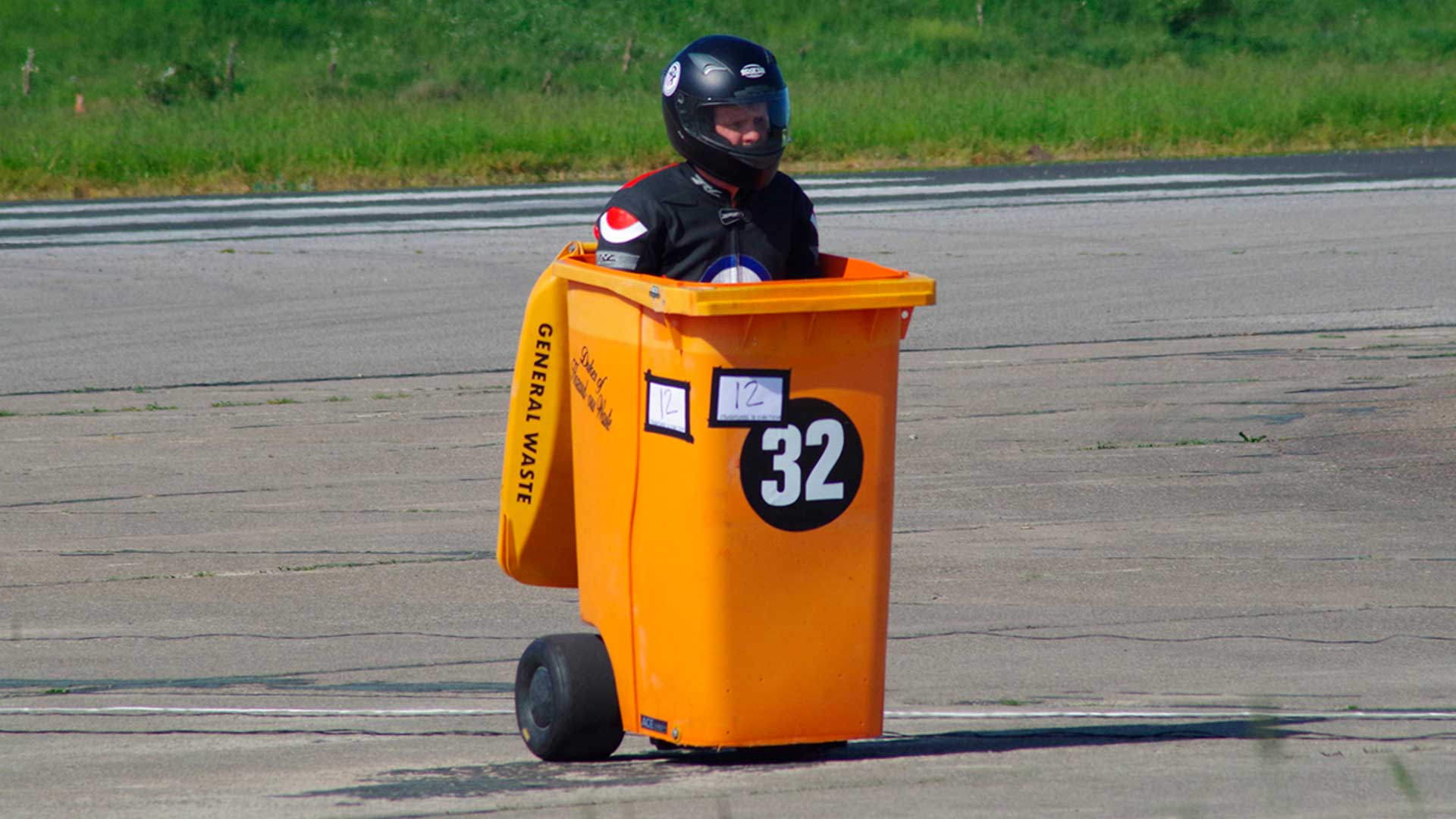
A UK Inventor Says He Took The Motorized Bin The General Waste To About 106 Km/h, Above The Current Official Guinness World Record. The Recognized Mark Is Still 88.344 Km/h, Registered In 2023. Now, He Claims The Project Could Evolve To Speeds Close To 127 Km/h.
Michael Wallhead, a British inventor, is once again grabbing attention by claiming that his motorized bin, nicknamed The General Waste, has already reached about 106 km/h in recent tests. The speed, if confirmed and validated under the required criteria, would easily surpass the mark that is currently listed as the official record of the Guinness World Records for the category.
For now, the officially recognized record by Guinness remains 88.344 km/h, achieved by Wallhead himself on May 24, 2023, in York, North Yorkshire, UK. This detail is relevant because, in speed records, it’s not enough to just “go fast” once, as the record depends on methodology and validation.
The story began as a garage joke that turned into a competition. Guinness itself describes the project as a backyard invention that evolved with training, adjustments, and a lot of trial to control stability.
-
Neither in the refrigerator nor in the fruit bowl: this is the correct way to store lemon.

-
It has only 11 thousand residents: Brazilian Tuscany impresses everyone with mountains of 1,900 meters and wide views of valleys.

-
Without experience and without giant machines, a young person builds a complete house made only of wood in 30 days, impressing with talent and a surprising final result.

-
12-year-old student builds gravity-powered solar tracker with recycled parts and under $25 that increases panel efficiency by 20% and will now present the invention in Washington as the national STEM champion.


The result is a curious mix of humor, improvised engineering, and real risk. And it’s precisely this contrast, between an ordinary bin and a motorcycle-like speed, that helps explain why the case goes viral and returns to the news.
Motorized Bin At 106 Km/h And The Difference Between Official Record And Unofficial Mark
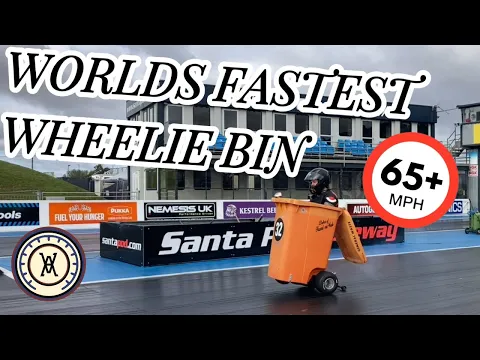

Wallhead claims that the bin has already reached 106 km/h, equivalent to 66 miles per hour, after continuing to improve the project. Guinness also records the inventor’s statement that he has already made 66 miles per hour, although the official record listed on the site remains 55 miles per hour, which corresponds to 88.344 km/h.
The difference between “reaching” a speed and “registering” a record usually lies in the process. Generally, Guinness works with evidence requirements, specific rules by category, and validation of what has been measured, in addition to technical documentation. Guinness itself reminds us that records can change and are not always published immediately.
In the case of the fastest bin, the previous official mark was 72.568 km/h, attributed to Andy Jennings in 2021, before Wallhead took the lead in 2023. This ladder of numbers helps to understand why the jump to 106 km/h, if it becomes official, would be a huge step within the same joke.
The General Waste Inside Suzuki GP125 Engine And Adjustments That Transform A Bin Into A Vehicle
The base of the project is literally a second-hand wheeled bin. According to published reports, Wallhead found the bin in a Facebook Marketplace ad for about $25 and invested nearly $900 on modifications.

The list of adaptations draws attention for the mix of parts and solutions typical of karts and motorcycles. The project was assembled with a Suzuki GP125 two-stroke engine, magnesium kart wheels, a rear axle, and a five-speed transmission, as well as reinforcements and items to improve steering and stability.
Guinness describes that, in practice, the bin “hides” a small tricycle with a motorcycle engine, with extra effects to “entertain” the viewers, such as lighting and a rear bar for the bin to lean on and create a visual effect. It’s the absurd aesthetic helping the performance to become a spectacle.
However, the interior was not made for comfort. Guinness itself reports that the knees touch the front when settling in, and that the foot is so close to the engine that it burns the shoe during driving.
Even controlling the “vehicle” requires improvisation. Descriptions indicate that he uses a handlebar set between his legs to steer and brake, which shows how ergonomics become as much of a challenge as power.
Falls, Risk And Safety Protocol In The Project That Turned Into Serious Fun
The funniest part, a person inside a bin running, is also the most dangerous part. Guinness records that Wallhead has already fallen at about 30 miles per hour and hit his shoulder on the ground.
After that, he began to adopt a simple and not glamorous safety procedure. The recommendation became to curl up inside the bin when it tips over and let the set slide to a stop, instead of trying to get out in a hurry.

The discussion about limits is not just curiosity, as stability is an issue cited by the inventor himself during preparation and training. In projects of this type, any oscillation can turn into a loss of control at high speeds.
What Guinness World Records Evaluates And Why These Garage Records Draw Attention
For the audience, the question is usually straightforward. How can something so improvised enter Guinness and still be taken seriously? The answer involves clear rules and documentation of the feat, as records are not measured just by excitement but by defined criteria for each title.
Guinness maintains the official record of Wallhead as 88.344 km/h, which helps separate what has already been validated from what is still in the realm of new attempts. And it’s precisely there that the story gains a new chapter, because the inventor insists that the bin has already gone beyond the number that appears as “official”.
Another point that fuels the interest is the escalation of goals. Guinness records that Wallhead claims that theoretically, the bin could reach 79 miles per hour, something close to 127 km/h, which would turn a garage joke into an even more extreme object.
In the end, the appeal of these records is the same as many homemade inventions. It’s the sense that anyone with creativity, tools, and stubbornness can create something unexpected, even if it involves discussing safety, responsibility, and the line between entertainment and recklessness.
Whether Guinness should validate increasingly faster attempts or impose stricter limits to avoid unnecessary risks is an open debate. Do you think records like this encourage innovation or just push people into dangerous situations? Leave your comment with your opinion and say how far this bin should go before someone says enough.






Seja o primeiro a reagir!