





 Portuguese
  English
  Spanish
  5 min of reading
  0 comments


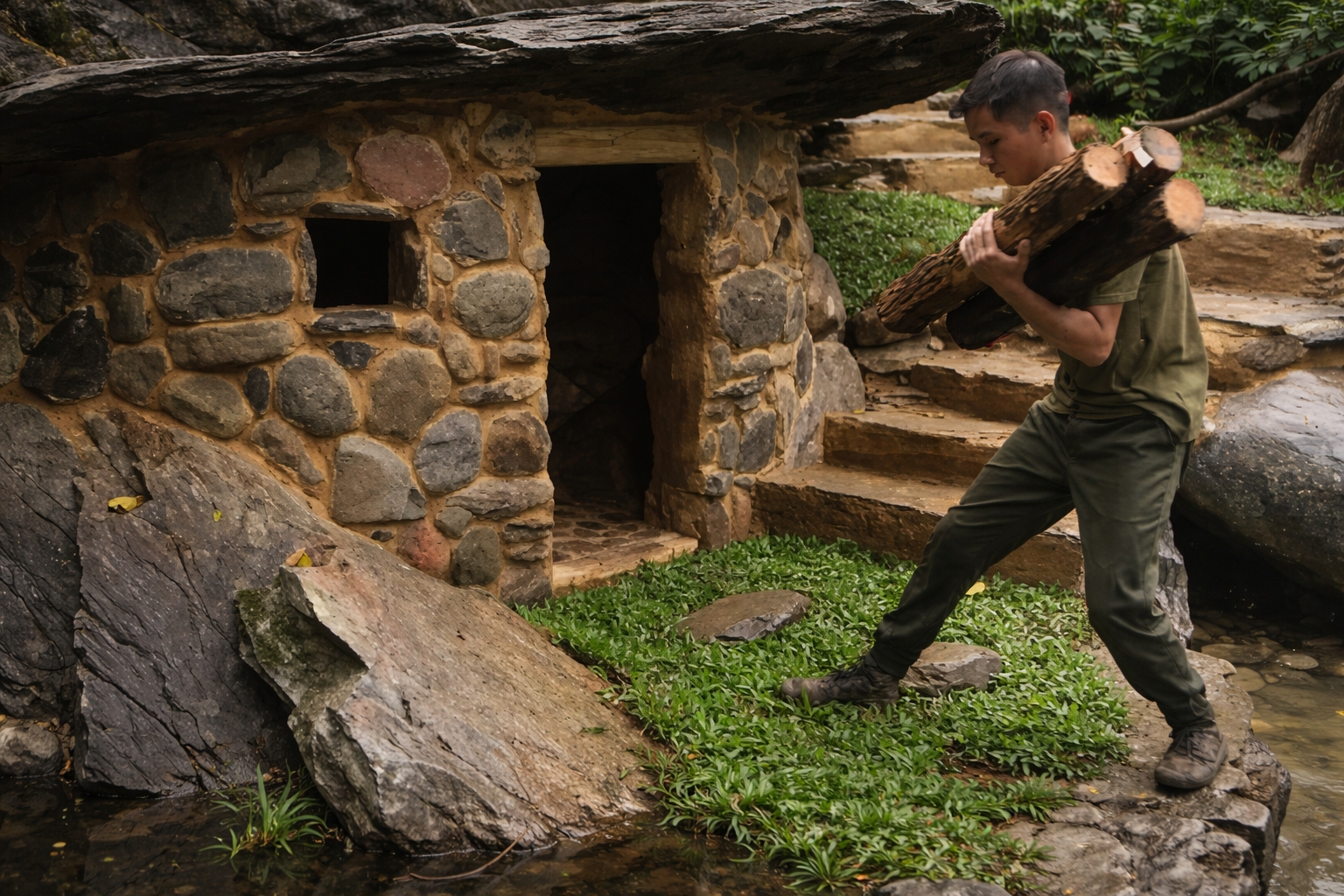
House Under Stone, Built by Hand in 30 Days, Comes from the Basics with Wood, Clay, and Rock, Attracts Attention for Showcasing a Root Construction Method That Dispenses with Machines, Relies on Technique and Persistence, Transforming a Raw Space into a Functional Home
Stone Transformed into a Home in Just 30 Days of Work! It masters a space that already exists, a low void beneath an enormous rock, and transforms it into a home hidden beneath stone in the jungle. The process takes a month to unfold: nothing fits in place on the first try, and almost everything goes through adjustment, pressure, and correction until it is stable.
The roof doesn’t need to be invented. The stone already solves that part. So the work turns to another task: cleaning the floor, stabilizing the base, and erecting stone walls with joints filled with clay. Wood comes in later, giving contours, support, and closure to the entrance.
What captivates is the contrast between the disorganized beginning and the well-resolved final stage. Without exaggeration, the result looks like a thoughtfully designed structure. And the merit lies in the details that almost no one values: small wedges, well-compressed joints, rotated stones until locked in place.
-
Friends have been building a small “town” for 30 years to grow old together, with compact houses, a common area, nature surrounding it, and a collective life project designed for friendship, coexistence, and simplicity.

-
This small town in Germany created its own currency 24 years ago, today it circulates millions per year, is accepted in over 300 stores, and the German government allowed all of this to happen under one condition.

-
Curitiba is shrinking and is expected to lose 97,000 residents by 2050, while inland cities in Paraná such as Sarandi, Araucária, and Toledo are experiencing accelerated growth that is changing the entire state’s map.

-
Tourists were poisoned on Everest in a million-dollar fraud scheme involving helicopters that diverted over $19 million and shocked international authorities.


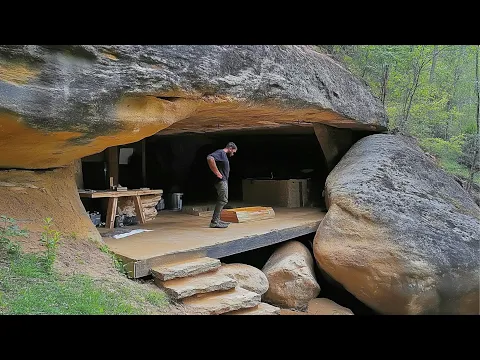

The Beginning Is Raw and Physical: Man Carves the Base of the House Hidden Beneath Stone in the Jungle Before Thinking About Walls
The first step has no glamour. Small stones and dirt are cleared until the floor is more even. The void beneath the slab begins to take shape when the edges are cleaned, and the space gains clearer boundaries.
The work progresses through layer removal. Hand, strength, and impact tools come into play to loosen hardened sections, always with the same goal: to reduce unevenness and remove anything that might give way later.

With a firmer base, the larger stones begin to settle without much rocking. This prevents misalignment right from the start and reduces gaps, something crucial for a home hidden beneath stone that relies on fitting and compression.
Discipline becomes evident when nothing is stacked on unstable ground. The time spent in this phase pays off as stability in the following steps.
Clay with Water Comes into Play and Man Carves Joints That Lock Stone with Stone Over a Month
Clay appears as working mass, kneaded and moistened until it is compressible. The right consistency is important because it needs to allow pressure and filling, without turning into mud flowing through the gaps.
The application goes straight to the joints. It fills the gaps, receives compression, and becomes a base for new stones. This reduces looseness and helps to regularize the whole, even when using irregular stones.
The gain is visible in the wall’s appearance: fewer holes, less instability, and more of a continuous mass look. The clay also compensates for differences in thickness and improves the settling without requiring perfect pieces.
The Wall Grows Without Rush
The wall rises with large stones at the base and corners, flatter stones forming more regular faces, and smaller stones serving as wedges. Nothing is done impulsively. Almost everything is tested.
The method is purposefully repetitive. Place, turn, test, remove, replace. When it wobbles, it doesn’t work. When it locks, it stays. Clay goes in between, but the fit is what dictates.
The whole gains thickness and functions through compression. The wall stops looking like a pile and starts to resemble a block made of pieces that hold each other up.
The wedges do the silent work. Small stones fill specific gaps to eliminate micro-gaps and improve alignment, the kind that no one notices from afar but that determines stability.
Inside, the Jungle Continues Outside
With the sides closed, the interior receives real attention. Dirt is pulled, compacted, and corrected. In critical points, smaller stones are added to provide support and reduce holes.
The work alternates hand, clay, and stone. Unevenness is filled. Parts that require a more continuous surface receive flatter stones, diminishing steps and irregularities.
The space changes function. It stops being a cavity and becomes a traversable environment. In a home hidden beneath stone in the jungle, this defines practical comfort, even with low height.
The rhythm conveys a month of persistence. Adjust, step, perceive, correct, return. This cycle repeats until the ground stops resisting the step.
Wood Complements: The Entrance Is Made with Boards, Sticks, and Well-Adjusted Ties
Wood appears and changes the reading of the entrance. Straight pieces and cylindrical sticks, including elements resembling bamboo, form the outline, support, and closing structure.
Simple cuts emerge along with ties that secure the pieces. A panel of planks gains crosspieces, helping to maintain alignment and firmness without relying on visible hardware.
The opening now has a clear boundary between inside and outside. Besides organizing the space, this closure helps control dirt and splashes, keeping the interior more protected.
The assembly follows the same pattern as the rest. Adjust until firm, with no apparent slack, with visible care in the fit.

One Month in the Jungle and the Finish That Makes a Difference
The external finish seeks integration. Loose stones are organized, and vegetation plates with roots and attached soil come in as coverage in nearby areas, creating a more natural transition.
The surroundings also become cleaner. Clay scraps disappear, cut remnants are not scattered, and the ground around appears reorganized with intention.
The home hidden beneath stone draws less attention in the rocky and green terrain. What often reveals improvised constructions is contrast, and this phase works precisely to reduce that.
In the end, there’s a feeling that the man carves because he respects what the place already offers and uses locking techniques to transform a raw void into a functional shelter, with stone, clay, and wood working together.
And you, were you impressed by any specific part of the process? Let us know in the comments.










-

-

-

-

-

-

75 pessoas reagiram a isso.