





 Portuguese
  English
  Spanish
  3 min of reading
  0 comments


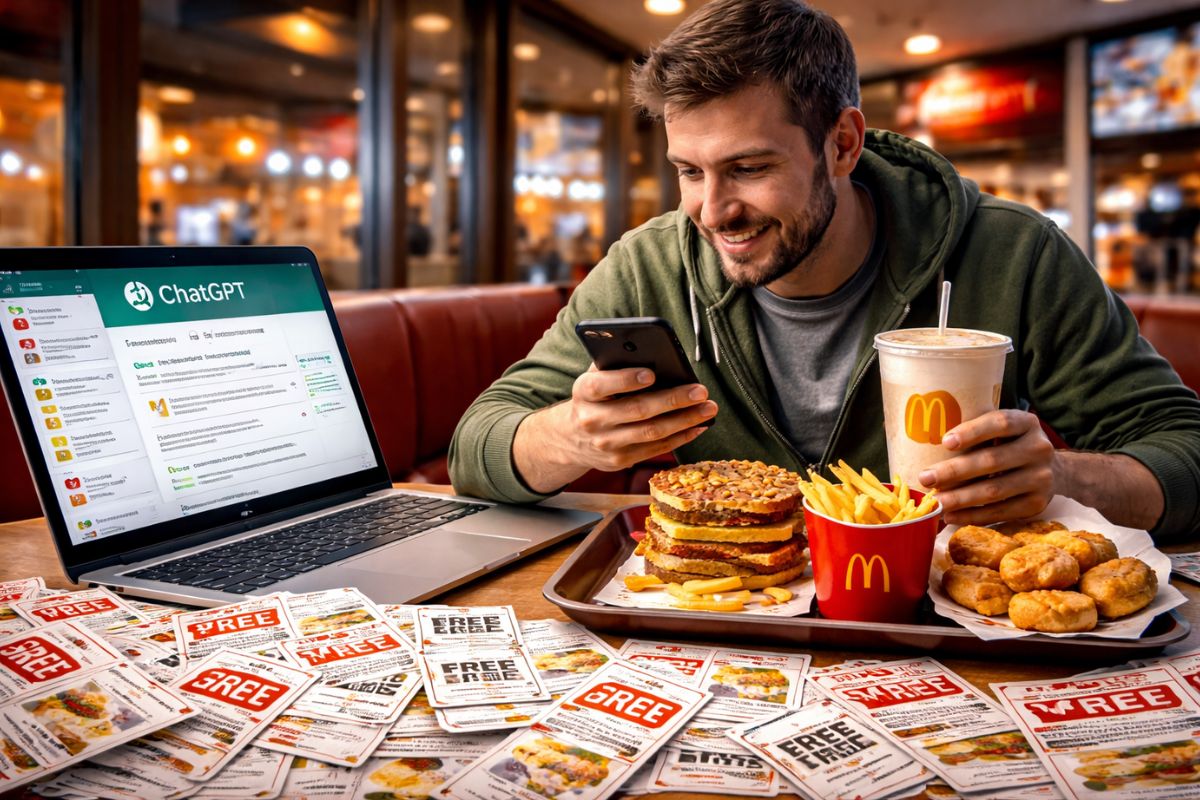
The Repeated Use of McDonald’s Coupons Generated from Satisfaction Surveys Caught the Network’s Attention After Nearly a Year of Free Meals Obtained with the Help of ChatGPT Revealing Digital Loopholes in the Relationship Between Consumers and Large Fast Food Chains
A case in the United Kingdom exposed how McDonald’s coupons were systematically used by a single consumer to obtain free meals for nearly a year. The man resorted to ChatGPT to create standardized complaints and negative reviews in the chain’s satisfaction surveys, accumulating rewards offered as compensation.
Since the first record, the scheme involved collecting physical receipts from McDonald’s, each containing access codes to online surveys. With the assistance of artificial intelligence, the user began to generate detailed and recurring responses, always resulting in valid McDonald’s coupons for free consumption.
How the Scheme with McDonald’s Coupons Worked
The method started simply.
-
50 viaducts, 4 tunnels, 28 bridges, and 40 kilometers of bike paths: BR-262 in Espírito Santo will receive 8.6 billion reais for the largest engineering project in the state’s history, inspired by the Immigrant Highway in São Paulo.

-
Brazil produces too much clean energy and doesn’t know what to do with it: over 20% of solar and wind capacity was wasted in 2025 while investors flee and 509 renewable generation projects were abandoned in the last year.

-
Piauí will produce a new fuel that replaces diesel without needing to change anything in the truck’s engine and reduces pollutant gas emissions by half: truck drivers from all over the Northeast are already celebrating the news that will arrive later this decade.

-
A new Brazilian shopping center worth R$ 400 million will be built in an area equivalent to more than 4 football fields, featuring 90 stores, 5 cinemas, a supermarket, a college, and parking for 1,700 cars, potentially generating 3,000 jobs.


The man gathered receipts from different purchases made at the chain, either his own or obtained from others.
Each receipt allowed access to a digital satisfaction survey, a tool created to measure the customer’s real experience.
Using ChatGPT, he filled out these surveys with fictitious accounts of negative experiences, described in a convincing and consistent manner.
As an automatic response, the system released McDonald’s coupons as a form of compensation to the dissatisfied consumer.
Repeated Use and Standardization of Complaints
Over time, the pattern repeated itself dozens of times.
The use of artificial intelligence allowed varying phrases, adjusting the tone of the complaints, and maintaining a level of detail sufficient to avoid raising immediate suspicions.
This process enabled the continuous accumulation of McDonald’s coupons, ensuring free meals over several months.
The practice remained active until the frequency of similar evaluations began to attract the attention of the company’s internal systems.
Detection of the Pattern and Interruption of the Benefit
The chain began to identify structural repetitions in the responses sent to the surveys, even when associated with different codes.
The similarity in the content of the complaints led to the interruption of the supply of McDonald’s coupons to the user.
Although specific measures taken against the perpetrator were not disclosed, the scheme was shut down after the recurring behavior was identified.
The episode highlighted failures in the automatic validation mechanisms of the surveys.
Impact of the Case on Fast Food Companies
The incident involving McDonald’s coupons reinforces the challenges faced by large chains in balancing consumer benefits and protection against abuse.
Trust-based and automated systems become vulnerable when strategically exploited.
The practice raises alarms about the need for more robust controls, especially in digital environments where artificial intelligence tools are becoming increasingly accessible to the public.
Artificial Intelligence and Risks in Consumer Relationships
The use of ChatGPT in this case was not aimed at improving services, but at exploiting operational loopholes.
This broadens the debate on how companies should prepare for interactions mediated by artificial intelligence.
In the fast food sector, where promotions and McDonald’s coupons are part of the loyalty strategy, the challenge is to identify artificial behaviors without compromising the experience of the legitimate customer.
In light of this case, do you believe that companies will be able to adapt their systems to prevent abuses with artificial intelligence, or will this type of practice tend to become increasingly common?









Seja o primeiro a reagir!