





 Portuguese
  English
  Spanish
  3 min of reading
  0 comments


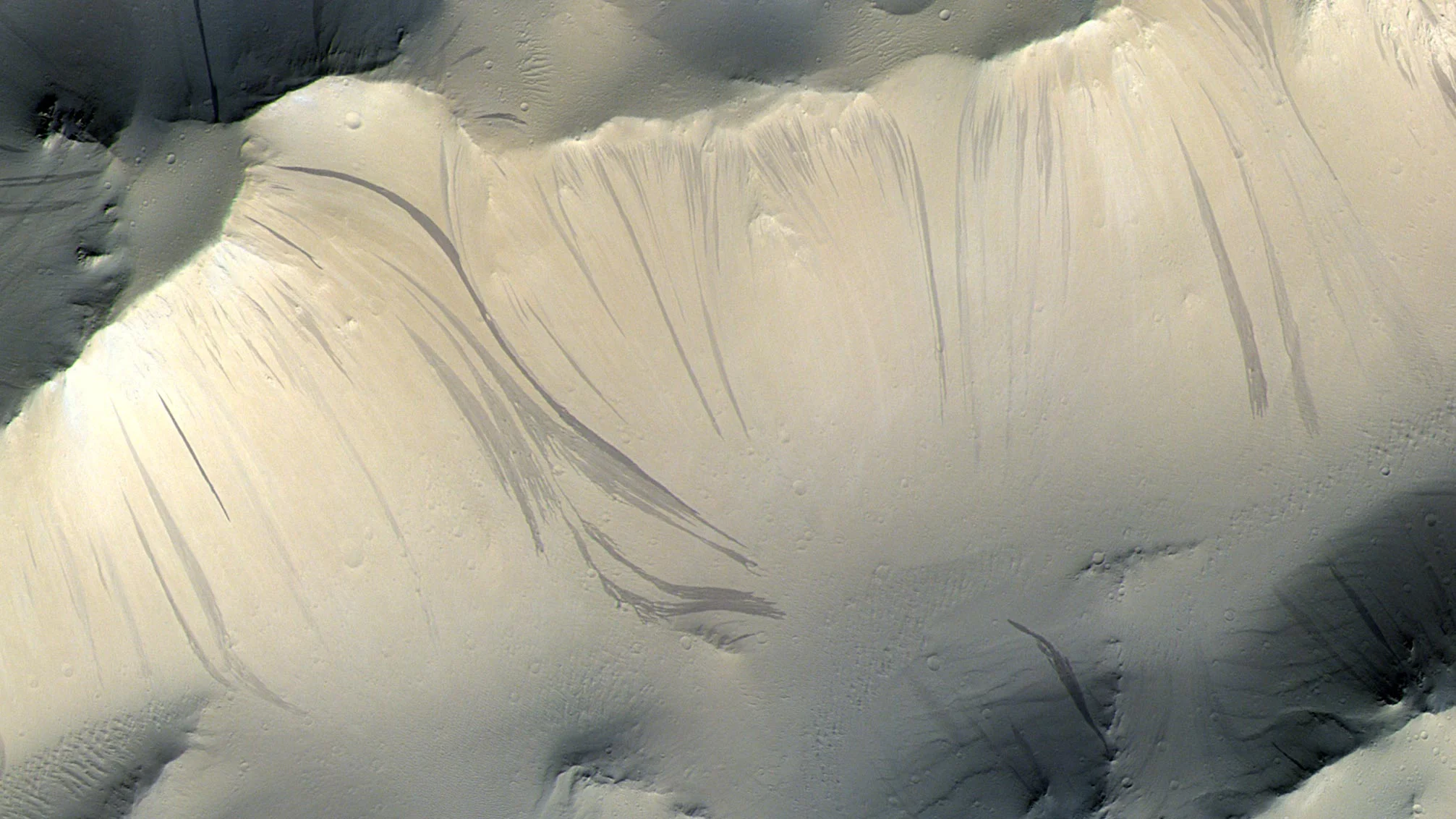
New Study With Artificial Intelligence Reveals That The Mysterious Stripes Of Mars Are Formed By Dry Dust, And Not By Water.
Since the 1970s, images of Mars have shown slopes with dark and light stripes. For years, scientists believed that these marks could be signs of briny water and possibly life. Now, new research indicates that the phenomenon has a different origin.
Initial Observations And Theories About Water
The first images of these stripes appeared in the 1970s with NASA’s Viking orbiters. The photographs showed long, narrow marks extending hundreds of meters across sloped terrain.
From there, hypotheses formed that flows of briny water could be responsible for the stripes. If proven, this would indicate the existence of potentially habitable environments on Mars, even with its freezing temperatures.
-
Motorola launched the Signature with a gold seal from DxOMark, tying with the iPhone 17 Pro in camera performance, Snapdragon 8 Gen 5 that surpassed 3 million in benchmarks, and a zoom that impresses even at night.

-
Satellites reveal beneath the Sahara a giant river buried for thousands of kilometers: study shows that the largest hot desert on the planet was once traversed by a river system comparable to the largest on Earth.

-
Scientists have captured something never seen in space: newly born stars are creating gigantic rings of light a thousand times larger than the distance between the Earth and the Sun, and this changes everything we knew about stellar birth.

-
Geologists find traces of a continent that disappeared 155 million years ago after separating from Australia and reveal that it did not sink, but broke into fragments scattered across Southeast Asia.

For a long time, the possibility of water drew attention.
Some researchers suggested that small amounts of brine could flow down the slopes, creating the observed patterns.
This idea fueled the debate about the possibility of life on the red planet.
New Images With High Resolution
More recently, detailed images captured by the CaSSIS camera aboard the European Space Agency’s (ESA) ExoMars Trace Gas Orbiter revealed more details about the mysterious stripes near Olympus Mons, the largest volcano on Mars.
The images showed the stripes appearing and disappearing over time. Some remained for years, while others vanished in a few months. Additionally, the colors and brightness of the stripes varied with the seasons.
These characteristics increased the mystery, as the stripes appeared on slopes in both hemispheres of the planet. The pattern gave the impression that huge brooms had swept across the Martian surface.
The Contribution Of Artificial Intelligence
Now, a new study from the universities of Bern and Brown offers a different explanation. Published in the journal Nature Communications, the research points out that the stripes are not caused by water, but by dry processes involving dust and wind.
To reach this conclusion, scientists used a machine learning algorithm. The program analyzed over 86,000 satellite images captured by NASA’s Mars Reconnaissance Orbiter (MRO). The technology allowed for the mapping of nearly 500,000 stripes on Mars, creating the largest database ever produced on these formations.
Images From Multiple Orbiters
In addition to the MRO images, the team used records from other cameras in orbit around Mars, such as CaSSIS itself and HiRISE, also from the MRO. By combining decades of observations, scientists were able to monitor the changes in the stripes over time, analyzing variations in color, brightness, and extent.
The correlations obtained from hundreds of thousands of records provided a new insight into the topic. With no clear indications of water, researchers concluded that dry processes explain the formation of these stripes on Martian slopes.
How The Stripes Form
The study indicates that the stripes emerge when thin layers of dust slide down steep terrain. Several factors can initiate the movement: the fall of small rocks, impacts from meteoroids, or gusts of wind. These events generate shock waves that cause the dust to slip.
To highlight the details in the images, the contrast captured by the CaSSIS camera is enhanced. The images are adjusted between the minimum and maximum brightness levels for each color before being combined and published.
Even with the new discoveries, the ESA’s ExoMars mission continues to investigate the past of Mars and its potential habitability.
The Trace Gas Orbiter continues to send detailed images and analyze the Martian atmosphere.
The equipment provides the best inventory of atmospheric gases ever obtained and maps the surface in search of water-rich locations.
The central objective of the ExoMars missions remains: to understand the history of water on Mars and discover if the planet ever hosted life.
Study published in Nature Communications.








Seja o primeiro a reagir!