





 Portuguese
  English
  Spanish
  3 min of reading
  0 comments


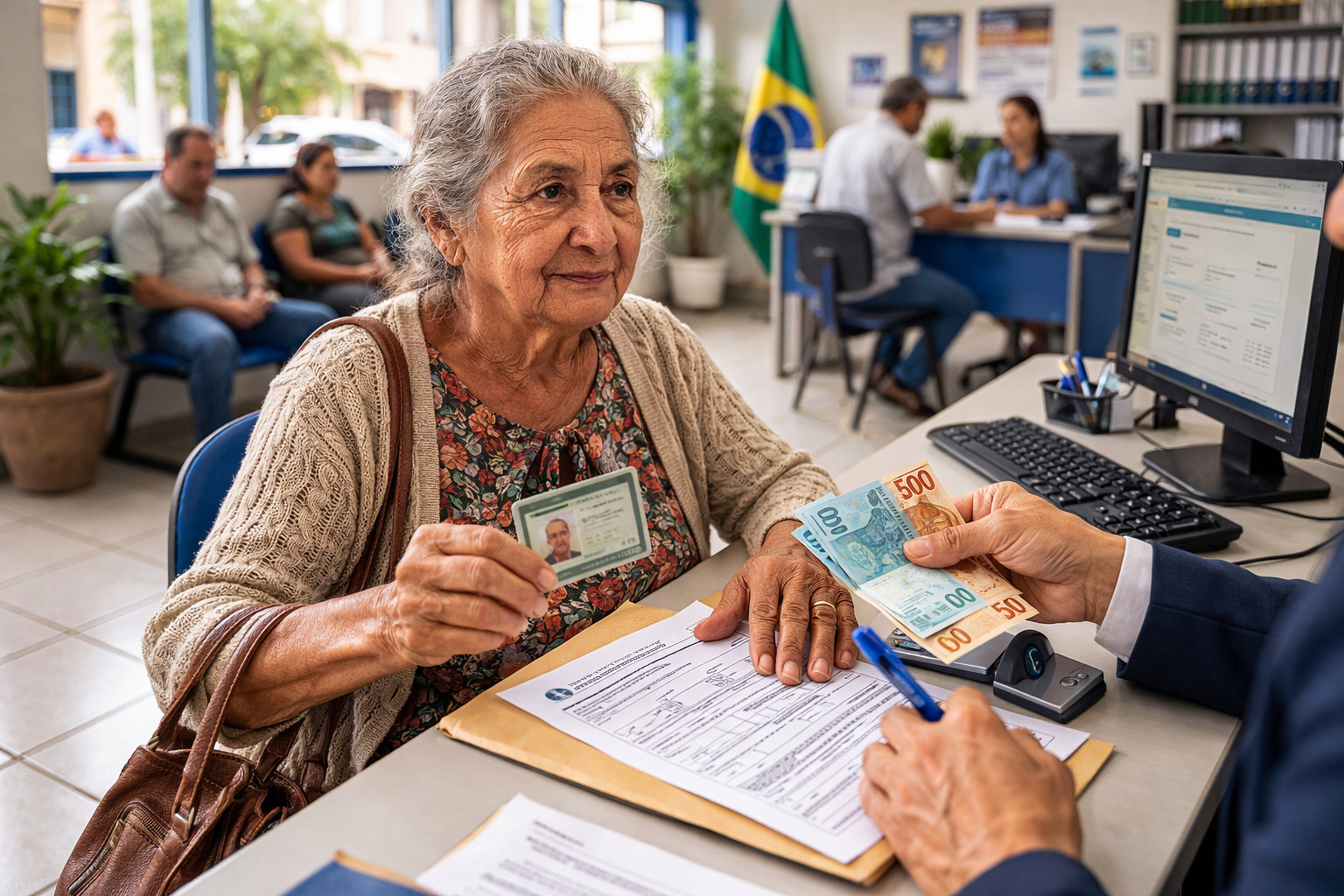
Understand Who Can Request the Monthly Payment, What Legal Criteria Are Required and How the Family Income Analysis Conducted by INSS Works
An assistance benefit paid by INSS can guarantee a monthly minimum wage to elderly people aged 65 or older who are in a situation of social vulnerability. Even without a history of social security contributions, the right can be recognized, provided that legal criteria defined in the Organic Law of Social Assistance, in effect since 1993, are met. Currently, considering the minimum wage in 2026, the annual amount exceeds R$ 18 thousand, reinforcing the social relevance of the measure.
According to guidance released by lawyer Maycon Matos, known on social media as “Terror of INSS,” many elderly people still do not know the possibility of requesting payment. The benefit serves exclusively people with proven low income. In addition, it is mandatory to maintain an active and updated registration in the Cadastro Único, a database used by the federal government to identify families in vulnerable situations.
Who Can Request the Assistance Benefit
The payment is intended for elderly people aged 65 or older. To qualify, individuals must prove limited family income, according to parameters established by legislation. The general rule sets the per capita income at less than 1/4 of the minimum wage. However, each case undergoes an individual analysis by INSS, which evaluates the economic reality of the family group.
-
The government requests the Federal Revenue Service for a new system to automate the income tax declaration, reducing errors, time, and bureaucracy for millions of Brazilians.

-
Pix in installments, international Pix, and contactless payment without internet: the Central Bank revealed the new features coming to the tool that is already used by almost every adult in Brazil.

-
Mercado Livre has just started selling medications with delivery in up to three hours to your door, and this move could completely change the way Brazilians buy medicines on a daily basis.

-
In Dubai, rising tensions from the war in the Middle East are causing super-rich individuals to leave the Gulf and direct their fortunes to a new financial refuge in Asia.


Additionally, unlike traditional retirement, no minimum social security contribution time is required. Thus, even those who have never contributed may be entitled, as long as they demonstrate a situation of social vulnerability.
Income Analysis and Recent Judicial Decisions
Although the income criterion is stipulated by law, judicial decisions in recent years have broadened the interpretation. Courts have begun to consider essential expenses, such as costs with health, medication, and housing. Therefore, the evaluation is not limited to the mere mathematical calculation of family income.
Furthermore, more than one person from the same household can receive the benefit, provided that each applicant individually proves the legal requirements. The analysis is conducted on a case-by-case basis, respecting the specific situation of each family.
Difference Between Assistance Benefit and Retirement
Although it is paid by INSS, the benefit has an assistance nature. Therefore, it is not considered retirement. For this reason, there is no payment of 13th salary nor generation of death pension. Additionally, the beneficiary undergoes periodic reviews to verify if the social criteria continue to be met.
To request it, one must be 65 years old or older, prove low family income, be registered in the Cadastro Único, and demonstrate a situation of vulnerability. The granting depends on documentary proof and administrative analysis.
Since 1993, when it was established, this social assistance instrument has consolidated itself as an important mechanism of protection for elderly people in situations of economic fragility.
Given the current rules and the latest judicial interpretations, isn’t it worth checking whether the right can guarantee greater financial stability in old age?









-

-

-

-

-

-

37 pessoas reagiram a isso.