





 Portuguese
  English
  Spanish
  4 min of reading
  0 comments


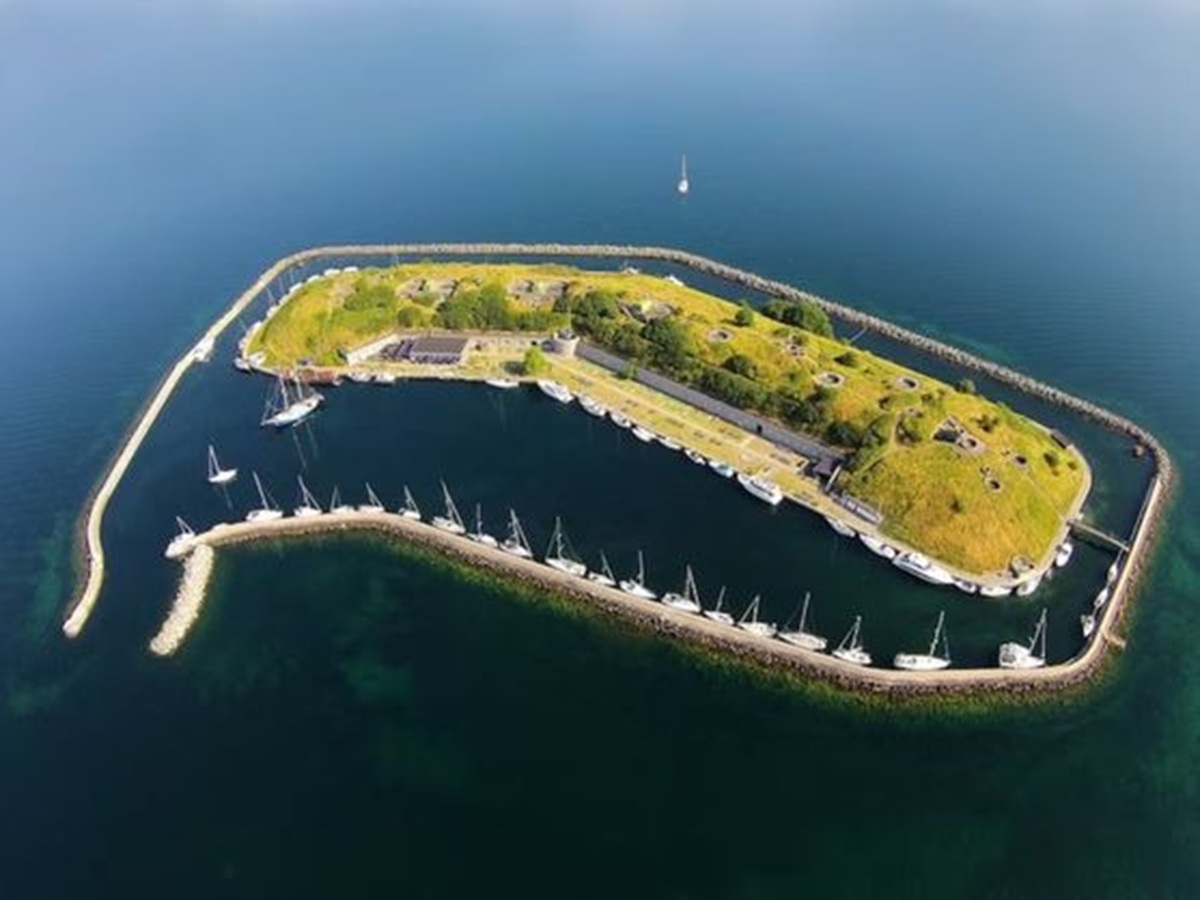
Built Between 1910 And 1916 With About 2 Million Tons Of Stone, Concrete And Sand, The Artificial Island Flakfortet Sums 3.1 Hectares In The Öresund Strait, Receiving Up To 50,000 Visitors In High Season And Is For Sale For 74.5 Million Danish Kroner, Almost 10 Million Euros
The artificial island Flakfortet, built between 1910 and 1916 to defend Copenhagen in the Öresund Strait, is for sale for about 74.5 million Danish kroner, almost 10 million euros, after decades transformed into a tourist destination with a marina, restaurant, and accommodations.
Constructed as part of the maritime defense system designed to protect Copenhagen, Flakfortet was conceived to house around 550 soldiers and equipped with heavy artillery. The goal was to protect one of the most strategic maritime corridors in Northern Europe, linking the North Sea and the Baltic Sea.
Built to defend the Öresund Strait, an area historically marked by conflicts between Sweden and Denmark or Norway over control of the Baltic Sea, the fortress never fired a shot during World War I. Denmark remained neutral in the conflict.
-
Friends have been building a small “town” for 30 years to grow old together, with compact houses, a common area, nature surrounding it, and a collective life project designed for friendship, coexistence, and simplicity.

-
This small town in Germany created its own currency 24 years ago, today it circulates millions per year, is accepted in over 300 stores, and the German government allowed all of this to happen under one condition.

-
Curitiba is shrinking and is expected to lose 97,000 residents by 2050, while inland cities in Paraná such as Sarandi, Araucária, and Toledo are experiencing accelerated growth that is changing the entire state’s map.

-
Tourists were poisoned on Everest in a million-dollar fraud scheme involving helicopters that diverted over $19 million and shocked international authorities.


During World War II, the fortress became a crucial point for the escape of Danish Jews to Sweden, an operation facilitated by local fishermen. Decades later, the former weapon depot began to combine historical heritage, nautical tourism, and investment opportunities.
Artificial Island Built With 2 Million Tons Of Materials
Located about eight kilometers from the port of Copenhagen, in the middle of the Saltholm plain, the artificial island was built with approximately two million tons of quarry stone, concrete, and sand.
The effort resulted in about 3.1 hectares of artificial land in the strait. The project integrated the Danish maritime defense system in the early 20th century, consolidating a bastion prepared for combat that never came to be used in open warfare.
The asking price currently is about 74.5 million Danish kroner, or nearly 10 million euros at the current exchange rate, according to the real estate agency Lintrup & Norgart, responsible for the sale.
This is not the first attempt at negotiation. The property had already been put up for sale in 2015, unsuccessfully. Now, after almost 25 years managing the complex, the Swedish company Malmökranen AB is trying again to finalize the sale.
From Military Fortress To Tourist Destination In The Öresund
After remaining under the control of the Danish army for decades, the fortress was abandoned in 1968. The weapons were dismantled, and the casemates were left empty, officially ending its military function.
The transformation began in the 1970s. The Copenhagen Nautical Union rented the space, converting old artillery positions into moorings. The officers’ mess was turned into a restaurant, marking the start of a new phase focused on tourism.
The most significant milestone occurred in 2001 when Malmökranen acquired the island for three million Danish kroner, about 400,000 euros, a value much lower than the current asking price by the owners.
Since then, investments have been made to modernize the facilities. Accommodations, conference rooms, a restaurant, event infrastructure, and a regular ferry connection to Copenhagen have been added, facilitating access for visitors and workers.
Current Structure And Capacity To Receive Up To 50,000 Visitors
Today, the artificial island is a landmark for sailors in the Öresund. In high season, it can receive up to 50,000 visitors, many of whom are sailors and water sports enthusiasts who use its marina protected by a historic breakwater.
The complex has over 30,700 m² of total area, of which approximately 9,900 m² are built. In addition to the restaurant and event spaces, it offers modern sanitary facilities for sailors and amenities for short stays or summer vacations.
The structure also includes a helipad, expanding access possibilities. The presence of this equipment is part of the infrastructure developed over the past decades by the current owners.
Self-Sufficiency And Legal Restrictions On Sale
One of the central features of the artificial island is its self-sufficiency. The site has a desalination plant capable of producing drinking water from seawater, as well as its own generators for electricity supply.
This autonomy is considered crucial due to the geographic isolation in the strait. The condition increases interest for tourism projects or commercial ventures that require independent infrastructure.
The sale, however, is subject to strict conditions. Since 2002, Flakfortet has been protected as a historical monument. Any structural renovation must be authorized by the Danish Agency for Palaces and Cultural Heritage.
Additionally, there is a fundamental requirement: the artificial island must remain open to the public, regardless of the future owner. The uniqueness of the location limits the profile of potential buyers.
The real estate agency suggests companies specialized in niche investments or high-net-worth individuals interested in isolated property. The possibility of the Danish government considering the acquisition is not ruled out, given the strategic location between Copenhagen and Malmö.
With this set of historical, structural, and legal characteristics, Flakfortet awaits a new owner who will take over the management of a space marked by military memory and its current tourist vocation, writing the next chapter of its journey in the Öresund.










Seja o primeiro a reagir!