





 Portuguese
  English
  Spanish
  5 min of reading
  0 comments


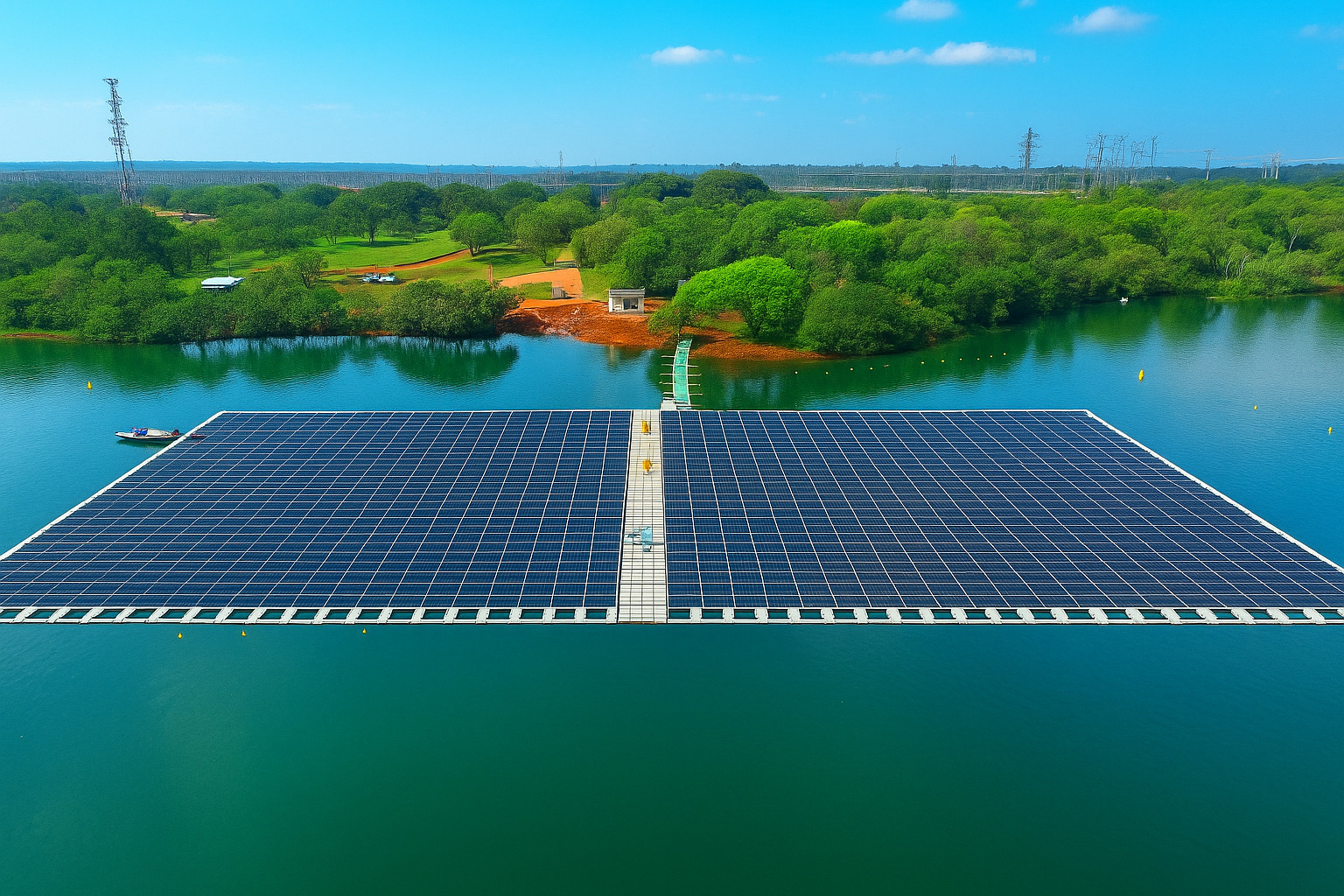
Discover How the Floating Solar Island of Itaipu Will Generate 1 MWp of Clean Energy for Internal Use at the Hydroelectric Plant.
Currently, the search for clean energy solutions has led the world to explore new technologies that combine sustainability, innovation, and efficiency.
In this scenario, the floating solar island stands out as a promising alternative, especially for regions with large water reservoirs.
Thus, in Brazil, an emblematic example of this innovation is the pilot project recently completed at the Itaipu hydroelectric plant, located on the border between Brazil and Paraguay, on the Paraná River.
-
Seagri’s headquarters invests in solar energy with Neoenergia Coelba and promises to cut electricity costs, highlighting a strategic advance in sustainability and energy efficiency within state public administration.
-
Solar Pyramid draws attention by converting solar energy into million-dollar savings and repositioning the City Hall of Curitiba as an example of innovation, sustainability, and intelligent use of public resources.
-
Europe records strong euro economy with solar energy in March and sparks curiosity about which country leads growth that redefines the energy market and reduces costs.
-
Piauí reaches a historic milestone in energy transition: State records nearly 160,000 households powered by solar energy and leads growth in the Northeast.

Indeed, the project represents a historical milestone in the adoption of renewable energy in the country.
The floating solar island of Itaipu has 1,568 photovoltaic panels installed over an area of 7,600 square meters, which corresponds to nearly a football field.
Thus, the venture generates clean energy for the internal consumption of the plant, with an estimated capacity of 1 MWp (megawatt-peak), enough to supply about 650 homes.
In addition, the total investment in the project reached approximately US$ 854,500, equivalent to R$ 4.5 million.
Historically, electricity generation in Brazil has been primarily based on hydroelectric plants.
For example, Itaipu, inaugurated in 1984, exemplifies this traditional model, responsible for about 9% of the energy consumed in the country.
With technological evolution and growing concerns about environmental impacts, the search for complementary and clean sources has intensified.
In this way, floating solar islands emerge as a solution capable of increasing energy efficiency without compromising large land areas.
In addition to generating clean energy, the project offers a unique opportunity for applied research.
Thus, Itaipu’s technicians and engineers study the performance of the panels under real operating conditions over the water, observing factors such as humidity impact, reservoir movement, and efficiency during different seasons of the year.
This knowledge will serve future projects, both in Brazil and abroad.
Technical and Strategic Benefits of the Solar Island
Consequently, the installation of the floating solar island on the Paraná River reservoir brought strategic and technical advantages.
For example, the water surface cools the photovoltaic panels naturally, increasing energy generation efficiency.
Moreover, the occupation of aquatic areas prevents the use of lands that could be allocated for agriculture or environmental preservation.
Thus, energy production and sustainability are efficiently reconciled.
The Itaipu project has, therefore, gone through an important experimental stage.
After completing the assembly on September 26, the plant began the installation of the final equipment and connected the power and communication cables.
Although the schedule anticipated starting operations in September, weather conditions, mainly rain, required adjustments, in addition to the need to ensure the safety of workers near the spillway and safety nautical area.
Thus, the forecast is that clean energy generation will start in November, marking the beginning of a new phase for the hydroelectric plant.
One of the great advantages of floating solar islands is their potential for expansion.
Estimates from Itaipu itself indicate that covering just 1% of the reservoir area could generate up to 3.6 TWh per year, representing about 4% of the plant’s annual production.
Furthermore, if 10% of the reservoir were used, the generation capacity could reach 14,000 MW, nearly doubling current production.
However, not all areas of the reservoir are suitable for the installation of floating panels, due to factors such as depth, water flow, and navigation.
Additionally, adopting this type of project provides indirect benefits for local biodiversity.
For instance, the partial shade of the floating solar island helps control excessive algae growth and contributes to the improvement of water quality.
Moreover, the integration of environmental research allows aquatic species to benefit from more stable conditions.
Thus, solar energy and the environment can coexist harmoniously.
International Experience and Learnings
Beyond Brazil, the concept of floating solar islands has already expanded to other countries.
For example, Japan, China, and Singapore have been investing in this technology for years.
Japan, specifically, initiated its first projects on artificial lakes after the Fukushima nuclear disaster, seeking safe and renewable energy sources.
Consequently, international experience shows that these islands can reduce water evaporation, improve panel efficiency, and contribute significantly to the national energy matrix.
In addition to the technical aspects, the Itaipu initiative promotes positive environmental and social impacts.
For example, clean energy production reduces dependence on fossil fuels and decreases greenhouse gas emissions.
Moreover, by generating electricity for its own consumption, the hydroelectric plant reduces operational costs and directs resources towards research in renewable energies, such as green hydrogen and biofuels.
The project therefore forecasts a one-year evaluation period, during which the floating solar island will be monitored regarding technical feasibility, environmental impacts, and achieved benefits.
In this way, it ensures that future expansions occur safely, efficiently, and sustainably.
Additionally, the experience will allow specialists to develop preventive and corrective maintenance strategies adapted to the conditions of the reservoir.
Thus, it increases the lifespan of the equipment and contributes to the reduction of long-term operational costs.
Historical and Environmental Impact
Historically, innovation at Itaipu has always been aligned with technological development and environmental preservation.
Since its inauguration, the plant has invested in research and development, establishing itself as a global reference in hydroelectric engineering and in initiatives focused on sustainability.
Thus, the success of the floating solar island reinforces this commitment, demonstrating that it is possible to reconcile high energy generation capacity with environmental responsibility and technological innovation.
In addition to the energy impact, the implementation of floating solar islands positively influences public perception and engagement in sustainable projects.
Indeed, pilot projects like Itaipu’s serve as a model for other hydroelectric plants and large reservoirs in Brazil and worldwide, encouraging investments in renewable energy and promoting the diversification of the electrical matrix.
In summary, the completion of the floating solar island on the Paraná River represents a significant step in Brazil’s energy transition.
By uniting hydroelectric tradition, technological innovation, and environmental commitment, the project demonstrates how large enterprises can adapt to current demands for clean and sustainable energy.
With the expectation of starting operations later this year, Itaipu consolidates its leadership position in the development of innovative energy solutions and prepares the way for a more sustainable future, showing that the integration between water and solar energy can yield significant results for the country and the planet.
Moreover, the implementation of this technology opens possibilities for other hydroelectric plants and reservoirs to explore the potential of floating solar islands, strengthening a diversified, resilient, and low-impact environmental energy matrix.
Thus, Itaipu’s experience will certainly serve as a global reference, consolidating the country in the world stage of innovation in renewable energies.











Seja o primeiro a reagir!