





 English
  Francês
  Alemão
  Italiano
  Japonês
  Norueguês
  Portuguese
  Spanish
 6 min of reading
  0 comments


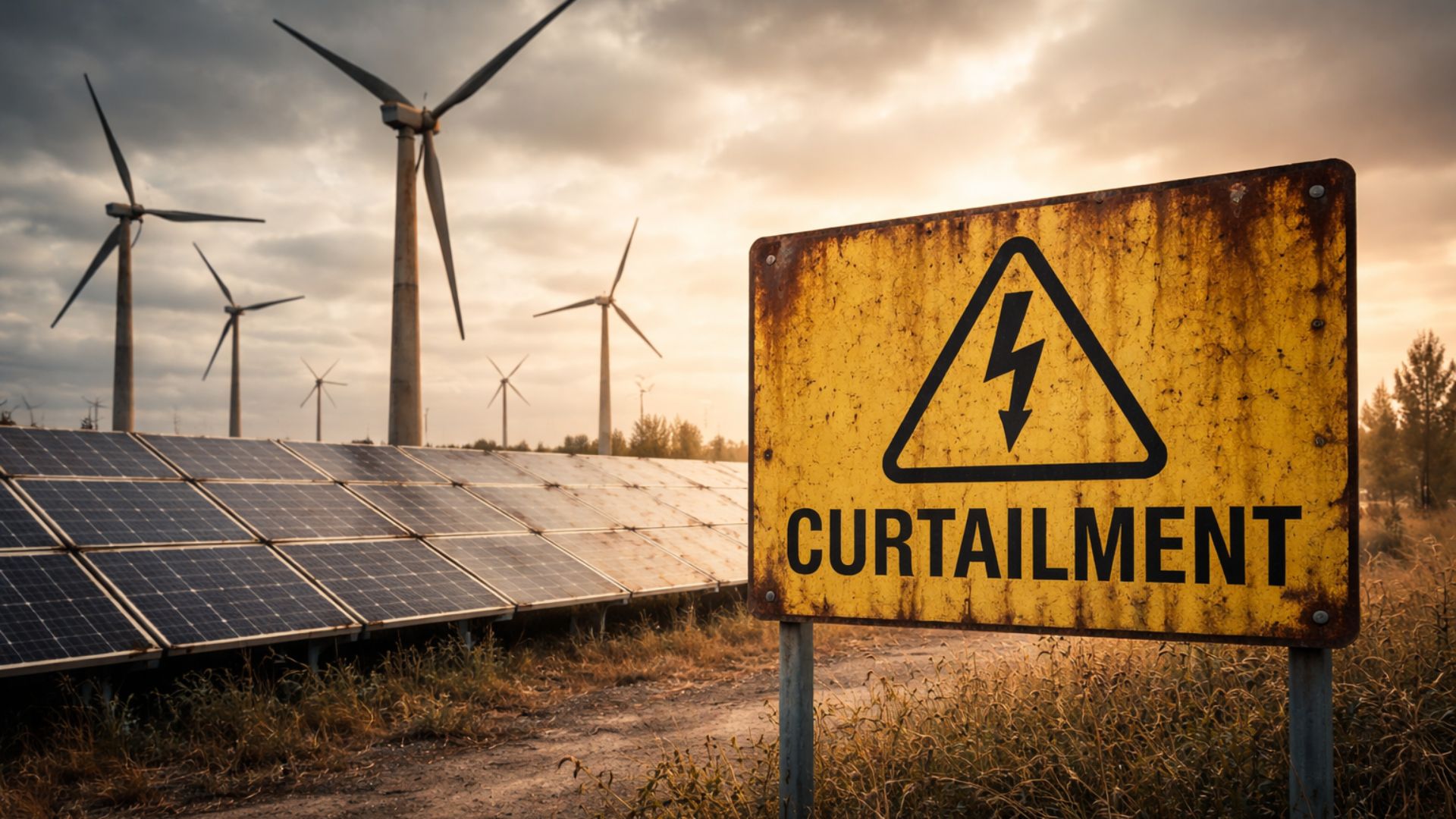
The Advancement of Curtailment in Rio Grande do Norte Has Already Accumulated Billion-Dollar Losses in 2025 and Triggers an Alert for Investors and Public Managers. Understand How Cuts in Renewable Energy Impact Contracts, Transmission, and the Economic Future of the State.
The advancement of curtailment in 2025 placed the Rio Grande do Norte at the top of the national ranking for financial losses among the states most affected by generation cuts of renewable energy. According to data from the consulting firm Volt Robotics, the state accumulated an estimated billion-dollar loss of R$ 2,243,123,173 considering contractual energy sale values. When the calculation is based on PLD (Settlement Price of Differences), the impact reaches R$ 1,880,766,619.
According to a report published by Tribuna do Norte on February 21, the scenario reflects a structural problem within the Brazilian electricity sector. Nationwide, the cuts totaled 35,302,923 MWh in 2025, generating a financial impact of R$ 6,533,012,167 per contract and R$ 4,671,321,590 by PLD. The national figure is 195% higher than that recorded in 2024, when the impact was R$ 2.2 billion. In the case of Rio Grande do Norte, the combination of high concentration of plants and transmission bottlenecks has made the state the main symbol of the economic effects of curtailment in Brazil.
Curtailment in Rio Grande do Norte: Leadership in Losses and High Proportional Cuts
The Rio Grande do Norte registered 11,268,033 MWh of curtailed energy in 2025. Proportionally to its installed capacity, the state lost 24% of the potential generation from wind parks and solar plants.
-
With 160,000 m² of collectors, an area larger than 20 football fields, Silkeborg, in Denmark, hosts a solar thermal plant that heats 19,500 homes and could become the largest solar heating plant in the world.

-
A study reveals the expansion of renewable energy procurement in Brazil and shows how companies are taking advantage of opportunities to reduce expenses, ensure energy efficiency, and strengthen strategic environmental commitments.

-
Mato Grosso do Sul excels in the sugar-energy sector: the state reaches a milestone of 22 operating mills and accelerates the production of clean energy in MS with a focus on sustainability.
-
National energy dilemma: Brazilians support clean energy but reject increases in tariff costs to finance the sustainable transition.

This means that for every 100 MWh that could have been generated, only 86 MWh were actually delivered to the system. Proportionally, RN was the third state with the highest cut rate, behind Minas Gerais (27.4%) and Ceará (25.8%).
In the ranking of losses per contract in 2025, the numbers were:
- Rio Grande do Norte: R$ 2,243,123,173
- Bahia: R$ 1,759,893,080
- Ceará: R$ 849,735,232
- Minas Gerais: R$ 778,174,095
- Piauí: R$ 504,602,495
- Pernambuco: R$ 167,772,352
- Paraíba: R$ 84,051,464
- Rio Grande do Sul: R$ 57,816,619
- São Paulo: R$ 49,330,083
- Maranhão: R$ 36,354,637
- Santa Catarina: R$ 2,158,936
The national total reached R$ 6,533,012,167.
What Explains the Advancement of Curtailment in the Renewable Energy Matrix?
The curtailment is determined by the National Electric System Operator (ONS) and occurs mainly when there is an excess of energy supply or limitations in transmission lines.
In systems with a high share of renewable energy, such as Brazil’s, generation depends on climatic factors. When there are strong winds and high solar incidence simultaneously in different regions, the produced volume can exceed the outflow capacity.
The ONS classifies the phenomenon as a necessary technical measure to preserve the safety and reliability of the National Interconnected System. However, experts evaluate that the rapid growth of renewables has not been accompanied by a proportional expansion of transmission infrastructure.
In 2025, the Brazilian electric system jumped from 1 to 16 days of operation at a critical safety limit due to excess supply, which increased the need for cuts.

Renewable Energy in RN: Concentration and Structural Vulnerability
The Rio Grande do Norte has established itself as one of the largest hubs of renewable energy in the country. According to a bulletin from the state’s Department of Economic Development, RN has:
- 10.6 GW of installed capacity in wind energy;
- 1.5 GW of installed capacity in solar energy;
- Together, they account for 97.61% of the capacity in operation concentrated in these two sources.
Of the 11,268,033 MWh curtailed in the state in 2025, 10.45 million MWh (92.79%) were from wind sources, while 0.81 million MWh (7.21%) were from photovoltaic solar sources.
RN led the cuts in wind sources and ranked fourth in solar energy cuts in the country. This concentration, which boosted regional development over the last decade, has also increased exposure to the risk of curtailment.

How the Billion-Dollar Loss Is Calculated and Why the Values Differ
Volt Robotics uses two main methodologies to estimate the financial impact of curtailment. The first calculation considers the contracts signed between generators and buyers. In this model, the billion-dollar loss reflects the amount that the entrepreneur failed to earn by not being able to deliver the contracted energy.
The second method uses the PLD, which represents the short-term market price. In periods of excess energy, the PLD tends to drop, reducing the estimated loss value.
In the ranking valued by PLD, the numbers for 2025 were:
- Rio Grande do Norte: R$ 1,880,766,619
- Bahia: R$ 1,091,464,548
- Minas Gerais: R$ 677,834,251
- Ceará: R$ 412,665,372
- Piauí: R$ 349,400,667
- Pernambuco: R$ 122,467,885
- Paraíba: R$ 68,148,001
- São Paulo: R$ 27,331,734
- Rio Grande do Sul: R$ 22,238,251
- Maranhão: R$ 16,845,197
- Santa Catarina: R$ 2,159,065
The national total by PLD reached R$ 4,671,321,590.
Regulatory Risks and Impacts on New Investments
The advancement of curtailment has elevated the regulatory debate in 2025. The National Electric Energy Agency promoted discussions that resulted in Law No. 15,269/2025, which provides for compensation mechanisms for generation cuts.
Entities like the Brazilian Wind Energy Association point out that the cuts stem from transmission bottlenecks and the accelerated insertion of micro and mini distributed generation.
Meanwhile, the Brazilian Association of Photovoltaic Solar Energy claims that renewable energy entrepreneurs are being prevented from delivering clean and competitive energy while also bearing systemic costs.
For the Rio Grande do Norte, where the expansion of generation was an engine for economic growth, the scenario may reduce the attractiveness of new projects, increase the perception of risk, and raise financing costs.

Infrastructure, Storage, and the Challenge of Renewable Energy by 2030
Auctions announced in 2025 foresee the expansion of transmission lines in the Rio Grande do Norte, but structural works take years to complete. Estimates indicate that a significant portion of these improvements may only come into operation around 2030.
One of the discussed alternatives is energy storage via batteries. Absolar advocates for investments in BESS systems and integration with large loads, such as data centers and green hydrogen plants.
There is a forecast for a capacity reserve auction for batteries in the first half of 2026. The expectation is that the excess renewable energy can be stored during low-demand periods and released during peak hours, reducing the volume of curtailment. While these solutions are not realized, the state continues to face a scenario of structural excess supply and limited outflow.
What Is at Stake for the Economy of Rio Grande do Norte
The impact of curtailment goes beyond the accounts of the generators. The production chain of renewable energy drives jobs, specialized services, tax revenue, and foreign investments.
With 24% of potential generation cut in 2025 and over R$ 2.24 billion in contractual losses, the billion-dollar loss may influence strategic decisions in upcoming auctions and new ventures.
If on one hand RN maintains its leadership in installed capacity, on the other hand it faces the challenge of ensuring that the produced energy is effectively channeled and sold.
The future trajectory will depend on the expansion of transmission, the definitive regulation of compensation mechanisms, and the adoption of large-scale storage solutions. The debate on curtailment has ceased to be technical and has become central to the economic strategy of Rio Grande do Norte, with direct repercussions on the consolidation of renewable energy as a pillar of state development.








Seja o primeiro a reagir!