





 Portuguese
  English
  Spanish
  5 min of reading
  0 comments


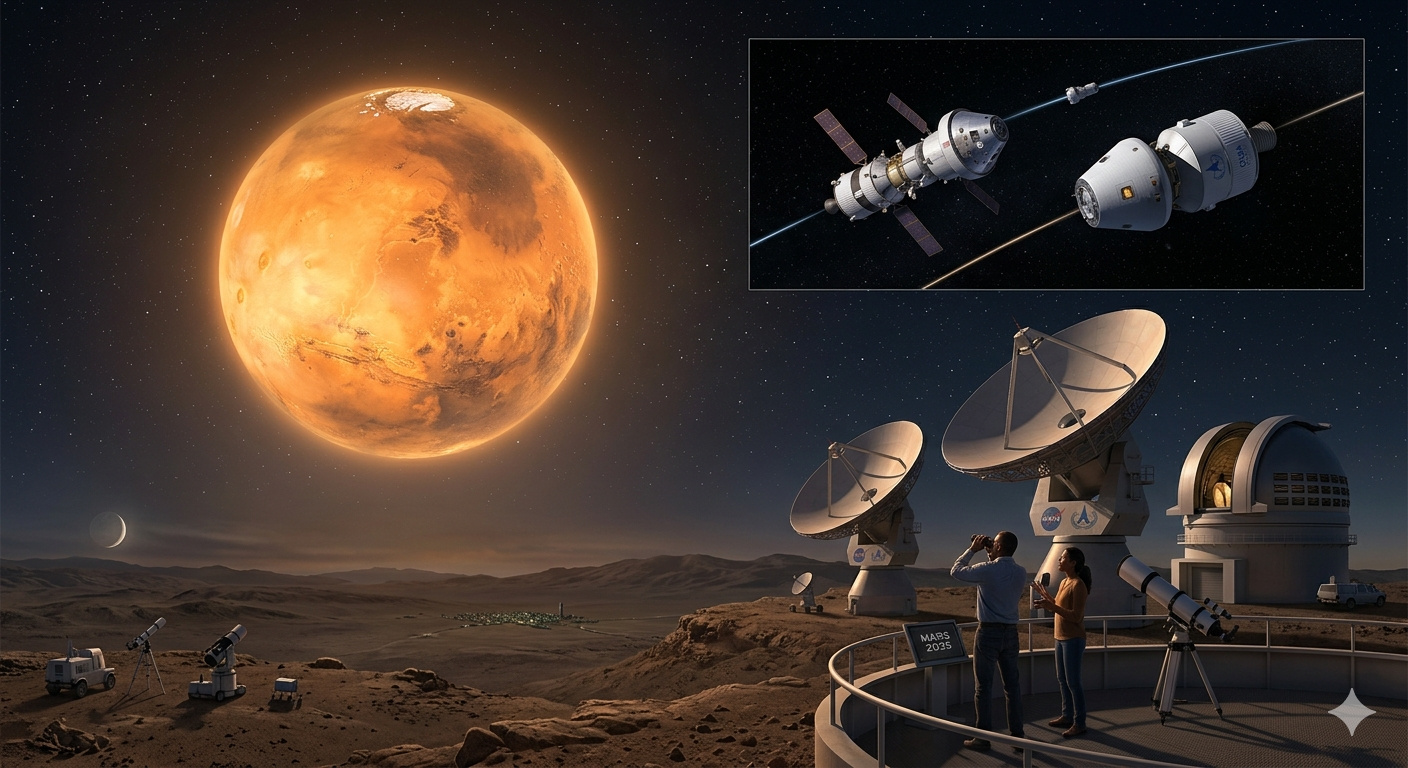
Mars will be closer to Earth in 2035 and will reach its brightest point since 2003, opening an orbital window for crewed missions from NASA and China.
In August 2003, Mars came so close to Earth that it broke a record that had stood for 60,000 years. The two planets were 55.76 million kilometers apart, the closest separation since 57,617 B.C., when Neanderthals still inhabited Europe. That night, Mars shone in the Southern Hemisphere sky with a magnitude of -2.88, brighter than any star, surpassed only by Venus and the Moon. Amateur observatories around the world were packed. NASA used the Hubble Telescope to photograph the planet with resolution equivalent to that of orbiting probes. That record will not be broken until August 29, 2287. But on September 15, 2035, something almost as rare will happen: the next perihelion opposition of Mars, when the planet will again approach Earth at a distance of 56.9 million kilometers.
According to data from the ALPO, Association of Lunar and Planetary Observers, Mars will reach an apparent diameter of 24.5 arc seconds — almost double what it presents in a common opposition and a magnitude that surpasses any star in the night sky. And for the first time in history, this astronomical spectacle may coincide with the arrival of the first humans to the planet they are observing.
What is the perihelion opposition of Mars and why does it make the planet extremely bright
On September 15, 2035, the next perihelion opposition of Mars will occur, when the planet will be approximately 56.9 million kilometers from Earth. This type of alignment happens when Mars is near perihelion — the closest point to the Sun — while Earth is overtaking it in its orbit.
-
Scientific studies indicate that drought may be strengthening a much greater silent threat: more resistant superbugs.

-
Man builds functional 5-meter submarine in his garage using gas cylinders, PVC pipes, and a refrigerator motor, and navigates with the vessel on a lake in Colombia.

-
Millions of people have been eating yam for centuries without knowing that this humble tuber contains a compound called diosgenin, which scientists have now discovered can improve memory and help control blood sugar levels.

-
Scientists from an international project drill 1,800 meters of ice in Antarctica using hot water and discover details about one of the most intriguing places on planet Earth.




According to data from the Association of Lunar and Planetary Observers (ALPO), Mars will reach an apparent diameter of about 24.5 arc seconds and a magnitude that surpasses any star in the night sky. This apparent size is almost double that observed in common oppositions, making the planet one of the most dominant objects in the sky.
This phenomenon occurs only every 15 to 17 years and represents the moment when Mars becomes most visible from Earth, transforming from a discrete point into a discernible disk with observable details.
Why Mars appears and disappears in the sky over the years
Mars has a significantly more elliptical orbit than Earth, varying between 1.38 and 1.67 astronomical units from the Sun. This difference of about 21% causes its distance from Earth to vary drastically over time.
Every 26 months, Earth overtakes Mars in its orbit, creating the phenomenon known as opposition. At this moment, the planet rises in the east at sunset and remains visible throughout the night. However, only a few of these oppositions coincide with Mars’ perihelion, and it is these that produce the most spectacular events.

In common oppositions, Mars can be more than 100 million kilometers from Earth. In perihelion oppositions, this distance can drop to less than 57 million, which explains the huge variation in brightness and apparent size of the planet.
What will happen in September 2035 and why the event will be special for observers
The maximum approach between Earth and Mars will occur on September 11, 2035, at a distance of approximately 56.9 million kilometers. The formal opposition will happen a few days later, on September 15, perfectly aligning the three celestial bodies.
During this period, Mars will reach a magnitude close to -2.9, surpassing Jupiter in brightness and becoming one of the most visible objects in the night sky. Its apparent diameter will remain above 20 arc seconds for weeks, allowing the observation of details such as polar caps and dark regions of the surface.
Another important factor is the position of the planet in the sky. In 2035, Mars will be near the celestial equator, ensuring excellent visibility in both the Northern and Southern Hemispheres, including Brazil.
The 26-month orbital window that defines all missions to Mars
The 26-month cycle between oppositions is not just an astronomical phenomenon, but the basis for all engineering of interplanetary missions. To send a spacecraft to Mars efficiently, it is necessary to use a Hohmann transfer trajectory, which depends on the precise alignment between the two planets.
When this window coincides with a perihelion opposition, as will happen in 2033 and 2035, the benefits are significant. The shorter distance reduces travel time, fuel consumption, and crew exposure to cosmic radiation, critical factors for crewed missions.
For this reason, these dates have been chosen as reference points by both space agencies and private companies.
NASA, China, and SpaceX converge on the same window for crewed missions
China revealed in 2021 a schedule for crewed missions to Mars with planned launches for 2033, 2035, 2037, and 2041, including plans to build a permanent base on the planet.
In the United States, NASA’s planning also points to crewed missions starting in 2033, continuing in 2035 and subsequent years. The model involves journeys of about nine months, extended stays on Mars, and return during the next orbital window, totaling missions exceeding a thousand days.
Meanwhile, SpaceX is working with a more aggressive schedule, with uncrewed missions planned for this decade and rapid expansion in the following windows. If these plans advance, 2035 could mark the beginning of a continuous human presence on Mars.
Mars oppositions have changed scientific history before and can do so again
Similar events have already altered the way humanity views Mars. In 1877, during a favorable opposition, Giovanni Schiaparelli mapped the planet and described the famous “canals,” which inspired decades of scientific and cultural speculation.

In 2003, the record approach boosted space missions, detailed observations, and global public interest, contributing to the advancement of robotic exploration of the planet.
The opposition of 2035 may represent a new milestone, this time not only in observation but in human presence.
The difference in distance between 2003 and 2035 is small, less than 2%, practically imperceptible to the naked eye. The spectacle in the sky will be almost identical.
What changes is the context. In 2003, Mars was a distant destination, explored only by robots. In 2035, it could be the destination of ongoing or even completed crewed missions.
The perihelion opposition of 2035 may be the last time humanity observes Mars merely as spectators — before becoming, for the first time, an interplanetary species.








Seja o primeiro a reagir!