





 English
  Francês
  Alemão
  Italiano
  Japonês
  Norueguês
  Portuguese
  Spanish
  7 min of reading
  0 comments


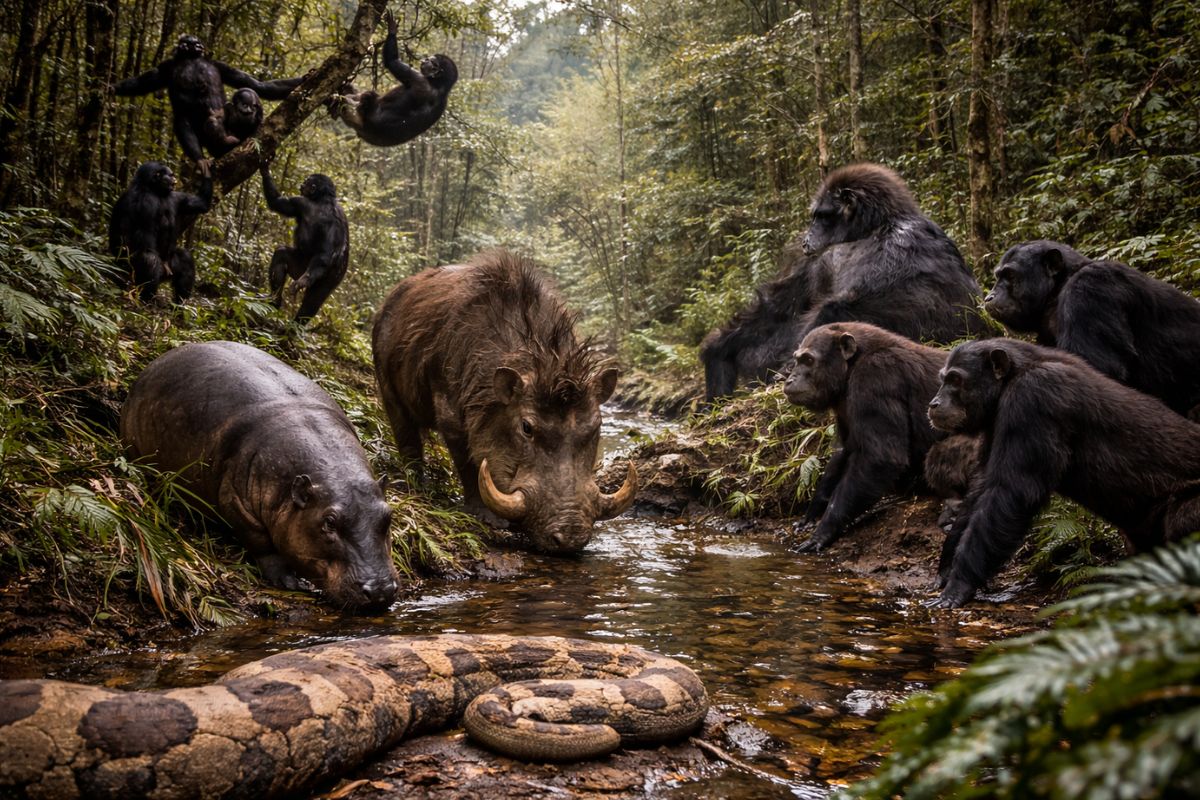
The native species that inhabit rivers, swamps, canopies, and hidden trails of the African forest reveal a world where silent predators, territorial giants, and almost prehistoric creatures coexist in one of the most intense and mysterious environments on the planet.
The native species of the African forest form one of the most impressive collections of wildlife on the planet. In a setting of dark rivers, silent swamps, giant trees, and soil covered with damp leaves, these animals have developed natural weapons, camouflage strategies, and extreme behaviors to survive in a territory where every movement can mean the difference between attacking, escaping, or disappearing into the shadows.
The most fascinating thing is that these creatures do not dominate a single space. Some control deep waters with lightning-fast attacks, others turn the forest floor into ambush territory, while certain birds and mammals observe everything from above. The native species of the African forest occupy every layer of this environment, from underground to the tops of the trees, creating a wild dynamic that seems to come from another time.
Dark rivers hide predators that attack in seconds
In the deep waters of the great African rivers, reduced visibility favors hunters shaped to act with brutality and precision.
-
The end of total solar eclipses has a deadline: the Moon is moving away from the Earth at about 3.8 cm per year, and in approximately 600 million years, it will no longer completely cover the Sun, ending one of the rarest coincidences in the Solar System.

-
Embraer’s flying car successfully takes off in SP, advances towards certification, has already completed 35 flights, reaches 43 meters in height, and promises to operate with much less noise than helicopters.

-
350-year mystery may have been solved: remains of a soldier who inspired the hero of The Three Musketeers found beneath a church in the Netherlands.

-
NASA photographed a nearly perfect square with 3 km sides on Mars, 13 times larger than the Great Pyramid of Giza, but the official explanation is natural erosion; still, no one has explained why the four sides have almost identical lengths.


One of the most impressive examples is the Goliath tigerfish, described as a fearsome-looking predator, capable of exceeding 1.5 meters in length and equipped with long teeth that function like blades.
When it springs into action, this fish behaves like an underwater projectile. It patrols strong currents, watches smaller schools, and strikes with enough speed to pierce its prey before it can react.
Among the native species of the African rivers, few seem as lethal as the Goliath tigerfish, which combines sharp vision, quick reflexes, and muscular strength to dominate turbulent waters.
Another inhabitant of these aquatic areas is the African softshell turtle. Unlike hard-shelled turtles, it has a flexible shell, long neck, and tubular snout, allowing it to breathe while remaining almost completely hidden in the sand or mud. When a fish or small animal approaches, the strike happens in a sudden and efficient movement.
On the forest floor, camouflage becomes a deadly weapon
Among dry leaves, roots, and shadows, the Gaboon viper represents one of the most feared presences in the African jungle. Its wide body blends into the environment, and its immobility does the rest.
The base describes this snake as having the longest fangs among venomous snakes in the world, with teeth that can exceed 5 centimeters.
The attack is quick and deep. The viper remains motionless for long periods and waits until a prey comes too close. At that moment, it injects a powerful dose of venom and lets the effect do the work.
It is one of the most impressive native species on the continent precisely because it does not rely on pursuit or brute strength, but on extreme patience and lethal precision.
On the same damp ground, the giant pangolin also appears, a mammal covered by large overlapping scales, almost like a living armor.
Without teeth, it uses a long, sticky tongue to capture insects in ant hills and termite mounds, breaking structures with its strong claws. Its unusual appearance and silent movement reinforce the air of an almost impossible creature.
African swamps have motionless hunters and birds that look prehistoric

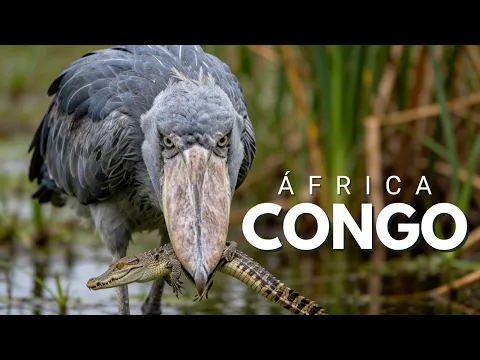
In the flooded areas of Central Africa, the shoebill transforms the stillness of the swamps into a hunting strategy. Tall, silent, and equipped with a huge shoe-shaped bill, it watches the water as if calculating every detail around before acting.
When it finds the right moment, it lunges its head forward and plunges its bill into the water to capture large fish, frogs, and small reptiles.
Then, it shakes the prey to remove excess water and swallows it whole. Among the native species of the swamps, few seem as strange and as efficient at the same time as the shoebill.
The pygmy hippopotamus also occupies this more hidden universe of the jungle. Smaller and more reserved than the common hippopotamus, it prefers calm streams and swampy areas surrounded by dense vegetation. Its discreet behavior, almost always solitary, contrasts with the strength of its robust and territorial body.
Jungle giants command respect without relying on venom
In the interior of the African tropical forest, the eastern lowland gorilla represents the weight of brute strength organized in family groups. Adult males can weigh over 200 kilograms, but the most striking thing is not just the size.
These primates live in structured groups, with clear leadership and slow movements in search of leaves, shoots, fruits, and stems.
Although they are described as calm animals, the reaction to a threat completely changes the scenario. The dominant male beats his chest, vocalizes, and imposes his presence with a combination of physical power and intimidation.
The native species of the African forest are not only frightening when they attack. Some instill fear just by their size and the control they exert over the environment.
Another terrestrial giant is the African forest elephant. Smaller than the savanna elephant, it is adapted to dense vegetation, with straighter tusks and a body capable of clearing paths where few animals can pass. As it moves, it spreads seeds, knocks down vegetation, and shapes the very ecosystem around it.
Wild boars transform the underbrush into hostile territory
The African forest also houses heavy-looking mammals that are surprisingly agile and aggressive. The giant forest pig can weigh over 250 kilograms, has bony plates on its face, and curved tusks capable of causing serious injuries in a confrontation.
Living in family groups, it roots through the soil for roots, fruits, fungi, and small animals. But behavior changes when the group feels threatened. The response can be a powerful charge, making the giant pig one of the most intimidating presences in the underbrush.
The red river hog also draws attention with its striking appearance, with reddish fur, light spots, and long ears with prominent tufts.
In small groups, these animals explore the jungle with a strong snout and even help in seed dispersal by rooting through the soil. It is yet another example of how native African species combine beauty, strangeness, and strength in one body.
Canopy predators turn height into absolute advantage
Far above the ground, the canopies hide other hunters. The forest leopard appears as one of the most discreet and efficient. Its spotted coat blends with light and shadow, its agile body climbs trees with ease, and its main strategy is silent approach followed by an explosive leap.
After the capture, the leopard often takes the prey to the branches, where it feeds away from competitors. This makes it an even harder predator to detect and more impressive in the dense forest, where every trunk, branch, or shadow can serve as cover.
Above it, the African crowned eagle dominates the forest sky. With extremely strong talons and sharp vision, it is capable of capturing large prey among the branches, diving with devastating precision.
In the heights, these native species prove that the African forest does not belong only to those who crawl or swim, but also to those who observe everything from above and descend with surgical violence.
Rare primates show intelligence, organization, and mystery

Among the most intriguing animals in the forest are the bonobos and the chimpanzees known as Bili apes.
Bonobos are described as very close relatives of humans, with societies marked by strong cooperation, especially among females, and intense communication through vocalizations, gestures, and facial expressions.
Meanwhile, the Bili chimpanzees have become famous for their impressive size and unusual behaviors, such as the more frequent construction of nests on the ground.
The image of these animals mixes intelligence, strength, and an air of mystery that reinforces the feeling that there is still much to discover in certain areas of the African forest.
Rare antelopes and discreet mammals reinforce the unique character of the forest
Not everything in the African jungle revolves around attack and violence. Some of the most fascinating native species impress precisely because of their rarity and the way they seem to escape human sight.
This is the case of the bongo, one of the largest and rarest African antelopes, with brown fur marked by light stripes and long spiral horns.
The okapi also falls into this category of almost legendary creatures. With a body resembling a small giraffe and legs striped like those of a zebra, it lives hidden in dense and inaccessible regions.
Its rarity reinforces the idea that the African forest still holds animals that seem to belong to another world.
The wild heart of Africa continues to be dominated by extreme creatures
Looking at this collection of animals, it is clear that the African forest is not just an exuberant setting. It is a living system in which each layer of the environment belongs to a different type of specialist.
Rivers, swamps, soil, underbrush, and canopies are occupied by hunters, giants, diggers, primates, and birds that have adapted extraordinarily.
The native species of this environment reveal the rawest, strangest, and most fascinating side of wildlife. Some frighten with venom, others with teeth, others with strength or an almost impossible appearance. Together, they show that the heart of the African forest remains one of the most intense and mysterious places on Earth.
Which of these native species of the African forest impressed you the most: the one that dominates the water, the one that hides on the ground, or the one that controls the tree canopies?






Seja o primeiro a reagir!