





 Portuguese
  English
  Spanish
  6 min of reading
  0 comments


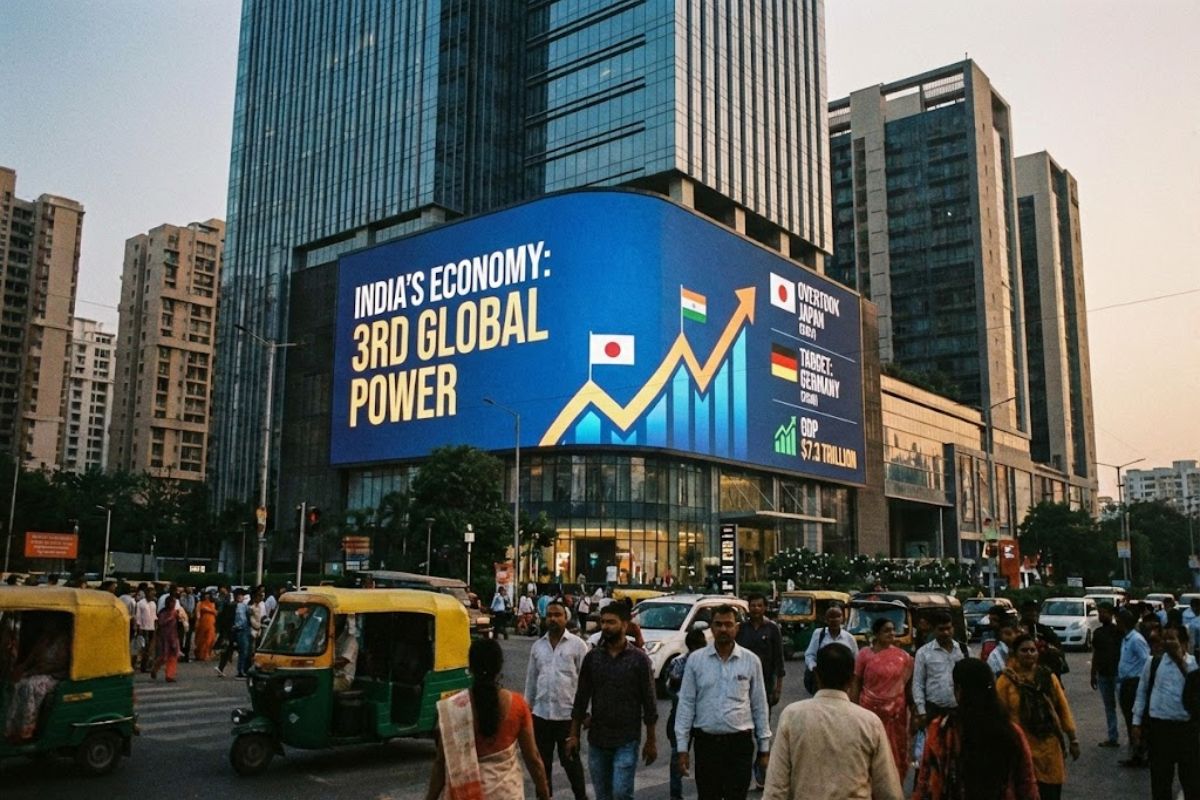
India Released Economic Review Projecting GDP of $4.18 Trillion, Consolidates Competition with Japan for Fourth Largest Economy, Aiming to Surpass Germany, Reach Third Largest Economy by 2030, and Reduce Still High Inequality in a Country with Low Average Income and Social Inequality.
In an end-of-year review presented on December 30, 2025, the Indian government stated that the country is practically operating as the fourth largest economy in the world, ahead of Japan, with an estimated GDP of around $4.18 trillion and projections to reach $4.51 trillion in 2026. The statement explicitates India’s ambition to consolidate its position among the major economic powers even in the context of global deceleration and uncertainty in international trade.
The plan outlined by New Delhi aims for an additional leap: the official goal is to surpass Germany in up to three years and transform the country into the third largest economy in the world by 2030, behind only the United States and China. By projecting a GDP of around $7.3 trillion, India aims to combine market scale, production, and innovation with internal reforms capable of reducing historical inequalities and raising the standard of living for a population that already exceeds 1.4 billion inhabitants.
How India Surpassed Japan in the GDP Race
The Indian government maintains that the combination of faster growth than mature economies and resilience amidst adverse global cycles has allowed the country to catch up and, according to its own accounts, surpass Japan as the fourth largest economy in the world.
-
A new Brazilian shopping center worth R$ 400 million will be built in an area equivalent to more than 4 football fields, featuring 90 stores, 5 cinemas, a supermarket, a college, and parking for 1,700 cars, potentially generating 3,000 jobs.

-
Larger than entire cities in Brazil: BYD is building a 4.6 km² complex in Bahia with a capacity for 600,000 vehicles per year, but the discovery of 163 workers in conditions analogous to slavery has shaken the entire project.

-
With an investment of R$ 612 million, a capacity to process 1.2 million liters of milk per day, Piracanjuba inaugurates a mega cheese factory that increases national production, reduces dependence on imports, and repositions Brazil on the global dairy map.

-
Brazilian city gains industrial hub for 85 companies that is equivalent to 55 football fields.


The official review points to a current GDP of around $4.18 trillion, while international organizations’ projections for 2026 indicate India at $4.51 trillion, compared to $4.46 trillion estimated for Japan.
In practice, the India versus Japan competition reflects the gradual repositioning of Asia within the global economic ranking.
This surpassing occurs in a context where Japan faces accelerated population aging and low domestic consumption dynamism, while India relies on a large domestic market and a young workforce.
The fact that India seeks to consolidate as the fourth largest economy while planning the next step to approach the third largest economy indicates a deliberate long-term strategy anchored in GDP targets, but also in structural reforms.
In presenting the data, authorities emphasize that the movement is not a one-off, but a result of a growth trajectory maintained over several years.
Still, the government acknowledges that exchange rate fluctuations, external shocks, and changes in the commodity cycle can temporarily affect its relative position against Japan, necessitating the preservation of macroeconomic stability and the ability to respond to crises.
Difference Between Total GDP and GDP Per Capita in the Indian Economy
India’s advancement in the global ranking is not reflected at the same pace when observing GDP per capita.
While the total volume of the economy approaches targets of $7.3 trillion by 2030, the GDP per capita hovers around $2,694, well below the levels of Japan and Germany.
This distance shows that being the fourth largest economy or, in the future, the third largest economy does not automatically mean high income for the population.
According to estimates cited by the economic review itself, India’s average income is about 12 times lower than that of Japan and 20 times less than that of Germany, which illustrates the coexistence of a giant economic scale with a social base still marked by scarcity.
The contradiction between the size of GDP and GDP per capita highlights the challenge of transforming growth into development, reducing social inequality, expanding public services, and increasing workforce productivity.
In practice, this means that a significant portion of the population still lives with low income, limited access to services, and vulnerability to economic or health shocks.
At the same time, segments integrated into the most dynamic sectors of the Indian economy benefit from opportunities in technology, services, and industry, reinforcing the perception that India concentrates islands of prosperity within a still unequal territory.
Youth, Employment, and Social Challenges in India
The demographic structure is one of the central factors behind India’s growth potential and the risks associated with its trajectory.
More than a quarter of the 1.4 billion inhabitants are between 10 and 26 years old, forming a broad demographic window that can sustain GDP expansion in the coming decades.
If well utilized, this base of young workers can consolidate India as the fourth largest economy and fuel the transition to the third largest global economy.
The challenge is to convert this potential into quality jobs at the necessary speed. Each year, millions of young people enter the job market in search of formal positions, stable income, and prospects for advancement.
When the economy fails to absorb this contingent, informality, underutilization of qualified labor, and the risk of social frustration increase, especially in large urban centers.
In addition to the employment issue, marked regional differences persist in infrastructure, access to health, and education.
In some areas, economic expansion still coexists with deficits in sanitation, adequate housing, and basic public services.
In these contexts, the contrast between the narrative of the fourth largest economy and the daily reality of part of the population reinforces the debate about the quality of the growth India is constructing.
How to Transform Economic Growth into Long-Term Development
For India’s advancement in the global ranking to convert into lasting development, economists point to an agenda of reforms that includes a simpler business environment, improved productivity, and social inclusion policies.
The transition from the fourth largest economy to the third largest economy requires more than GDP figures: it depends on strong institutions, robust infrastructure, and consistent public policies across several governments.
In the institutional field, the country is pressured to modernize labor legislation, reduce bureaucracies, simplify taxes, and provide regulatory predictability to domestic and foreign investors.
In the physical dimension, intensive investments are needed in highways, railroads, ports, energy, and digital connectivity to integrate still underserved regions and reduce logistical bottlenecks that increase production costs.
At the same time, the social agenda remains at the core of the equation.
Without clear advances in basic education, professional training, public health, and minimum social protection, India risks sustaining GDP figures comparable to those of Germany and Japan, while keeping a significant portion of the population on the margins of growth.
The difference between a statistical jump in GDP and an effective jump in quality of life lies in the ability to reduce internal inequalities.
What Can Define the Third Largest Economy in the World
Looking towards 2030, the declared goal of surpassing Germany and consolidating India as the third largest economy in the world depends on the combination of several factors.
Among them are maintaining growth above the global average, the capacity to attract investments in high productivity sectors, and the construction of a competitive innovation ecosystem.
Meeting the target of reaching a GDP of $7.3 trillion will be decisive for repositioning the country in the international economic hierarchy.
Also influential are the movements of the economies currently ahead of India.
If Germany faces prolonged periods of stagnation or more intense external shocks, the difference in growth pace may accelerate the surpassing.
On the other hand, potential internal crises, political instability, or setbacks in reforms could slow India’s trajectory and delay the moment when the country solidifies as the third largest economy.
At the center of this process is the choice between concentrated growth in a few segments and a model that better distributes opportunities among regions and social groups.
How India balances its ambition to become the third largest economy with the need to address inequality, low average income, and historical social challenges will define the real reach of this new economic level.
In light of this scenario, do you believe that India’s trajectory to surpass Japan and Germany and establish itself as the third largest economy will be able to reduce internal inequality or will it tend to deepen the contrast between GDP growth and the income of the population?







-

-

-

-

-

-

20 pessoas reagiram a isso.