





 Portuguese
  English
  Spanish
  3 min of reading
  0 comments


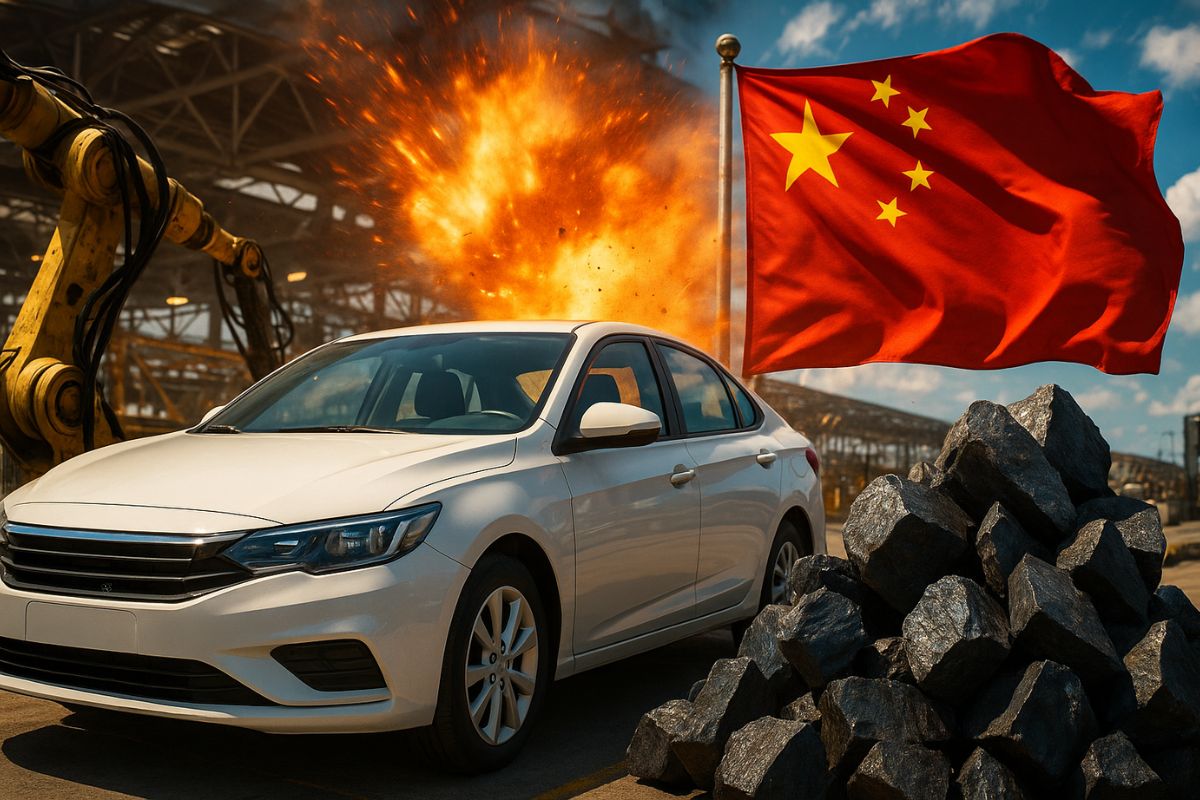
The Automotive Industry Faces Collapse Risk With China’s Decision to Cut Rare Earth Exports, Affecting Magnets Used in Vehicles and Threatening Car Factories on Different Continents in a Scenario Reminiscent of the Chip Crisis
The global automotive industry is experiencing a moment of increasing tension. The risk now does not come from semiconductors but from the scarcity of magnets produced from rare earths. More than 90% of the world’s processing capacity is in China’s hands, which drastically reduced exports in April 2025. According to experts consulted by Xataka, this decision puts the continuity of car factories in various countries at risk.
Just as happened with microchips during the pandemic, the new crisis threatens to disrupt entire production lines. ABS brakes, automatic transmissions, cameras, sensors, and electric motors depend on these magnets. The Chinese restriction, combined with heavy bureaucratic procedures for obtaining licenses, has already halved the volume exported, putting pressure on automakers and suppliers globally.
The Alert From Automakers and the Dimension of the Problem
In May 2025, the Alliance for Automotive Innovation, which includes giants such as General Motors, Toyota, Hyundai, and Volkswagen, sent a letter to the U.S. government.
-
For R$ 32,000, a brand new Hyundai car is a rival to the Kwid with a 1.2 engine producing 82 hp, 6 airbags as standard, multimedia with wireless Android Auto, up to 391 liters in the trunk, and a refreshed look for 2026 in India.

-
He bought a new car in 1983, locked it in the barn in 1988, and no one opened the door for 38 years until the family discovered what was stored inside and realized it looked like something out of a movie.
-
A 250cc motorcycle that can reach 560 km with a 14-liter tank, features disc brakes on both wheels and is among the most well-known in Brazil.

-
Man finds over 200 rare cars abandoned on a lot and tries to do the impossible in 8 hours with a surprise at the end.


The document warned that, without a stable supply of magnets, car factories could be paralyzed in a matter of weeks.
The concern was reinforced by the Motor & Equipment Manufacturers Association (MEMA), which represents auto parts suppliers and highlighted the absolute dependency of the supply chain.
The comparison with the chip crisis is not exaggerated. According to Xataka, while the sector is still recovering from the impacts of the pandemic, the current threat could be even more severe.
The difference is that, unlike semiconductors, rare earth production is concentrated in just one country, with no significant alternative for immediate replacement.
Why Magnets Are Irreplaceable in the Automotive Industry
Rare earth magnets are not peripheral components.
They are in vital safety and drivability systems, such as ABS brakes and power steering, and are also included in sensors, cameras, and electric motors.
Without them, there is no viability for modern, hybrid, or fully electric cars.
Experts consulted by Xataka explain that the complexity of the extraction and refining process, combined with China’s dominance over the supply chain, makes short-term substitution almost impossible.
Attempts to recycle electronics and explore mines in the United States and other countries are underway, but practical results are not expected for several years.
China’s Position and Global Impacts
Beijing’s decision to require complex licenses and extensive documentation before releasing exports has drastically reduced international trade.
In April, exports fell by half, according to data highlighted by Xataka, intensifying pressure on automakers.
Although some suppliers have managed to clear shipments, many automakers still face an imminent risk of shutdown.
India, for example, has already warned of the possibility of halting activities in early June 2025 if the situation does not normalize.
The domino effect can spread quickly, as few industries have enough stock to sustain weeks without replenishment.
Structural Dependency and Medium-Term Risks
Even if there are diversification efforts, the current situation shows a structural dependency that is difficult to break.
More than 90% of rare earth processing capacity remains concentrated in China, as pointed out by Xataka, and building alternative supply chains will require time, investment, and political stability.
In the meantime, governments and companies are trying to balance diplomatic pressures and emergency strategies.
In the United States, pressure on Washington is increasing, while Europe seeks alternative suppliers.
The race for autonomy in the supply of critical inputs is becoming a matter of national security, not just market.
The potential paralysis of car factories due to magnet shortages exposes the fragility of the global industry in light of dependency on China.
For you, what would be more urgent in this scenario: investing in recycling, expanding mining in other countries, or negotiating agreements that ensure immediate supply? Do you believe automakers should seek self-sufficiency or accept dependence on China as inevitable? Leave your opinion in the comments and share your view on the future of this crisis.










Seja o primeiro a reagir!